

June 4, 2026
How Felix Empanadas grew one fold at a time
Felix Godward discusses focus, expansion, and menu icebreakers
by Ebony Morman
Felix Godward started making empanadas when he was five years old, standing beside his grandmother and learning a tradition that stretched back generations in Argentina. Long before Felix’s Empanadas expanded to multiple Charlotte locations (in Optimist Hall and Latta Arcade) or opened in New York, the food existed as something more personal: folded dough, family ritual and recipes repeated enough times to become instinct.
That same food became the foundation of a business that focused on doing one thing well.
Felix’s Empanadas started as a food trailer in Charlotte in 2017, serving breweries at a time when empanadas still felt unfamiliar to much of the city. Godward saw an opportunity in that gap. Charlotte was growing quickly, food trucks were still relatively limited, and there weren’t many dedicated empanada concepts in the area.
“I thought it was an opportunity to introduce empanadas to a community that probably didn’t know much about empanadas,” he says.
A sense of focus helped the business carve out a loyal following over time. In Charlotte, Felix’s became closely associated with empanadas specifically, building its identity around hand-folded pastry and fillings that balanced familiarity with more unexpected flavor profiles.
The process remains intentionally detailed. Godward describes a great empanada as one built on layers, using a laminated dough technique similar to croissant-making, which creates flakiness and texture. Inside, fillings rely on browned meats, garlic, onions, and fresh peppers rather than shortcuts.
“When it bakes, the layers separate and create the flakiness essential to a perfect empanada,” he says. “Then you really get a good sear on the meat, and then stew it a little so it’s nice and juicy, and braise it a little bit, but still sear. That combination of seared and braised is crucial.”
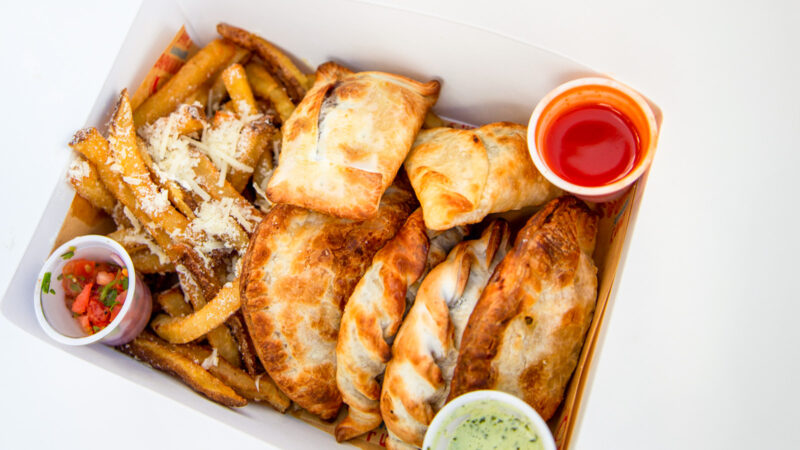
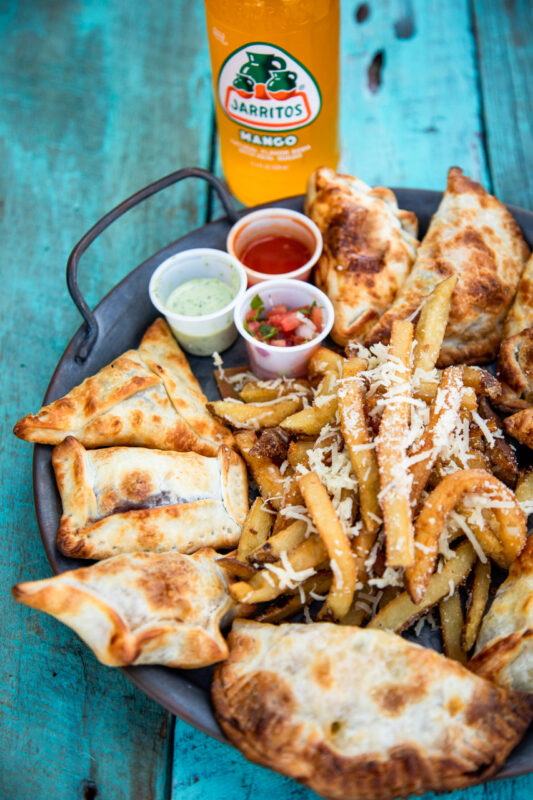
At Felix’s, each empanada is folded by hand into a different shape depending on the filling inside, a practice rooted in Argentine tradition.
The process is more labor-intensive than machine-folding, but Godward believes it changes how people experience the food. Groups of customers often pass around a guide sheet, comparing shapes and figuring out which empanada belongs to whom.
“It’s almost like a little game,” he says. “It’s like an icebreaker that forces people to talk and work together to figure out which empanada is which.”
These sorts of interactions have become part of the appeal. While the menu stays tightly focused, variety still plays an important role in keeping customers engaged. Core offerings like steak (made with hand-cut sirloin), street beef (ground beef, onions, bell peppers, and a tiny bit of hard boiled egg, raisins, and olives) and chicken continue to drive repeat visits, while rotating seasonal specials create room to experiment.
For Thanksgiving, the team made an empanada filled with turkey thigh, gravy, stuffing, yams, and mashed potatoes, served with cranberry sauce on the side. Around Halloween, a s’mores empanada briefly appeared on the menu.
While Felix’s has built a following locally, expansion has complicated the equation. When the company opened in New York eight months ago, Godward quickly realized the same tightly focused concept operated differently in a more saturated market, he says. Empanadas weren’t enough.
Godward’s decision to expand to New York was partly personal, he says. After making frequent trips to the city over several years, he became familiar with the market and saw what he viewed as an opportunity. He realized New York was missing laminated, baked, and elevated empanadas. He also viewed the move as a chance to push himself beyond the comfort of a market where the brand had already gained recognition.
“I wanted to grow,” he says. “Getting uncomfortable and thrown into a new environment sometimes is a good way to do that.”
In Charlotte, customers embraced the idea of an empanada-focused concept over time because there were fewer comparable businesses in the market. In New York, where food competition is denser and customer expectations differ, the fast-casual menu had to expand beyond empanadas alone to offerings such as skirt steak and ribeye with fries and a variety of pan sauces.
Even as the business expands, Godward continues to center the operation around the same things that helped it grow in Charlotte: consistency, ingredient quality and systems that allow the business to scale without losing its identity.
At the Latta Arcade location, the team still produces the empanadas locally before shipping them to New York, part of a broader plan to centralize production while maintaining the hand-crafted approach that defines the brand.
“The goal is to buy a factory or a massive warehouse in Charlotte or somewhere in North Carolina and continue the artisanal thing,” Godward says.
While purchasing a facility remains a future possibility, the company will likely lease a larger warehouse first and convert it into a production facility. The goal isn’t to automate the process, but to create more room for the one already in place.
The operation would still rely on many of the same processes the team uses today. Cooks prepare fillings in large tilt skillets while teams hand-fold empanadas assembly-line style. The work includes hand-cutting hundreds of pounds of sirloin each week, caramelizing onions overnight, blending garlic in large batches, and smoking pork shoulders covered in a house spice blend.
Godward plans to simplify operations as the business expands by opting out of training staff at every location to make empanadas from scratch. Instead, the team could produce them at greater capacity in Charlotte and continue to distribute them to other markets. He also sees North Carolina as a practical long-term production hub because commodity and operating costs remain lower than in larger cities like New York.
The tension between growth and craftsmanship shapes much of how Felix’s operates now. While expansion is important, many of its core practices remain unchanged, from hand-folding empanadas to cutting fries fresh and frying them in beef tallow and coconut oil rather than seed oils.
“We’ve been doing that before it was cool for seven years,” he says.
For Godward, though, the clearest sign the restaurant has resonated isn’t expansion alone. It’s the customers who have continued returning since the food trailer days. Over time, he’s watched families grow alongside the business, seeing customers who first visited as young couples return years later with children.
“It’s incredible to see somebody’s day turn around over something as simple as empanadas,” he says. “Those are the best moments for me.”