



October 3, 2022
Storm preparation down on the farm
Hurricane Ian did not treat Charlotte as harshly as predicted, but area farmers still had to prepare for the worst
By TM Petaccia
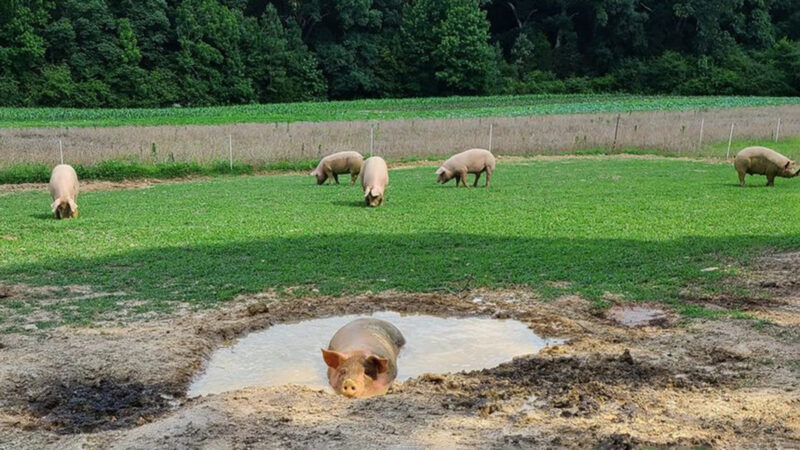
Coldwater Creek Farms raises pigs and chickens in addition to produce. Photo courtesy
Our area was put on high alert last week as Hurricane Ian churned through Florida and up the East Coast. In Charlotte, events were canceled days in advance of the impending storms. Many restaurants closed early on Friday as the worst of it hit town. And on area farms, farmers had to work hard to protect their livelihoods.
“Almost no one realizes the impact this kind of rain has with our heavy clay soil, and there isn’t time to reseed a lot of fall field crops now,” says Kim Shaw of Small City Farm, located off Brookshire Boulevard on the outskirts of Charlotte. “We just try to get everything we can out of the ground. There’s nothing else we can do. I have been working with Erin (Bradley) at Freshlist. They agreed to take watermelon radishes, scarlet queen turnips, and Hakeuri turnips and keep them in their walk-in for me.”
Just north of Charlotte, in Concord, Donna Clark Hinckley of Coldwater Creek Farms echoed similar preparations.
“Usually when a storm comes through, we’re rushing to protect the crops in some way,” she says. “High winds might take the okra to the ground. Most of our week was spent mowing and tilling as much ground as we could. Our biggest concern is our greenhouses — deciding which is best: closing them down all the way or opening them up. Either way, the winds could rip the plastic off (which could take months to replace). 75 percent of our winter crops and all the spring plants (seedlings for the field) come out of the 7,500 square feet combined between both greenhouses.”
In addition to produce, Coldwater Creek Farms raises chickens for eggs as well as pigs for a variety of pork cuts. Storm preparation for them isn’t quite as frantic. “Our chickens have shelters that are a little more permanent,” Hinckley says. “Our pigs have shelters too, but usually they just hide in the woods until the rain passes.”
In the end, Ian’s remnants stayed mostly east of Charlotte, sparing both farms from serious danger.
“We only got two inches of rain —enough to get some water in the ground, but not too much,” Hinckley says. “We’ll be able to keep working ground and planting in a few days. Strawberry plants (for Spring harvest) will be in next week, and it looks like we’ll be able to plant them right away.”