Hidden gem in Charlotte’s Oakhurst neighborhood where the menu is as creative as the food
Hidden gem in Charlotte’s Oakhurst neighborhood where the menu is as creative as the food


The food truck phenoms planted roots in Pineville this year, but they haven’t slowed down
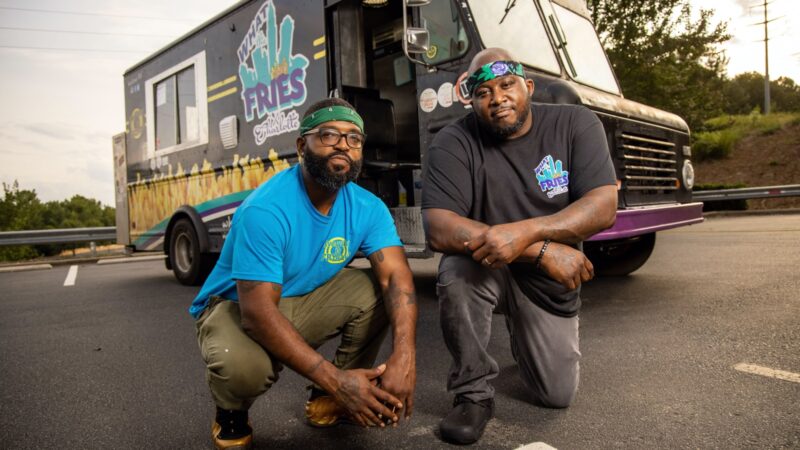
What the Fries’ owners Greg Williams (left) and Jamie Barnes with their food truck. Photo by Peter Taylor
What The Fries owners Greg Williams and Jamie Barnes met as roommates at Johnson & Wales 17 years ago, and they know each other’s strengths and weaknesses. Barnes is better at time management, for example, while Williams may occasionally get carried away with prep and forget to check the clock. After six years in business together, they’ve honed their collaboration with tremendous results. Their food truck, What The Fries, is regularly lauded as one of the best in town, and the pair opened a brick-and-mortar space in Pineville in March. On top of managing the restaurant, they still ferry their steak hibachi fries and fried bread pudding tots all over Charlotte, and they say that when you take your restaurant on the road, the challenges multiply.
Here’s what a day in their lives looks like.
7 a.m. Greg Williams and Jamie Barnes are up and at ’em. As soon as they wake up, they’re getting ready — and facing down a long commute. “I live in Fort Mill,” Williams says from the restaurant. “It really should take about 15 minutes to get here, but in the mornings it takes about 30 to 40 minutes to get here.” Barnes lives nearby, in Clover, South Carolina. On the way to work, he may make a quick store run for missing ingredients.
8 a.m. As soon as they arrive at the store, they get ready to leave again. “The truck was what got us here,” Barnes says. “That’s what people started to love us for, so we just wanted to get it back out and give people what they wanted.” They blanch fries, make sauces and bread pudding, fill up the truck’s water tank (for washing dishes on the move)to take on the road, and let the truck run, so the onboard refrigerator can get cool. “It’s an older truck, an ’86 Ford Kurbmaster, so it just needs a little time,” Williams says. “I guess it’s like, you get a little older, you need a little bit more time to get ready for the day.”
10 a.m. Lunch is still more than an hour away, but as soon as they’re on the truck, Barnes and Williams feel a time crunch. They may have to stop for gas or propane, which occasionally turns into a 30- or 40-minute ordeal. “You run into different types of obstacles daily,” Williams says. When I ask what other restaurateurs may not understand about operating a food truck, both chefs cite truck maintenance. “You have tires that blow out, radiator blows out,” Williams says. “On top of the prep you have to do, you have to worry about the truck as well.” (The food prep is mostly the same as in the kitchen, but they do take measures to save space, like opting for Ziploc bags instead of hard food containers.)
11:30 a.m. Despite the challenges, work on the move is fast-paced and interesting. They travel to different parts of Charlotte for a wide range of events, and the pair tailor their specials to the setting. They like the quick turnover, too. Customers don’t linger the way they do in restaurants. “Get them in, and get them out,” Barnes says.
2:30 p.m. After lunch, they steer the black, fry-bedecked truck back to the restaurant, hopefully without incident. “It’s a lot bigger than a regular car,” Williams says. “So sometimes you have to fit in tight spaces. You just got to remember that you got to take wide turns and watch yourself backing up.” In six years, he’s hit two cars — a pretty good record, he reckons.
When they get back, they jump in to help in the restaurant kitchen. With a business built on hand-cut fries, there’s always prep, prep, and more prep. Though they’ve graduated to a brick-and-mortar space, they haven’t swapped their kitchen stations for desks and computers quite yet. “We’re still used to just being a lot of hands on,” Williams says. “We’ve been in the industry for a long time.”
Plus, they have to fill the gaps when employees call out. Barnes and Williams employ about 20 people in front- and back-of-house positions, but they say the number fluctuates so frequently, an exact number is difficult to pinpoint. Staff members simply quit showing up for work. One Saturday recently, they had a food truck event and were so short-staffed, they could barely operate both the truck and the store. “We’ve both been at restaurants for years,” Barnes says, “and you see people come and go — but not at this rate.”
5 p.m. The guys sneak out early and grab food on the way home. “I’m really simple,” Williams says. “I don’t eat a lot of chef-y stuff when I get home. I’ll have a burger. I still eat a lot of stuff that I ate from growing up. I like hot dogs, a bologna sandwich, or something like that. If I want to splurge, I’ll stop and get some sushi.” (He likes Akahana in Fort Mill’s Baxter Village.)
9 p.m. At home, both have a similar routine: shower and spend time with their families. Barnes’ daughter, Lily, is 10, and his son, Levi, is 7. Williams has a 3-year-old daughter, Gabby. Lots of nights, they both flip on Netflix. Barnes has been watching You, while Williams recently binged Squid Game. For more adventurous family fun days, they head to Carowinds or Dave & Buster’s. On a typical night, Barnes goes to bed around midnight. He used to have trouble sleeping through the night, but now the bustle and stress of running a brick-and-mortar business wears him out. “Since this restaurant,” he says, “I’ve actually been able to sleep.”
Kindred’s Katy Kindred
Freshlist’s Jesse Leadbetter
James Yoder of Not Just Coffee
Christa Csoka of The Artisan’s Palate
The Hot Box NC’s Michael Bowling
300 East’s Ashley Boyd
Aria and Cicchetti’s Pierre Bader
Sea Level N.C., The Waterman, and Ace No. 3’s Paul Manley
Legion’s Gene Briggs