



December 10, 2018
What Charlotte restaurants can learn from New York
After cooking at the James Beard House, local chefs ate their way through the city. They share what NYC does better — and how we can get there
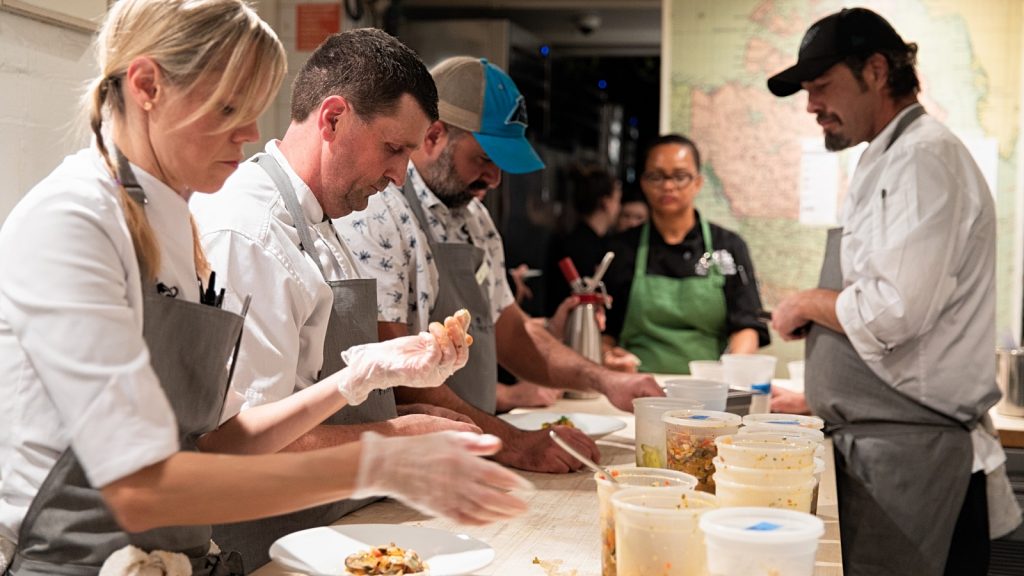
From left to right: Chefs Ashley Boyd, Bruce Moffett, Joe Kindred, and Paul Verica at the James Beard House. Courtney Collins/Jenna Bascom Photography
A group of local chefs recently cooked at the James Beard House, where the famed culinary foundation hosts chefs from around the U.S. for pop-up dinners. Ashley Boyd (300 East), William Dissen (Haymaker), Katy and Joe Kindred (Kindred, Hello Sailor), Bruce Moffett (Barrington’s, Stagioni, Good Food) and Paul Verica (The Stanley) were sent to represent Charlotte in the New York City kitchen. However, the chefs took a little time for culinary research, too, dining at some of the best restaurants in the country as well as some places they just happened upon. I’ve found that dining in another city helps refresh your perspective on the food scene here. So I asked Boyd, Moffett, and Verica what their biggest takeaways were on their trip.
Service
The level of hospitality was the standout in our conversations. Boyd and her husband, Dayne, decided to pop into The Modern, inside of the Museum of Modern Art, during the lunch rush and without a reservation. Instead of telling the couple there were no tables, the staff put together a cocktail table for them to dine at. The way they were treated is something Boyd will try to bring back to 300 East, even when a customer is asking for something that the restaurant can’t provide. “It’s not so much that you’re saying no, it’s how you make people feel and at these very high-level establishments, you’re never made to feel that way.”
Moffett describes a similar experience at Prune, after the group arrived past their reservation time. “We got there kind of late,” he says. “They didn’t bat an eyelash, they were super welcoming, happy to have us, happy to seat us, happy to go through the wine list with us. There was no like, ‘Oh my gosh, these people just came in at 9:30′ like I get here a lot.”
When things do go wrong, these elite restaurants are quick to correct them. Verica and his girlfriend Jane were eating at Per Se, and a server forgot to explain a tray of salts from around the world as they ate their foie gras course. The maître d’ brought them an additional foie gras dish (one they hadn’t tried yet) so the couple could eat it as intended, with the salt tray.
Servers knowing everything on their restaurant’s menus — whether it was wine or food — made an impact on all three chefs. Verica recalls the servers being able to even answer preparation questions about a broccoli soup poured tableside. Wine recommendations and pairings were spot on, and it was clear staff took pride in being able to provide them.
“That will come, I think it’s just a slow progression,” Moffett says of Charlotte’s struggles finding passionate servers. “As you become a restaurant destination, I would imagine there are more people that are excited to come to the city and more restaurant-related people that are excited to come to the city and work here.”
After all, he mentions, Joe and Katy Kindred have managed to cultivate a staff of excited, inspired servers up in Davidson. It can be done.
Simplicity
Another insight that echoed in our conversations was that when things are done right, they don’t have to be over the top.
“A lot of us get so carried away, we’ve got to have our little swipe of this or we’ve got to have our little extra item or crispy thing or whatnot,” Moffett says. At Prune, chef Gabrielle Hamilton’s dishes were harmonious and deep without trying too hard. Boyd had a similar perspective at Estela.
“Sometimes I feel like people are trying to make statements with food, and so once it gets to you it ends up feeling like maybe they were trying too hard to do something different,” she says. “All of it was different, but none of it felt like the chef was trying too hard.”
Boyd and Verica each mentioned having the best beef tartare they’ve tasted (from two separate restaurants) as an example of what nailing the basics can do for a meal. For two chefs to cite a dish common on menus across Charlotte as something memorable in New York City must say something about what we’re doing here; perhaps Charlotte has been overlooked for so long, we are trying too hard to get noticed.
Verica noticed the same restraint at Per Se: “There was a reason for everything on every single plate. It was just super, super clean. And they still had fun with it, too.” That’s something the chef once known for a having so many touches on his own dishes now sees the value of, creating dishes that are more simple and more refined at his restaurant The Stanley.
Looking forward
Restaurants like 300 East, Barrington’s, and The Stanley — chef-owned or chef-driven — may be the key to pushing Charlotte towards a higher level of cooking.
“We’re really seeing more and more chef-driven and chef-owned restaurants; I think that’s what’s really going to push the scales,” Verica says. “And continuing to educate our customers, our guests. It’s amazing the difference between being here in Elizabeth what we were able to do to and what we were able to do in Waxhaw. And so much of it is about the customer base.”
Verica points to chef Mike Noll of Bardo as someone pushing the city forward with a bold menu. And the humbling experience of eating at some of the best restaurants in the world inspires chefs to do better at home, too.
“I feel like as far as the level of cooking, that we’re going to evolve toward that naturally,” Boyd says. “We just don’t have enough people doing stuff, we’re just not big enough yet and that will come. That’s not something you can force, and it just takes everyone here trying to up their game and traveling and eating and chefs moving in from out of town and doing their thing and everybody working off each other and influencing each other. That will happen, and diners will expect more.” —Kristen Wile





Outstanding piece!
Thanks, Tom!
What a great read!
Thanks, Joy!