


Editor's Note: This story is unlocked for everyone to read courtesy of the CRVA, our partner in nourishing culinary exploration for residents and visitors of the Queen City.
August 13, 2026
Thirty years in, Mimosa Grill is still betting on Uptown
Three decades later, Burke Hospitality Group sees Mimosa Grill navigating another Uptown reset
by TM Petaccia
Tom Sasser’s first answer was no.
When the people managing restaurant space in the then Two First Union Center approached him about opening a new concept on South Tryon Street, the owner of Burke Hospitality Group had office space across the street in Latta Arcade. He knew the surroundings well enough to be wary.
“It was a ghost town up here,” Sasser says. “I said, ‘No, Uptown’s not ready.'”
They asked again six months later. Then they asked again. For roughly two and a half years, Sasser kept resisting the idea that this part of Charlotte could support the kind of restaurant they wanted: polished enough to serve the growing bank complex, but different from the restaurant already occupying the space, Prisms Bistro & Restaurant.
Eventually, Spectrum Properties brought Sasser into a meeting and asked him to put on paper what it would take to make the deal work. He and one of his partners did. The terms were accepted, Prism closed, and the space was rebuilt. Mimosa Grill opened in April 1996. The name comes from the mimosa trees found in Sasser’s hometown of Morganton, which at one time was called the “Mimosa City.”
It was, Sasser says, “a creative deal,” one made possible because the bank and its real estate partners were willing to invest in Uptown and help give a local restaurant a chance to establish itself there.
“In our business, whether it’s a hotel or whether it’s a restaurant, that’s the way you have a chance to be successful and to make it work,” Sasser says.
For Sasser, it’s that synergy of commitment between property owner and restaurateur that explains how Mimosa Grill reached its 30th anniversary and what it will need to remain part of Uptown’s next chapter.
Not another Harper’s
At the time, Sasser and his partners already operated other restaurants, including Harper’s locations with largely identical menus. Mimosa Grill offered a chance to create something different.
That distinction nearly disappeared just weeks before the opening.
Sasser says he received a call saying First Union chief executive Ed Crutchfield, who held the final word on the property, wanted the new restaurant to become another Harper’s. By then, Sasser had hired an architect, designed the restaurant, and was deep into menu and recipe development.
“I said, ‘No, I’m not going to do it,'” Sasser recalls. “I’ll walk away, but I’m not going to open Harper’s.”
For about a week, he thought the project might be over. Then the direction changed again: keep going with Mimosa Grill.
Sasser describes the original menu idea as Southern food with a global reach, although he resisted drawing tight boundaries around it.
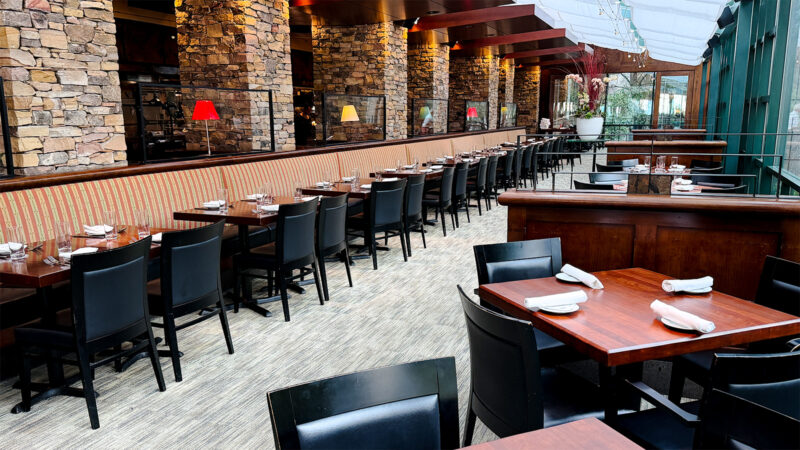
“The idea was always to give chefs a chance to try other things,” he says. “I tried to broaden it and say it was kind of a Southern-accent type place, but with global influences. So anybody that had a good dish that we thought we could tweak and make feel accessible and approachable, let me taste it. Let’s see it. Let’s see if it works.”
That willingness to move while maintaining a recognizable identity has become one of Mimosa Grill’s through lines. The restaurant has changed, with different chefs, different dining habits, and a much different Uptown. Its current menu, however, is in some ways a return to the beginning.
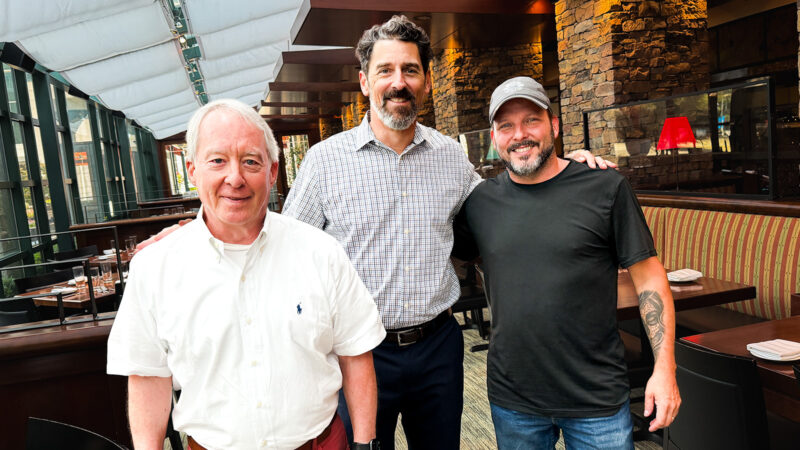
Burke corporate chef Scott Wallen has worked with Sasser in two stints dating to 2003. He says the present menu, developed with Sasser and director of operations Tripp Cagle, feels more like Mimosa’s early menus.
“Not simple in their preparation or simple in the sourcing of ingredients, but simple in the sense that they’re understandable and approachable and not trying to be pretentious,” Wallen says. The goal is good food, with as much sourced locally from the Carolinas as the restaurant can manage.
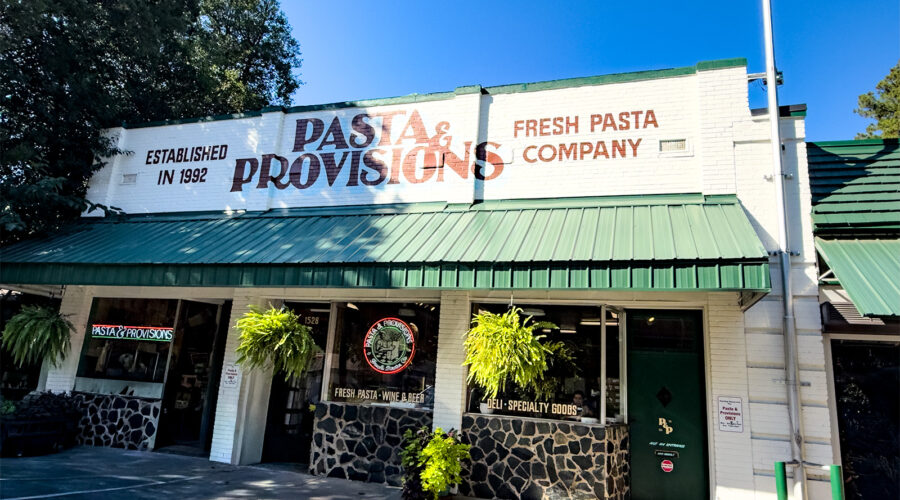
For a restaurant with roughly 200 seats, Wallen says, buying everything locally is not feasible. Some ingredients also come from elsewhere by design because of the menu’s global influences. The kitchen instead looks broadly at Carolina connections, from farmers to local artisan producers such as Pasta & Provisions.
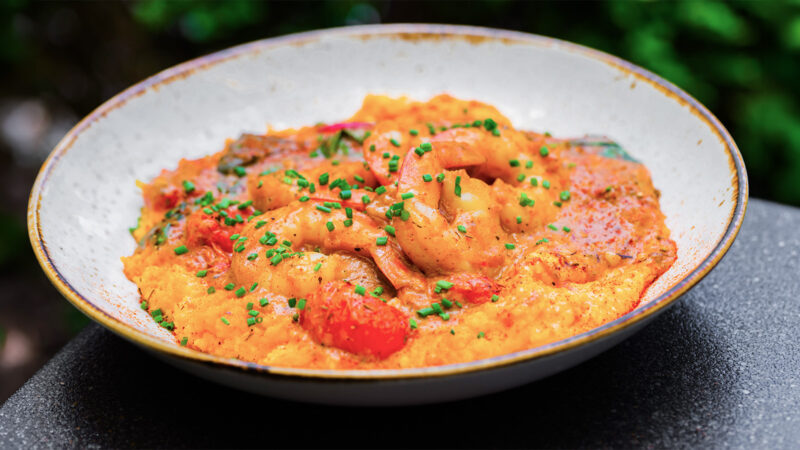
Several dishes have become constants. Cagle, who joined the company in 2004 and has spent most of that time at Mimosa Grill, points to the crab cakes, which combine crab with smoked trout, and the pecan-crusted North Carolina trout with peach chutney and honey-lemon butter. The restaurant’s shrimp and grits has changed over time, but its foundation of tasso gravy and andouille sausage remains familiar.
“The set may just be a little bit different,” Cagle says of the trout, but the central ingredients and identity have endured.
Familiar, but worth remembering
All three men see a change in what diners now want from a restaurant. Cagle believes guests were more willing a decade ago to let a server explain an unfamiliar ingredient or a chef’s more experimental composition. Since the pandemic, he says, many are looking for dishes they immediately understand.
“People just want something that’s simple, that is just done really well with great ingredients, that’s approachable,” Cagle says. The challenge is to start with that familiar base, then “take some liberties” and elevate it without losing the guest.
Wallen sees the same instinct as a response to pressures well beyond restaurants, including higher prices, uncertainty, and a general sense of discomfort.
“People come into the restaurant and they want comfort,” Wallen says. “They want a nostalgia they like. They want something that feels familiar.”
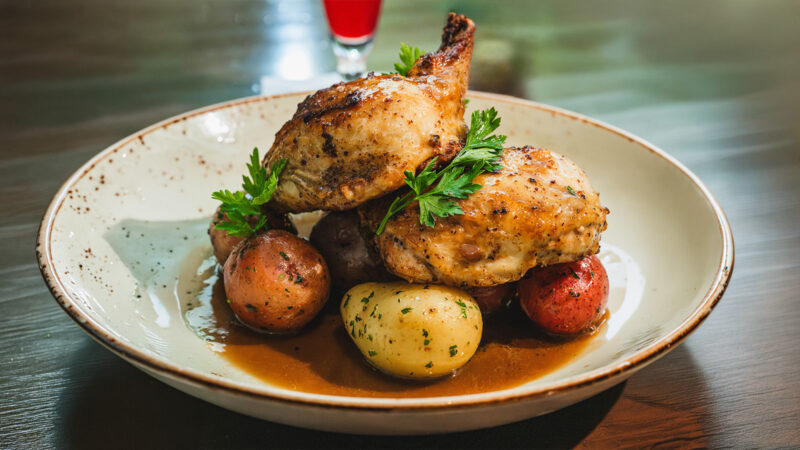
That does not mean Mimosa Grill is simply replaying its past. Wallen points to a roasted half chicken with rosemary-thyme jus and local creamer potatoes: a straightforward plate that depends on good sourcing, careful seasoning, and disciplined execution instead of layers of competing flavors. Carolina black grouper from Charlotte Fish Company is prepared piccata-style. A shrimp cocktail uses North Carolina shrimp when available (South Carolina or Georgia shrimp when not), with avocado salsa and two dipping sauces.
“It just takes it up a little bit,” Sasser says of the shrimp cocktail. “It’s just not cocktail with some cocktail sauce. It’s different. But at the same time, I get that. I see that on the menu.”
Wallen puts the goal another way: “It’s a dish you remember, but you don’t remember it tasting like that.”
For Sasser, creativity still has to be paired with consistency. He likes hearing that a guest can return to a favorite dish and have it taste the same each time.
“I think that’s a good thing,” he says. “Consistency is great.”
The food, however, is only part of the explanation for three decades in business. Cagle argues that the more durable foundation is the hospitality culture he found when he arrived and that Sasser’s restaurant group had established years earlier.
“If you have the best food in the world and you walk in the door and you don’t feel that smile from that server, from that host, from the bartender, the guest doesn’t feel like you’re on their side,” Cagle says.
The mechanics of a restaurant are inherently transactional: take the order, deliver the drink, clear the table and accept payment. The difference, Cagle says, is “how we make them feel while we’re doing that.”
Another Uptown transition
Mimosa Grill was born during one Uptown transformation. Its 30th anniversary arrives during another, although this one is far less predictable.
Before COVID-19, Sasser says, office buildings around the restaurant were nearly full and more development was underway. Remote work abruptly changed the pattern. Even buildings with strong occupancy on paper do not deliver the same number of workers to Uptown on Mondays and Fridays.
Cagle has watched that change play out on the floor. Lunch service requires a much leaner staff than it once did. Sporting events, conventions, business conferences, and restaurant buyouts still bring guests through the doors, and longtime Uptown workers continue to return, but the area is no longer as consistently crowded.
Hotel patterns have changed, too. Sasser says Uptown hotels once ran close to full during the business week and were quieter on weekends. Now weekend occupancy can be steadier, but some guests are simply using Uptown as a place to sleep while visiting family or exploring elsewhere in Charlotte. Business travelers have not returned in the same numbers.
“It’s a whole different landscape,” Sasser says.
Mimosa Grill also has a new landlord for the first time in its history. A joint venture of Riverside Investment & Development and Singerman Real Estate recently bought the surrounding block from Wells Fargo and is studying a major redevelopment. Sasser says early concepts call for reworking the plaza and upgrading the atrium, which could become part of a hotel lobby. He has also heard discussion of new office and residential space, although details were still being studied at the time of the interview.
The only commitment so far, Sasser says, is that Riverside wants Mimosa Grill to stay and hopes it continues to succeed. He is encouraged by the conversations while remaining realistic about the construction challenges that could accompany a large project around the restaurant.
If Riverside follows through on the broader vision, Sasser believes it could bring exactly the mix Uptown needs: hotel guests, office workers, and residents occupying the same block throughout more of the week.
Still, he says real estate alone cannot do the job. Charlotte also needs civic and corporate leaders willing to make a visible investment in its center city.
“What I hope is that Charlotte produces some new leaders from all areas,” Sasser says. “We do have one or two, but we used to have three or four. And those one or two need to be loud. The thing is, out a lot of the companies that are in Charlotte right now, many of the CEOs are not in Charlotte. That’s unfortunate because I think if they were here, I think they would love Charlotte like we do, and they would be more involved, and their companies would be more involved.”
Sasser credits the Charlotte Regional Visitors Authority and Charlotte Center City Partners with helping fill the summer calendar with conventions, concerts, and sporting events. But he says both organizations need continued private support and pressure to do more. The smallest retailers, restaurants, and hotels cannot be expected to create Uptown’s momentum on their own. “But Uptown has to be safe. It’s got to be occupied. And it’s got to be promoted,” he says.
With solid concepts like Mimosa Grill, opportunities for Burke Hospitality to open more restaurants have occurred, but as Sasser notes, construction and occupancy costs have climbed so high, he now begins many development conversations with a basic question: Is this a traditional real estate deal, or is it a partnership? “Unless you have a really good developer partnership, it makes it really, really tough,” he says.
Without a developer willing to participate, he says, the numbers are difficult for a local independent operator to make work, particularly when private-equity-backed restaurant groups can afford to pay rents that attract landlords, at least in the short term.
Sasser saw the stakes firsthand when Harper’s closed in SouthPark after nearly 32 years. The landlord had control over the final five years of the lease and accepted an offer from Chase to open a bank branch. Sasser says he understood why the property owner took the deal, even if he disliked what the change meant for the neighborhood. “I saw the deal. I would have taken it too, but it’s probably not great for the community,” he says.
That experience sharpens the significance of Mimosa Grill’s anniversary. Thirty years is not only a measure of whether guests still order the crab cakes or shrimp and grits. It represents thousands of daily decisions by workers and diners, along with a landlord relationship that has allowed a local restaurant to remain in place while Charlotte changed around it.
Wallen acknowledges the pull of every newly opened dining room.
“Everybody likes the new and the shiny,” he says. “But to be a staple in any community for 30 years means that you’ve done something right. You’ve taken care of the people who are with you, you care about the community that’s around you, and they’ve taken care of you.”
Sasser is less interested in nostalgia for its own sake than in whether Charlotte still values the businesses that helped build its dining culture. Longevity, he notes, is rarely the story that dominates social media.
“It’s not Instagrammable,” he says. “I hope the folks who write and the folks who get people’s attention are continue to talk more and more about classics and about folks that have been really doing the deal in the community for quite a while.”
Cagle also sees the promise in Uptown’s transitioning landscape. “It’s definitely changed quite a bit with business, but you still see some of the same faces who have worked up here for 10 or 15 years.”
For a restaurateur who repeatedly said Uptown was not ready, the fact that Mimosa Grill is still here 30 years later carries its own weight.
“The fact that you’re talking to us about 30 years is meaningful to me,” Sasser says.