Hidden gem in Charlotte’s Oakhurst neighborhood where the menu is as creative as the food
Hidden gem in Charlotte’s Oakhurst neighborhood where the menu is as creative as the food


“It’s women who kick ass on the line,” she says
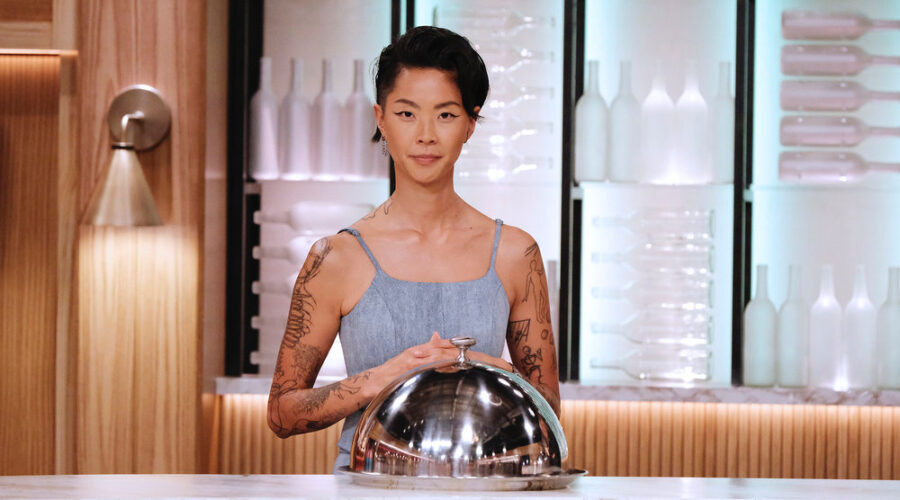
In honor of Women’s History Month, we’ll be interviewing a female voice in Charlotte’s food and beverage industry each week in March. Today, we’re speaking with Subrina Collier, who owns Camp North End’s Leah & Louise and Uptown’s The Yolk with her husband Greg. Collier shares why she’s become more visible, how misogyny has been normalized in restaurants, and the example she hopes to set for women following in her footsteps.
Unpretentious Palate: When did you come to realize that there were so few females in leadership and ownership roles in the restaurant industry? And how does that change your career?
Subrina Collier: That happened in 2005 or ’06, when I was working at a chain steakhouse. We had one general manager and three managers and only one was a woman, and she probably had the least amount of power. I don’t think it directly affected me then, because at that point, I didn’t know I would be doing what I’m doing now. Over the years, it changed how I thought about leadership, as far as I’m probably not going to get this job if I apply for GM here, because women being GMs or front-of-house management, especially when you go higher up in clientele, is just not normal. Then go even deeper, for Black women, that’s just not the norm especially. You only see Black women in positions of power front-of-the-house at like McDonald’s and Burger King, your fast foods — never in higher end clientele. You probably couldn’t find one in South Park right now for a white tablecloth dining spot.
That was what changed my perspective. I started doing restaurant ownership. It made me be like, “Well, I have to create my own,” because I didn’t want to sit around and wait. I wanted to make my own thing.
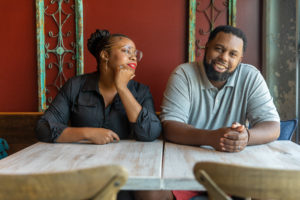
Subrina and Greg Collier at their restaurant Leah & Louise. Photo by Peter Taylor
UP: Why do you think it’s beneficial in the restaurant industry to have and make sure that women are in leadership positions?
SC: It’s easy to pigeonhole women into certain areas. Of course they want you up front, they want you to serve, but they do not want you to have leadership. I think it’s important for women to see other women as leaders because it’ll keep you inspired and it can drive you. We just don’t see that too often.
Women have to deal with a lot in the restaurant industry. You’ve got to deal with being sexually harassed by the guys; it’s almost the norm in the kitchen world. That’s why we don’t play that shit here, because everywhere I’ve worked, it was a norm for the manager to be sleeping with the front of the house hostess or always flirting with her or always flirting with the servers. They were never reprimanded about it. It was kind of like, well, you know, it’s just the kitchen world, but it’s very misogynistic. The restaurant world is super misogynistic. And so having women that are in leadership that have your back to make it clear that you don’t have to deal with that type of shit. The world itself can be misogynistic and I don’t need to deal with it coming to work and trying to make some money. I think that’s a whole other conversation in the culinary industry. But that’s one of the reasons why I do what I do.
UP: What responsibility do you take as a female leader in the restaurant industry?
SC: The responsibility I feel is to show them someone that has already been where you’ve been, worked where you’ve worked. I went from serving to ownership to being a highly accoladed person. For Greg and I, it’s huge that people know that we held the positions. I’ve held every position that I’m hiring for except for back of the house. Front of the house, I have done every position in someone’s restaurant that I’m hiring them for. That’s important for me, for the women to see that no position is too small. You can always get to where you need to go.
UP: You’re in a unique position, being married to your business partner. Have you noticed some ways he’s treated differently as a man?
SC: Outside of us being business partners and married, Greg is the chef, and the chef always gets the recognition. I’m not a recognition person. I’ve just gotten in the past two years more comfortable doing more interviews and being more vocal. Even though I’m not introverted by any means, I just didn’t need to do the interviews and things like that. Over the past two years I’ve understood how important it is for me to have more of a voice, because it’s not just about me. It’s other people that want to do what I do and own restaurants.
With Greg, it’s just different because he’s the chef. He’s the man. I’ve seen it in certain things where they will refer back to Greg after I’ve said something. But my husband is very good about that — Greg will tell anybody, “I just cook, my wife is the boss.” He’s saying that being funny, but he is saying that to let them know any type of deal that someone’s trying to do, you need to refer back to my business partner, i.e. my wife.
People do check back or, “I’ll ask chef.” That’s fine, you can ask chef, and chef refers them back to me. It’s happened with a purveyor or someone like that, I’ve already told “No.” And what they might not know is Greg has told me to tell them no. You referring back to him doesn’t change the answer. You can see it in certain things.
But I think over the past two or three years, I’ve been able to establish myself to stand on my own, so there’s more respect now. I think chefs — and men — are almost given this level of respect. And women have to like, kick down a door to be like, “No, this is what it is.” They’re given respect, especially by other men, and sometimes women. Women can practice misogyny. But it’s different now. And hopefully in the next decade, we won’t have to be having these conversations. It’ll be something different. There will probably still be some misogynistic shit, but it won’t be the same thing.
UP: How can diners help encourage change and make sure there’s more equality in the restaurant industry?
SC: Support. Diners don’t realize their support is huge. Words of affirmation to the people that you are coming across and give you the customer service. Even if it’s not monetary, words of affirmation are huge for a lot of people in this industry.
A change in the mindset, because I feel like a lot of people have a mindset if they see a woman in culinary — especially in the back of the house, they assume she’s pastry. Pastry is amazing; pastry is getting to be a huge business. But women get pigeonholed into pastry because they’re pretty and dainty. And so they pigeonhole women into that, where it’s women that kick ass on the line. It’s women that kick ass in the front of the house, it’s women that are kick ass sommeliers. I want people in general to change their mindset about where they think people belong in certain fields, specifically the culinary field.
UP: Who is one female in the restaurant industry in Charlotte that you think people should know about?
SC: My girls. They need to know more about Courtney Evans, Tchnavia Carter, my sous chef. They need to know more about Jasmine Macon, my pastry chef. I’m going to always stick up for my folks, so they need to definitely know more about them. They are on the rise. They’re very hungry for it. If they stay on the path that they’re on, they’ll bust so many doors open.
Right now, we’re big into mentorship, so now we’re being a mentor to them. Not only do they work for us, but we encourage them to do their own pop-ups, to do their own thing. We’re having Courtney do her pop-up. Jasmine does her donut pop-up. Tchnavia, our sous chef, she’s going to be doing her pop-up. We’re big on, yes, you work for me. Yes, I cut you a paycheck, but you’re not going to work for me forever. So what would you want to do outside of this? We know you love culinary, you love food, so what do you want to do?
People need to be on the lookout for them. Our kitchen is primarily women. That was done by design. I think that’s important. Greg thinks that’s important. Women are the future. That’s something we want to practice. People say that a lot, “the future is female.” But when I go through and look at their boards and in their partnerships, it doesn’t reflect that. We want to walk how we talk.