


July 28, 2026
Key takeaways from our Managing Personal Finances industry breakfast
Three experts share how to keep your financial strategy moving up in a rollercoaster business

by TM Petaccia
If there was one clear takeaway from Monday’s Unpretentious Palate Industry Breakfast: Managing Personal Finances as a Hospitality Worker, it was hospitality paychecks don’t follow a script. Workers don’t need a perfect financial plan. They need one that can bend without breaking.
For hospitality workers, creating a budget is rarely as simple as dividing a dependable paycheck among a predictable set of bills. Income can rise or fall with the season, the shift, the section, the weather, and any number of circumstances beyond an employee’s control.
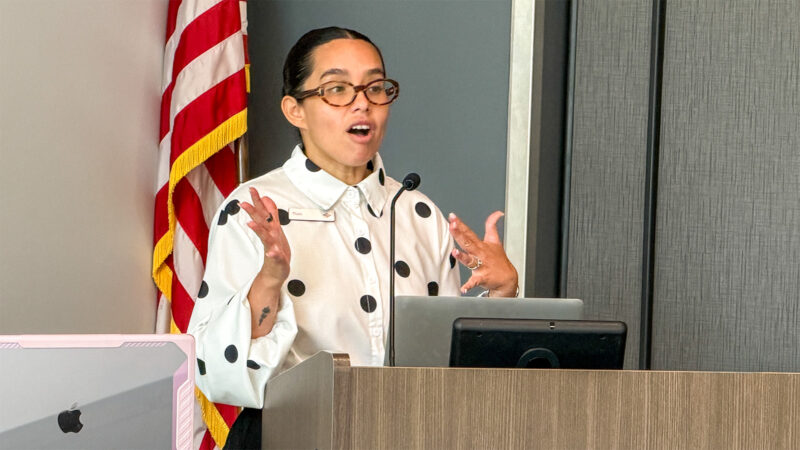
Speakers Martha Rivas and Thais Baldovinos, both financial center managers with Bank of America, joined Jason Ackerman, CPA, financial advisor, and co-founder of retirement-planning platform WealthRabbit, to offer strategies for managing money in an industry where no two months necessarily look alike.
Budget from what you know
Rivas began with the basics: use a checking account for routine expenses, a savings account for money being set aside, and understand the advantages and risks of cash, debit cards, credit cards, and digital wallets. From there, she encouraged attendees to put their actual income and expenses on paper.

“Sometimes we’re navigating somewhere we’ve never been before,” Rivas said, comparing a written spending plan to the GPS used for an unfamiliar trip. First establish where you are, determine where you want to go, track your progress, and make adjustments when you stray from the route.
That ability to adjust is especially important when income fluctuates. In response to an attendee who said earnings had varied dramatically from job to job, Baldovinos recommended beginning with known obligations: recurring bills, existing debts, and the minimum payments required each month. At month’s end, any remaining money can be directed toward savings, retirement, or additional debt repayment.
“I think it should be fluid,” Baldovinos said. “You have a plan, but there also has to be space for you to make changes to it.”
Rivas called a budget “a living, breathing document.” During stronger months or unusually good years, she advised workers to save more than usual, creating a reserve that can help support them when business slows.
Build a buffer before an emergency arrives
All three speakers repeatedly returned to the importance of an emergency fund. Without one, an unexpected car repair, medical bill, or loss of shifts can quickly become high-interest credit card debt.
Rivas suggested establishing at least three months of necessary expenses as an initial target, with a larger cushion—potentially six to nine months—depending on household circumstances and income stability. The total should be based on essential housing, transportation, debt, insurance, food, and personal expenses rather than gross income alone.
The final number may feel daunting, but the speakers emphasized that consistency matters more than trying to reach it all at once. Automated transfers can move a manageable amount into savings before it gets absorbed into everyday spending.
“Please build an emergency fund,” Rivas said. “Because an emergency fund is going to help you from falling back into that credit card debt.”
Attack the most expensive debt
Rivas explained two familiar debt-repayment strategies. Paying the smallest balance first can provide a psychological lift as accounts disappear. Paying the debt with the highest interest rate first — the “avalanche” approach — usually costs less over time.
Ackerman reinforced that interest rate should be the deciding factor when comparing debts. Paying extra on a relatively low-interest mortgage or student loan makes little sense if a credit card balance is accruing interest near 20 percent. After preserving an adequate emergency reserve, he recommended concentrating first on the costliest debt.
Baldovinos illustrated how even a modest increase above a credit card’s minimum payment can change the outcome. In the presentation’s example, a $3,000 balance paid at $65 per month lasted 17 years. Raising the payment to $100 reduced the payoff period to three years and two months and substantially reduced the interest paid.
If paying in full is not possible, make at least the required minimum on time, she said, then add more whenever the budget permits.
Treat credit as a long-term asset
Baldovinos broke a credit score into its principal components: payment history, 35 percent; amounts owed, 30 percent; length of credit history, 15 percent; and new credit and types of credit used, 10 percent each.
Her practical advice was straightforward: pay every bill on time, keep credit-card utilization below roughly 30 percent of the available limit, avoid applying for several accounts in a short period, and think carefully before closing an older account that contributes to the length of one’s credit history.
She also encouraged workers to review all three credit reports for unfamiliar accounts, inquiries, addresses, or personal information that could signal an error or identity theft. Free weekly reports from Equifax, Experian, and TransUnion are available through AnnualCreditReport.com.
Capture the match, then make saving automatic
Once emergency savings and high-interest debt are under control, Ackerman recommended turning to retirement. Workers whose employers offer a 401(k), SIMPLE IRA, or another matched retirement plan should try to contribute at least enough to receive the entire match.
“That’s free money,” Ackerman said. “You’re literally leaving money on the table if you don’t do that.”
For workers currently in lower tax brackets, Ackerman generally favored Roth contributions. Roth accounts do not provide an immediate tax deduction, but qualified withdrawals are tax-free. The best choice between Roth and traditional contributions depends on a worker’s income, tax situation, and plan options.

He also urged attendees to favor diversified, low-cost investments over individual-stock bets or tips from friends. In a hypothetical example, Ackerman showed how a recurring $50 monthly investment beginning at age 22 could grow to $194,500 by age 60 if it earned an average annual return of 9 percent. The example was an illustration rather than a guaranteed result, but it demonstrated the power of starting early and contributing consistently.
His preferred strategy was to automate the contribution, review the account periodically, and resist reacting to routine market swings.
“You can’t time the market,” Ackerman said.
Understand the new deductions for tips and overtime
Ackerman also addressed two federal income-tax deductions of particular interest to hospitality workers. Effective for tax years 2025 through 2028, eligible workers may deduct up to $25,000 in qualified tips per tax return. Qualified overtime compensation may be deductible up to $12,500, or $25,000 for married couples filing jointly. For time-and-a-half pay, only the premium above the regular rate generally qualifies.
Despite the shorthand “no tax on tips” and “no tax on overtime,” both forms of compensation must still be reported and remain subject to payroll taxes. The deductions also phase out for taxpayers with modified adjusted gross income above $150,000, or $300,000 for joint filers. Current IRS guidance provides the complete eligibility rules.
Because 2025 W-2s and 1099s were not redesigned to separately report all qualifying amounts, Ackerman advised workers filing a 2025 return to gather their tip and overtime records and make sure the deductions are addressed by their tax software or preparer.
The key takeaways
- Build a monthly plan around essential expenses and minimum obligations, then adjust it as income changes.
- Use strong months to prepare for weaker ones.
- Establish an emergency fund before an unexpected expense forces you onto a credit card.
- Pay every debt on time and direct extra money toward the highest interest rate first.
- Review credit reports regularly and investigate anything unfamiliar.
- Contribute enough to capture an employer retirement match whenever possible.
- Automate savings and retirement contributions—even when the starting amount is small.
- Keep records of tips and overtime, and ask a qualified tax professional how the new deductions apply to your situation.
- Resources: Check out Bank of America’s Better Money Habits site for advice on how to manage day-to-day finances and emergency spending or WealthRabbit for easy-to-use retirement investing
For hospitality workers, financial stability may not come from making every month predictable. It comes from having a plan flexible enough to handle the months that are not.
UPcomig Unpretentious Palate Industry Breakfasts
September 8 — Making Moves Towards Leadership
October 28 — Mastering Marketing and Branding
Open to all culinary/hospitality industry professionals. Click here to request an invitation.
Support local food journalism in Charlotte.
UNPRETENTIOUS PALATE is a digital publication covering food and drink in Charlotte. At UP, you’ll find ethical food journalism that isn’t based on free meals. We’ll be your taste testers around the city, letting you know where you can’t miss and where to skip. And we’ll ban any condescending food-writer speak. We’ll tell you the dishes we love, where to go on date night, and the best places for cocktails. You can trust us.
Become an Unpretentious Palate member today to dine better in Charlotte.
Not ready to become a paying Member? Sign up for our free newsletter below.