Hidden gem in Charlotte’s Oakhurst neighborhood where the menu is as creative as the food
Hidden gem in Charlotte’s Oakhurst neighborhood where the menu is as creative as the food


The chef’s farmer is growing more than food
by Allison Braden
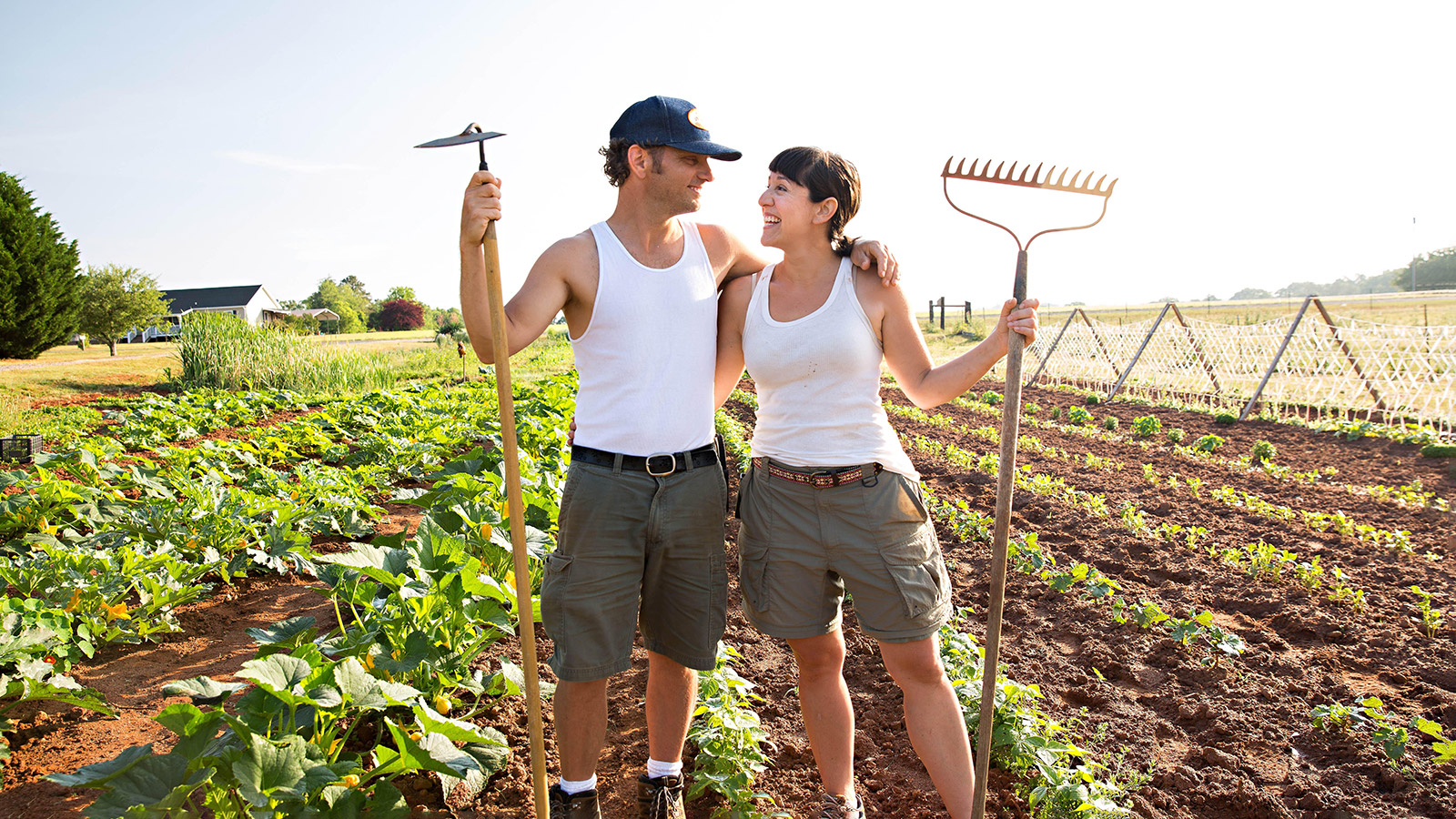
Old North Farm’s Jamie Swofford with wife Keia Mastrianni. Peter Taylor Photography
In 1975, Jamie Swofford’s grandfather purchased 55 acres in Shelby to start a commercial chicken farm. On a warm April afternoon, Swofford stands on the land he grew up on and points to where his grandfather produced eggs.
“That building back there was a quarter of a mile long,” he says. “It’s since been disassembled.” He turns and points at a cluster of homes. “We still have 60 acres of pasture across the street. I grew up in that house. My parents now live there. My sister lives there. This house was my aunt’s house.”
When he was young, Swofford didn’t expect that he’d one day farm on his family land. “At 17, I took the first train leaving,” he says. “I was like, ‘No way, I don’t want to be on this farm. I need to be in a city.’” He spent nearly two decades as a chef in Charlotte kitchens, but in 2012, he moved back; carved out a niche as “the chef’s farmer”; and launched Old North Shrub, a line of drinking vinegars. The forward-thinking Swofford embraces methods that may have seemed foreign to his factory-farming grandfather, but he hasn’t let go of an old-fashioned focus on community.
In his 18 years as a chef, Swofford worked at several Charlotte mainstays: Mimosa Grill, Upstream, Bistro La Bon, Cantina 1511. “I did a lot of moving around, a lot of learning from different culinary angles,” he says. “And then things just started clicking. I could affect more people if I wasn’t in one kitchen, but if I was growing for chefs.”
Swofford knew of a farm called The Chef’s Garden, in Huron, Ohio, where regenerative farming pioneer Lee Jones grew and shipped specialty produce — baby vegetables and edible flowers, for example — for chefs around the country, including Charlotte. Swofford thought, “I think I can do that. I can do it locally, and I can do it high quality and for chefs that I have a relationship with.”
So he quit kitchens and began to farm on his family land.
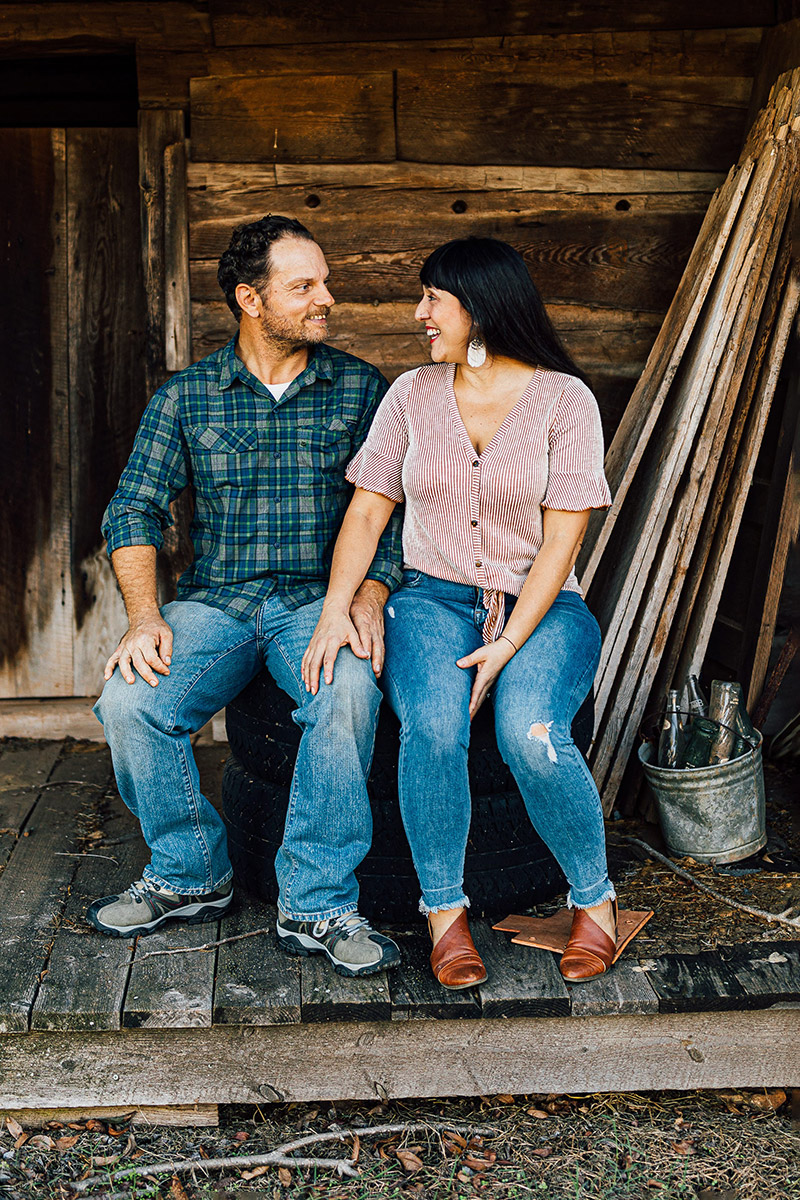
Swofford and Mastrianni. Photo courtesy
For two years, he worked by himself. The first season, he grew for two chefs and refined his process. The third year, he met his now-wife, Keia Mastrianni. “I convinced her to work a full season with me, and we had three different gardens,” he says. “We were just growing wherever we could, and I saw the value of working with other people, the magnitude of what you can accomplish.”
In 2019, Swofford and Mastrianni moved to Shelby. “It was always said that if I ever got married, I could have a small piece of land to start with,” Swofford says. They settled on a 2.5-acre parcel. It was a hayfield at the time but didn’t produce much hay. “It was just a blank canvas.” The couple married on January 1, 2020. “The world as we know it ended right after that,” Swofford says, referring to the pandemic, “and that changed everything.”
With restaurants closed, he hastily started a CSA. The week after that fateful Friday the 13th in March 2020, he started thinking about how to diversify, looking into farmers markets and trying to sell produce to grocery stores and local food markets. “All of a sudden,” he says, “it just flipped my whole model upside down.”
These days, Old North Farm supplies chefs in Charlotte (via Freshlist) and Asheville. Swofford also sells to the public at Foothills Farmers Market in Shelby and still operates a small CSA program. Mastrianni, a baker and food writer, runs a small-batch pie business, Milk Glass Pie, out of their kitchen, and sells via online preorder and at Charlotte’s Uptown Farmers Market.
When he started, Swofford grew produce based on customers’ requests. He’s since switched to growing what he wants, trusting his own instincts as a chef — little gem lettuce and other salad greens, radishes, turnips, carrots, summer squash, cucumbers, tomatoes, eggplant, okra, and other produce. He used to focus on supplying chefs, with the farmers market and CSA providing an outlet for leftovers. “Now, I’m growing things for my community,” he says. “Chefs know that it’s the best quality, and they will buy it no matter what it is because they want to support what we’re doing. Everything is based on relationships.”
Swofford has hired two women to help run the farm, part of a bigger project to incubate talent. In kitchens, he says, “I loved having young cooks and watching them develop, teaching them skills, and then they go off and flourish, and you have these contacts in different places. I wanted to do the same thing with young farmers.”
New farming talent is much needed. Small family farms are in decline across the country, development is swallowing farmland, the average age of farmers has risen to 58, and young farmers face steep barriers to entry in an industry where average profits are dwindling
Members of a local Amish community built a pavilion on the farm with capacity for 64 people. Overlooking rolling pastoral land, the pavilion has hosted fish pickings and chef popups. So far, the events have mostly been opportunities to welcome folks to the farm and hang out with friends, but Swofford and Mastrianni hope to make them a bigger part of their revenue stream. This year, they’ll cook and host seasonal suppers to showcase the farm’s produce and support their work.
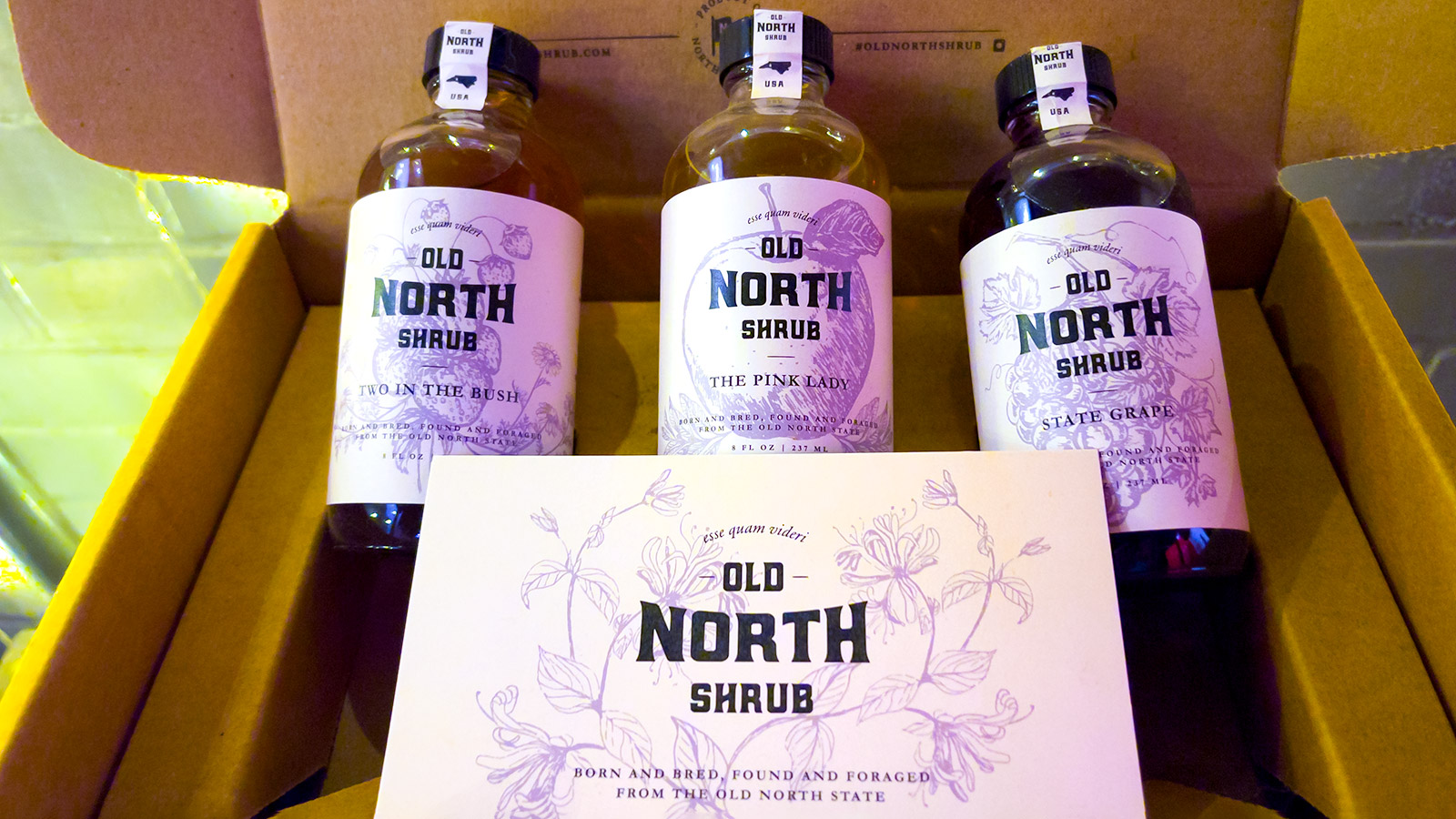
Jamie Swofford uses all NC ingredients to create his shrubs. TM Petaccia/UP
Along the way, Swofford managed to build a beverage brand, too. In 2015, Jason, Jeff, and Sarah Alexander, who co-own Free Range Brewing, invited Swofford to develop a nonalcoholic drink option for when they opened the brewery. Swofford went down “the rabbit hole of vinegar-based beverages.” They weren’t new to him. His grandmother claimed that a capful of vinegar would keep mosquitoes at bay when Swofford played outside as a child.He leaned on his agriculture community, sourcing blackberries, strawberries, and muscadine grapes from local farmers. He grows other shrub ingredients himself: ginger, turmeric, hibiscus. The shrubs are rooted in place, the product of “modern North Carolina ingredients using century-old techniques.” They took off. In April, his State Grape Shrub won a Good Food Award, and Swofford has picked up customers as far away as the West Coast.
Forty miles west of Charlotte, in a historically insular rural area, the farm fosters a diverse community. “At all of our events, we have Black and queer and brown and people of all colors and ways of life,” Swofford says. OnMay 28, the couple is hosting Chef Awo Amenumey on the farm for a pop-up Ghanaian dinner. A lot of locals, Swofford says, “have never seen anything like that.”
When Swofford returned to the farm, his grandfather, he says, “was still around, and he took it upon himself to become my farming mentor.” One of the first things he said was that Swofford needed to keep another job, because there’s just not enough money in farming. (His grandfather was a full-time welder.) Swofford calls it an old-timer’s mentality: that the only way to profit is to have a thousand acres dedicated to corn or soybean monocultures. “Just in defiance of him, I said, ‘Well, I think I can just keep on doing it.’”
The mentorship didn’t always run smoothly. At one point, they went a year without speaking. But Swofford values his wisdom, and his grandfather, he says, “admired what I was trying to do.” He died in 2016, but Swofford says his presence remains on their land, where old ways of farming have given way to new.
“I feel a lot of responsibility, both to my family and to the people, our customers in the community around us. When we came to this area and to this space — it’s very conservative,” he says.
“What we brought is a vision of a different world.”