
Hidden gem in Charlotte’s Oakhurst neighborhood where the menu is as creative as the food
Hidden gem in Charlotte’s Oakhurst neighborhood where the menu is as creative as the food


Charlotte cooks share secrets for more environmentally-sound ways with food and drink
We at UP are rounding up some of Charlotte’s best to give their best take on everything from devilishly good deviled eggs to the crispiest chicken wings. This time, they’re taking a break from the kitchen to chime in on the subject of culinary sustainability. Editor’s note: Responses have been edited for clarity and brevity.
Earth Day is April 22, but it should be observed each day. It’s the small changes, collectively, that create impact. That’s why we are departing from our regular format for this month’s Chef’s Takes. Instead, we will closely examine green culinary approaches over three segments, from three Charlotte food and beverage industry pros. These three cooks, including one mixologist, will be sharing tips beyond the obvious and tired, culled from ways they practice sustainability in day-to-day operations.
Their different vantage points all strive towards a common goal: turning a carbon footprint into more of a toeprint. Reducing food waste and overreliance on animal meat as a primary protein source are both worthwhile steps to take in decreasing overall ozone-depleting gas emissions.
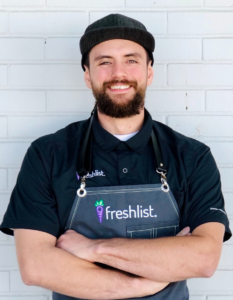
In Chef’s Takes, we ask, they answer, and you benefit from pro tips and insights. Here’s what our first expert, Chef Matt Martin, has to say on being better stewards of produce and keeping it as far away from the landfills as possible. Freshlist delivers fresh food from local farmers and food makers to professional and home kitchens throughout the greater Charlotte region.
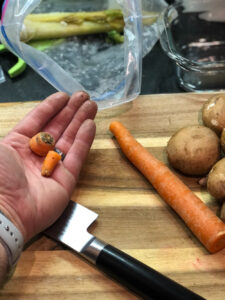
Making vegetable scrap stock. Courtesy of Matt Martin
Experimenting and being creative when it comes to scraps. Not only can that lead to interesting flavors, textures, or food ideas, it is a way to maximize cost. When you can make flavorful broths from mushroom remnants or syrups for the bar from peels, you’re increasing the ability to use a whole product and stretching the return you get from a purchase. It’s the head-to-tail approach commonly seen with butchery, but applied to vegetables as well.
One of the biggest things we do is work off of a model where food is not brought into our facility without it having a final destination. This is one of the biggest differences between Freshlist and other food providers. Our model is pick-to-order, which vastly helps us provide a fresher product with less waste. Another intentional component to our approach is working with The Bulb mobile market. They rescue food that may not be supermarket “perfect” but is still nutritionally viable. The Bulb staff get these foods to people in food deserts around our area. Then, of course, there will always be a “bad apple” or spoilage, so we compost everything we can through our friends at Crown Town Compost. The main goal is to be intentional in what you’re doing to proactively avoid producing waste, as much as possible.
I strive to create sustainable abundance. To know we limit our waste as much as possible is something we at Freshlist pride ourselves on. Being intentional about how we handle this has been a founding principle since the business’s inception.
Using a home compost is a great start; you can also utilize the services of Crown Town Compost very easily. It’s cool to see how many things can be turned back into soil, which then can obviously be used to create new produce. A win-win.
Everyone should try to create a meal plan, stick with it, utilize leftovers for new dishes, be creative, and have fun. Find something that is about to go bad and freeze it instead of tossing; keep a bag in your freezer where you can add vegetable tops and bottoms to make your own vegetable stock. Take pride in creating as little waste as possible. It’s important, and can also save you money.
There really is no “recipe,” but I try to use roughly 2 parts onion to 1 part carrot and celery, combined. Then I add in peppercorns, thyme, parsley, a few bay leaves, and whatever vegetable scraps I have frozen. Avoid adding any cruciferous vegetables like broccoli and cauliflower or tomatoes, because they turn the stock cloudy and smelly. Once you’ve gathered the ingredients, brown those in a 6-quart stock pot, simmer in water for 1 to 2 hours or until the vegetables have sunken and the broth has darkened. Finally, strain and use as needed –– freezing the rest, of course!
Want intel on a certain cooking technique or culinary topic? Let us know in the comments, and we’ll get the scoop from Charlotte’s food and beverage maestros.
You can catch Chef Matt Martin conducting a cooking demo at Charlotte StrEATs Festival on Saturday, April 16. He’ll be on stage at 1:25 pm, directly before celebrity Food Network chef Amanda Freitag joins the lineup at 2 pm. The Bulb will also be on site engaging young people to help them connect the dots between food, environmentalism, and the city where they reside as part of the StrEATs Festival Family Night. Stop by their booth on Friday, April 15 between 5:00 and 8:30 pm at Gateway Village (900 W. Trade St.). Get your tickets and check out the full schedule for this don’t-miss event.













I love the idea of a vegetable scrap stock. My friend who is now a chef did this in high school when we were kids and I never tried it myself. Is it OK to freeze mushroom scraps? And can I include the onion skin or should I only use the end after I have peeled it?
Hi there! We reached out to Matt with your questions; here is what he had to say: “I think it’s perfectly fine to freeze the mushrooms for the stock. I would refrain from freezing them for any other use, as in if it is about to go bad and you need a way to preserve it, I would favor dehydrating it in that scenario. And you can for sure include the onion skin. The skins may make your stock a bit darker, but that isn’t an issue!”