

July 21, 2020
For Uptown restaurants, Covid’s effect is amplified
A dearth of businesspeople, tourists is shaking up business models
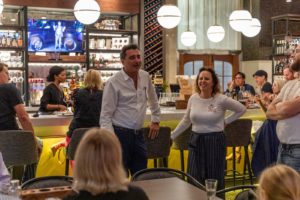
Pierre Bader, left, is the owner of Aria and Cicchetti in Uptown. Photo by Peter Taylor/Peter Taylor Photography
Restaurants everywhere are struggling to adjust their business models to the ongoing Covid-19 pandemic. Many are bringing in just enough revenue to get by in phase two of the state’s reopening plan, and are hoping North Carolina isn’t forced to revert back to a stay-at-home order. With Uptown office towers remaining nearly empty for the foreseeable future, however, restaurant owners that depend on lunch service and happy hours packed with the 9-to-5 crowd are left with fewer diners and some of the city’s most expensive leases.
Aria is a 7,000-square-foot Italian restaurant owned by Pierre Bader. It’s been in business in the Bank of America Corporate Center for a decade, and is regularly packed with diners. The rush of diners is necessary in order to offset the cost of operating such a big space amid the city’s prime real estate. With all of Uptown’s draws — office buildings, museums, hotels — quiet, and dining rooms operating at half-capacity, getting enough diners in the door is impossible.
“Our model basically is to feed lunch to the 100,000 people that come in downtown Charlotte every day,” Bader says. “And that business model doesn’t work if there is nobody downtown to eat lunch.”
William Dissen, owner of Haymaker, was one of the first local restaurateurs to close his dining room due to Covid-19. His restaurant on Romare Bearden Park focuses on seasonal ingredients, and draws many visitors — whether they’re checking out Charlotte for the first time or making a trip into town from the suburbs.
“Certainly a big part of our business is the business crowd … tourism also,” Dissen says. “We get a lot of folks that are business tourists or pleasure tourists coming Uptown to go see a play or a concert or a game, and a lot of those folks are not gonna be traveling a lot, not staying in hotels.”
At Haymaker, Dissen is looking to diversify their sales by adding delivery to apartment buildings. The restaurant is also offering curb-side delivery and takeout.
“We’re definitely — the verb that everybody is using — we’re going to be pivoting and doing our best to make the best of this and keep our business afloat,” he says.
For Bader, opening to the current demand covers some of the bills, but isn’t a sustainable operation. Aria’s famously large menu has been trimmed down to make prep easier, and the restaurant is doing curb-side delivery as well as dine-in service. The income is helping to cover bills like health insurance for the staff he’s kept on, phone and internet for the restaurant, and utilities.
“Our location is very dependent on the theater,” Bader says. “It’s very dependent on the business traveler. It’s very dependent on the conventions. It’s very dependent on hotels and businesses and this and that. And those guys are not there. We’re not in the healthiest shape that we could be.”
According to Bader, it’s cheaper to remain closed, but he also doesn’t want his restaurant to be the only one that hasn’t reopened.
“It’s almost a trap, I call it,” he says.
Both Bader and Dissen oversaw restaurants through the Great Recession, and Dissen says he’s confident his restaurant will make it through the ongoing pandemic, as well. Bader’s biggest fear is the uncertainty of when things will return to normal, which makes it hard to come up with a plan for survival.
“The theaters are closed. The arena is closed. The concerts are closed. Conventions are closed,” Bader says. “There is a lot of closure that restaurants do rely on. And then on top of that, you’re telling people that it’s 50 percent capacity. These businesses like ours, like Aria’s 7,000 square feet, it was modeled to be a busy restaurant. It was modeled to have 200 people for lunch. It was modeled to have 300 people for dinner. And all of the sudden you’re reducing this capacity to very minimum.”
Already in Uptown, La Belle Helene, Queen City Q, and Fitzgerald’s have permanently closed. —Kristen Wile