Hidden gem in Charlotte’s Oakhurst neighborhood where the menu is as creative as the food
Hidden gem in Charlotte’s Oakhurst neighborhood where the menu is as creative as the food


Haymaker’s William Dissen explains the Appalachian ingredient
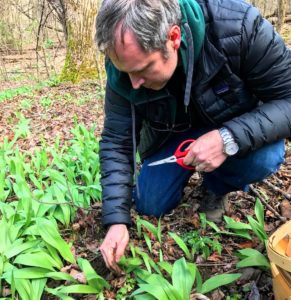
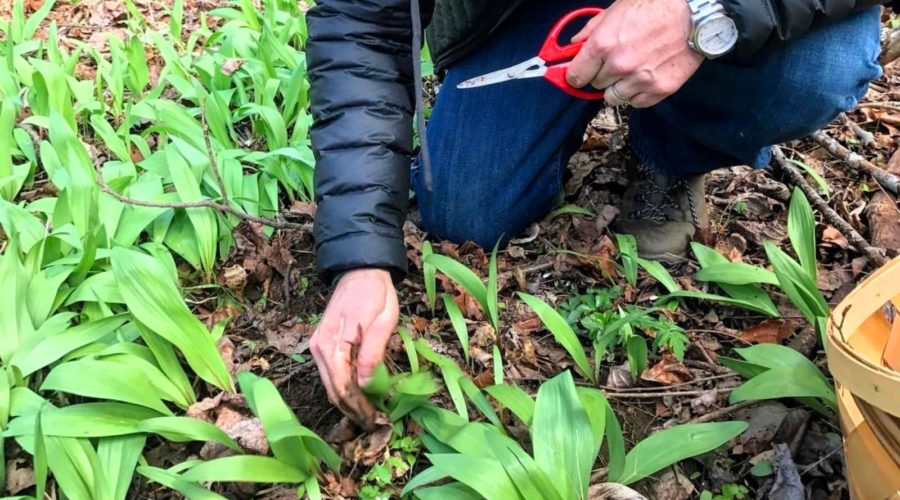
Haymaker chef and owner William Dissen forages for ramps outside of Asheville. Photo courtesy
One of the first indicators that spring has arrived is the presence of ramps on nearly every locally sourced menu around town. You’ll find them grilled, puréed, and over this and that. But what are they? We asked owner and executive chef of Haymaker William Dissen what, exactly, a ramp is and what makes the wild ingredient so special. —Kristen Wile
Unpretentious Palate: What is a ramp?
Chef William Dissen: The Latin name is Allium tricoccum, so it’s in the Allium, or onion, family. I like to tell people it’s like a cross between garlic and wild leeks.
UP: Why are ramps so popular with chefs?
WD: The thing with chefs and restaurants is we’re always searching for a unique product or a unique dish to spark people’s interest and create excitement amongst our guests. And ramps have been around forever, but I think in the culinary community and chef-driven restaurants have become a hot ingredient over the past decade because it’s an ingredient that mainly you can only find in the wild. It can be cultivated, but is very, very difficult to cultivate, and so it’s a rare ingredient, like getting truffles or something along that line. Typically it’s only available for four to five weeks a year, that’s it. So you get what you get.
UP: How are they used?
WD: I like them just gently tossed in olive oil and a little salt and grilled over a wood fire as a garnish for a dish. I think that’s really nice, almost like grilling a spring onion. We use them for a lot of different applications. We’ll ferment them like kimchi; I’ve got some ramp kimchi in my restaurant The Market Place [in Asheville] that’s over two years old and is just a perfect amount of funk and perfect amount of ramp/onion flavor. I think they’re really great for purées and pestos also. You make a standard pesto, but instead of basil, we typically cut it with a little bit of fresh arugula and then obviously we’re not adding any garlic to it, because the ramps have that flavor covered. That’s really delicious. Something I do to try and preserve the ingredient and the flavor for the year is to make a purée and pesto and then vacuum seal it and freeze it. We also will take the bulbs and pickle and can them. To me, that’s really a delicacy, the pickled bulbs.
UP: When is ramp season, and how long does it run?
WD: I had an old-timer where I’m from in West Virginia tell me that Tax Day is ramp day. Typically, they’re available and you start seeing posts on social media in late March and early April, but the ramps are immature at that point. They start hitting their maturity in our region around Tax Day, around the middle of April, and then they’ll go until, if we’re lucky, the first week of May.
UP: How many do you cook with each year?
WD: Between Market Place and Haymaker, I’ll probably buy 400, maybe 500 pounds of ramps this year.
UP: Are ramps a North Carolina thing?
WD: Ramps are definitely an Appalachian thing. They do not grow in lower elevations like around Charlotte. You need the higher mountain altitude and cooler temperatures. They grow all over the place — in England, if you’re over there in the spring, they’ll talk about ramson, which are ramps. They grow up into Canada as well, and you can find them some in the Midwest even. But Appalachia, really central Appalachia in particular, is the epicenter of it.
UP: Are there any sustainability concerns with how many ramps we eat?
WD: A lot of folks, when they go into the mountains to go get the ramps, you come upon a mountainside and literally it’s, you know, 10 acres of ramps just going up and down the hill. You think, ‘Well, gosh, there’s so many, let’s just yank them out as fast as we can.’ They’re not cutting them, they’re literally pulling the whole plant out of the ground, roots and all. But if you read [this Facebook post from Zero Acres Farm], what the guy’s saying is typically when you cut them, you want to get your fingers under the ground and imagine a spring onion, where the root starts on a spring onion almost looks exactly the same for a ramp. You want to get underneath that and cut it, leaving the roots intact in the ground, so you’re almost cutting the tip of that bulb off and leaving it there intact. That allows the root system to stay in and for the organism to keep replenishing year after year.
UP: If you’re a consumer at the farmers’ market, what should you ask to make sure the ones you’re purchasing were harvested properly?
WD: If you see them at the market, you’ll know typically first just looking at them if they’re sustainable. If [they haven’t been properly harvested], they’re sitting there and they’ve got six inches of roots hanging out off the bottom. If they’re a little more cleaned up and they look more like the standard spring onion, the ones you get at the grocery stores with the nice clean bulbs, then you can ask the purveyor or forager, ‘Do you know if these were sustainably harvested?’ It’s almost the same thing if you were going to the fish monger, asking ‘Hey, where’s the red snapper from? Do you know if it was sustainably harvested?’ Informed consumers should ask questions like that.
Got more questions about ramps? Shoot us an email and we’ll answer them in our weekly Q&A!