Hidden gem in Charlotte’s Oakhurst neighborhood where the menu is as creative as the food
Hidden gem in Charlotte’s Oakhurst neighborhood where the menu is as creative as the food


A whirlwind farm tour showcases innovation in an area of the state not known for its agriculture
By Allison Braden
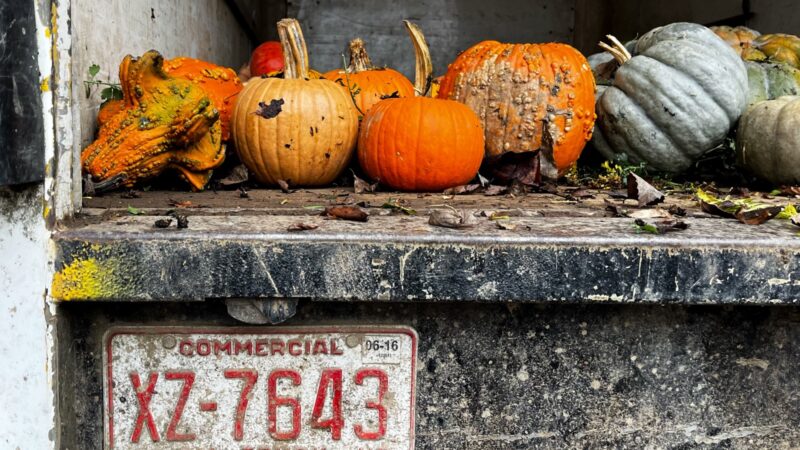
Darnell Farms’ Nate Darnell has been trying to save farmland in southern Appalachia. Photo courtesy
In November, Leah McGrath hosted a weekend event to showcase the diversity of farms in westernmost North Carolina, a mountainous region whose agricultural contributions are often overshadowed by big producers down east. McGrath is staff dietician for regional grocery chain Ingles, but she conceived and organized the event — Best of the West NC — as a passion project, not associated with her employer. Feed the Dialogue NC, an organization that fosters conversation and connection between farmers and the public, and the North Carolina Department of Agriculture signed on as sponsors, and attendees included representatives from those organizations along with a few journalists, academics, and the director of communications for the North Carolina Farm Bureau, which lobbies for the industry.
This merry band set out on a blustery Saturday to visit three farms, which have responded in distinct ways to the challenges facing small producers. These farmers must negotiate a complex web of incentives and pressures to survive and profit. Our short visits provided insight into how they’ve navigated, but for the layperson, they were snapshots without context. They hinted at the vast complexity of agriculture in America, a landscape difficult for the layperson to understand. Our series of meet-and-greets didn’t aim to fully illuminate the big picture, and it’s unlikely that any farm tour ever could.
Without pushing a particular point of view, the tour interrogated my assumptions, showcased a variety of perspectives, and deepened my appreciation for the diversity of North Carolina agriculture. Each of the farms below illustrate the challenges facing modern farmers — and the strategies they’ve chosen to survive.
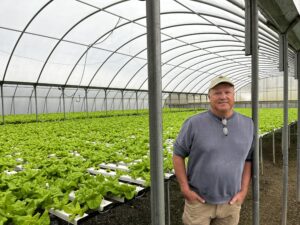
William Shelton has supplied Ingles with hydroponic Bibb lettuce for more than three decades. “Thank God for Ingles,” he says. Photo courtesy
William Shelton runs one of western North Carolina’s oldest continuously operated farms. With a bachelor’s degree in plant and soil science from the University of Tennessee at Knoxville, he took over the family farm in 1984. Early on, he shifted the farm’s focus away from tobacco, and now grows strawberries, cucumbers, and squash. He’s supplied Ingles and Blue Apron with tomatoes, and he’s harvested hydroponic Bibb lettuce every week since 1986. A traditional, non-organic farmer, Shelton acknowledges that, in a perfect world, organic practices would be standard, but he says that route has remained economically infeasible for him. His land, not far from Great Smoky Mountains National Park, has been in his family for four generations. Though he has children, he’s not sure whether the fifth generation will keep the farm going.
The country’s small family farms are disappearing. The number of farms in the U.S. peaked at 6.8 million in 1935, 15 years after Shelton’s great-grandfather purchased his land. The average age of farmers has crept up, from 52 to nearly 60, in the last couple of decades, and they often retire without anyone willing to take over. Farm expenses rise, and profits dwindle. “It has been estimated that living expenses for the average farm family exceed $47,000 per year,” according to a 2018 Environmental Protection Agency report. “Clearly, many farms that meet the U.S. Census’ definition would not produce sufficient income to meet farm family living expenses. In fact, fewer than 1 in 4 of the farms in this country produce gross revenues in excess of $50,000.” The U.S. Bureau of Labor Statistics projects that sector employment will decline by another 3 percent in the next decade. Shelton’s children may represent part of that exodus. “They’re all seeking their fortunes in plastics,” Shelton says, referencing It’s a Wonderful Life, “and I’m here fighting the battle of Bedford Falls.”

Nate Darnell manages Darnell Farms’ 100 acres and still finds time to welcome visitors, lead hayrides, and be a farming ambassador online. Photo courtesy
Like farmers, farmland is vanishing too. North Carolina has 8 million acres of farmland, ranking 31st among U.S. states and representing 1 percent of the country’s farmland. The American Farmland Trust lists North Carolina as the second-most threatened state, after Texas, in terms of potential farmland loss in the next 20 years. If development continues apace, in North Carolina, just over a million acres will transition from agriculture to other uses. According to the N.C. Department of Agriculture, the state lost 2,200 farms and 210,000 farm acres between 2012 and 2016. Nevertheless, agriculture remains North Carolina’s biggest industry.
Conservation easements — a legal agreement with a land trust or government that restricts the land’s use in perpetuity — help protect farms. Land trusts use state and federal funding, as well as private donations, to establish easements and monitor the land’s agricultural use. Farmers have to meet certain land use restrictions but retain ownership of their land.
In the 1970s, Jeff Darnell saw that farmland in southern Appalachia — already scarce thanks to mountainous terrain — was disappearing. He leased property in Swain County, in Tuckasegee River bottomlands, in 1982. The farm now encompasses 100 acres that the family is working to conserve through the Mainspring Conservation Trust. Today, Jeff’s children, Nate Darnell and Afton Roberts, run the farm, which produces strawberries, beans, corn, pumpkins, squash, and tomatoes. They’ve adopted agritourism as another survival strategy. The farm is open to visitors seven days a week, February through December, and hosts concerts, pick-your-own events, hayrides, and food trucks. Nate has embraced his role as an ambassador; online, he’s known as Nate the Farmer and shares videos on everything from cooking ramps to crop frost protection.
Wood Farm
Andrews

Ed Wood looks at aerial photos that show how U.S. Highway 74 bisected his family farm. Photo courtesy
The Wood Farm sits in a challenging environment for agriculture. In a high mountain valley of Cherokee County, Ed Wood manages to produce 200 bushels of corn and 70 bushels of soybeans per acre, a yield that routinely nets him state and national yield awards. The valley runs east to west, however, creating heavy fog up to 200 feet above ground during the summer. The fog traps moisture near the ground then burns off, making the farm an ideal incubator for gray leafspot, a fungus that devastates corn crops. Pioneer, a GMO seed producer; Monsanto, an agrichemical company and GMO seed producer acquired by Bayer in 2016; and BASF, a chemical company, have all rented land from Wood to conduct fungicide tests. Pesticides and fungicides are essential to Wood’s high yields.
Wood’s grandfather established the farm during the Great Depression, and on top of row crops, it was home to a dairy and livestock operation, a blacksmith shop, tenant housing for workers, and, remarkably, its own electrical supply. Wood’s grandfather dammed a stream and built a small generating plant to power farm buildings. The farm has since lost ground to a small airport, owned by Cherokee County, and U.S. Highway 74, which slices through the family farm. The four-lane highway created a number of tight corners where it’s impossible to operate a combine, taking more land out of production than just the acreage required to build the road. Wood says his operation could conceivably farm twice the land it does now, but it’s simply not available.
North Carolina’s livestock industry, particularly poultry producers, provides a constant demand for grain, which the state’s farmers have been unable to meet. North Carolina’s hogs, chickens, and turkeys require about 310 million bushels of feed grain annually, just half of which comes from in-state farmers. Between 2016 and 2020, major row crop acreage declined 17 percent, and feed grain acreage declined 28 percent.
Leaning against a farm warehouse at the edge of the airstrip, Wood is soft-spoken and self-effacing, embodying the romantic conception of the hardworking family farmer. He points out that in 1935, when the number of U.S. farms peaked, there was one farm for every 19 Americans. Today, there is one farm for every 166 people. In 1840, farm workers made up 70 percent of the population; today, ranchers and farmers account for just 1 percent. They’ve had to innovate and evolve to feed the people who zip past on the highway, on their way to camp at Smoky Mountains National Park or raft the nearby Nantahala River. Wood says, “We’re still the best in the world at what we do.”