Hidden gem in Charlotte’s Oakhurst neighborhood where the menu is as creative as the food
Hidden gem in Charlotte’s Oakhurst neighborhood where the menu is as creative as the food


Three local pitmasters share their expert advice
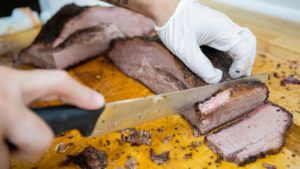
Lewis Donald slices barbecue fresh off the smoker at Sweet Lew’s. Photo by Peter Taylor.
It’s Fourth of July week, which means firing up (or the debut of) smokers for a lot of Southerners. We reached out to some of the city’s best pitmasters to get some tips on how to get the best barbecue at home. Offering their advice is Lewis Donald, chef and owner of Sweet Lew’s Barbecue; Kevin Kurac, the executive chef and pitmaster at Mac’s Speed Shop, and Matt Barry, pitmaster at Midwood Smokehouse. Have more questions? Send them our way for our next Concierge, and we’ll get them answered! —Kristen Wile
What smoker would you recommend for a first-timer to use at home?
Lewis: I personally like the mini offset. It’s cheap, and no gas or electricity!
Kevin: Smokers can get very expensive. Until you find your groove, a propane grill with a wood chip box or any inexpensive Weber type charcoal grill will work. Having a really good thermometer is most important. Doing some research on BBQ cooking websites is important too. BBQ is easiest to learn if you think of it as chemistry instead of cooking.
What kind of wood is best?
Lewis: I suggest starting with charcoal and using pecan and hickory chunks.
Kevin: I prefer hickory. Oak is a close second, especially for beef.
Matt: Hickory — just the opinion of a North Carolinia native.
What’s the best meat to learn with?
Lewis: Meats are expensive! Chicken, then pork butt, then ribs. Brisket last. Brisket is more expensive because of its weight, and the hardest to cook.
Kevin: A pork butt is the most forgiving and best tasting meat to learn with. Chicken thighs are good too if you don’t have a lot of time.
Matt: Whole chicken for quick leaning. Learn how to control temperature on this, because a high temperature won’t necessarily ruin a chicken like ribs or a brisket. Use pork butt for that first long cook.
What tips can you give about temperature?
Lewis: I suggest smoking at a lower temperature, 225 to 250 degrees. The temperatures of the meats are exactly that; you can’t mess with it. Chicken: 165 degrees, rest. Pork: 190 degrees, rest. Ribs: four-hour smoke, then 90 minutes wrapped in foil, then rest. Brisket: 195 degrees, rest for one hour, then wrap and continue to rest to 165 degrees, then hold hot.
Kevin: Temperature comes down to controlling air flow via the vents. Each smoker is different but if you start wide open and then back down the vents generally you will get good results. Having a heated smoker is key. After it gets to the target range, it’s just maintaining coals.
Matt: Keep the temperature as consistent as possible. If you want to cook at 250 degrees, then cook at 250 degrees. Going back and forth between 200 and 300 degrees will produce an uneven cook.
What tips can you give about timing?
Lewis: You can’t rush cooking with wood. Other than chicken or ribs, I suggest giving yourself plenty of leeway in regards to when you’re serving — hence why it’s done overnight. You can always hold it hot; you can never cook it faster.
Kevin: Timing is about maintenance of the smoker and the temperature of the meat. The use of a great thermometer lets you know what is going on inside. Timing is about being observant and keeping the heat steady.
Matt: Don’t be impatient—it’s done when it’s done. You can’t rush it.
What tips can you give about seasoning or rubs?
Lewis: I personally like salt and pepper only. If you’re smoking, you want to taste the smoke. Use coarse ground pepper. If you’re using a rub, keep in mind that sugar burns!
Kevin: Starting simple with rubs is best. Salt and pepper are amazing when smoke is added. It’s really about trusting your tastebuds. If it tastes good to you, then it’s good. Just keep tasting until you find your favorite.
Matt: Don’t just sprinkle it on, rub it in.
What do you love about the process of smoking meat?
Lewis: It’s one of the oldest forms of cooking.
Kevin: My love of the smoking process involves my love of cooking. With just a few raw ingredients and some hickory wood I can forget about the little stuff for awhile. It’s a throwback to a simpler time. Tasting bbq just off the smoker is an experience everyone should have. It’s one of life’s gifts if you have some time to treat yourself and others.
Matt: The whole process. It’s not just one step or a quick fix. It takes planning, patience, and execution. When you put that much time and thought into preparing an item it makes it that much better when it’s done. Also you don’t smoke meat just for yourself. It’s meant to be shared and that for me is the best part.