


May 11, 2021
Scared seafoodless after “Seaspiracy?”
A local expert in seafood sustainability shares his thoughts
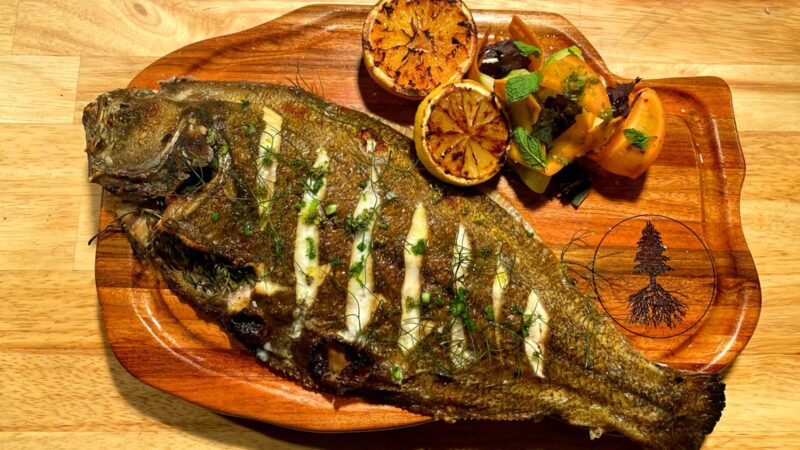
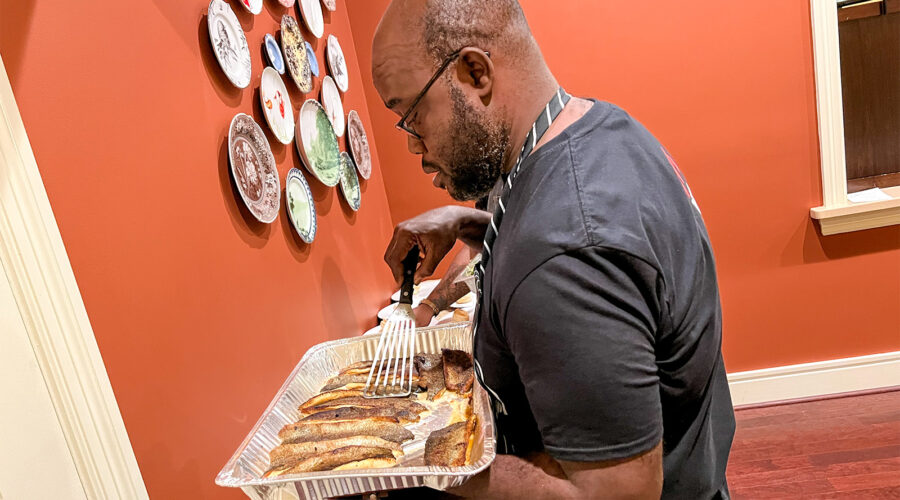
Buying whole fish gives you more chances to tell how fresh it is, according to chef William Dissen of Haymaker. Kristen Wile/UP
Now airing on Netflix, the documentary Seaspiracy examines the seafood industry. The filmmakers bring to light some of the controversies behind the seafood trade, including mislabeled products and the human cost of convenient shrimp cocktail. Even as seafood-heavy Mediterranean diets gain in popularity, however, the documentary has scared many consumers away from seafood. We spoke with Uptown restaurant Haymaker’s chef/owner William Dissen to get his thoughts on the documentary and concerns about the seafood industry. Dissen is active in conversations about sustainability in food, including seafood specifically as a partner with the Monterey Bay Aquarium Seafood Watch and part of its Blue Ribbon task force of chefs. He has also cooked at a James Beard House dinner highlighting sustainable seafood.
Unpretentious Palate: Let’s start with your thoughts on the documentary itself.
Chef William Dissen: It was obviously an interesting dive into the seafood market and how fish gets from sea to table. As a chef, if you buy a lot of seafood and know where your seafood’s coming from, you also know there’s not a lot of transparency in seafood, and that the market is a little bit clandestine, a little bit shady. It takes an educated buyer to understand what you’re getting, where it’s coming from, because a lot of times things get greenwashed. You’re told you’re getting X, but you’re getting Y. I’ve had fishmongers before try to sell me red snapper that’s actually red grouper or red drum. And I’m saying, “Look, I know what I’m getting. This is not the right fish.” We end up sending it back and it creates a little bit of hoopla.
With the movie, I think they dove into that topic about, where’s your seafood come from? Is it actually as sustainable as you think it is? I think it was a great topic to try to bring into the forefront in media. But I also believe that the filmmaker has an agenda, and I personally think the movie was one-sided and really was propaganda.

Chef William Dissen in Haymaker Restaurant. Photo by Peter Taylor
UP: What would you tell people who are wary of seafood after seeing the film?
WD: Be an educated consumer. Follow the science. I like Seafood Watch because it works in conjunction with NOAA to get information from the scientists running our federal fisheries. I look to them for information about how federal fisheries are being managed, where the fish is coming from, how abundant are the fish? How clean are the waters we’re sourcing the seafood from? I feel like they have no agenda to whitewash anything; they want to give the facts to give us the choice of how we’re eating and where it’s coming from and to ensure we don’t make any species of seafood go extinct. I feel like that’s where the buck stops in terms of understanding seafood management, sustainable seafood, and what’s the best fish to put on my menu at my restaurant. Why would I look anywhere else?
UP: I want to revisit the statement you made about sometimes even you get fish that’s been wrongly labeled. Where is that mistake coming from? Is it the fishmonger or is it more the entire supply chain?
WD: I believe all the above. I’ve sent back thousands and thousands of pounds of seafood over the years because it’s not what I ordered and somebody is trying to pawn it off as something else. The other thing, it’s a trust in your fishmonger. Hypothetically, the snapper example, I’m ordering American red snapper from Wilmington, North Carolina. How am I to know the fish came from North Carolina? It could have come from Costa Rica, could have come from the Gulf of Mexico, could’ve come from Florida. I’m trusting that when I order the fish that the fishmonger has truth in the origin of the product. Was it caught hook in line or was it purse seined or dragnet? How was the fish caught?
UP: Your knowledge is going to be significantly more than what an educated home consumer’s would be. What tips can you share on buying seafood that’s sustainable — and making sure it’s the real thing?
WD: Super easy. Go to seafoodwatch.org and type in the species of fish that you’re interested in buying. They have a stoplight approach to how they rate their seafood. Green is the best choice. Yellow’s a good alternative. And then red is avoid. In my opinion, if you want to eat sustainably, you should be eating the seafood that is on the green or the yellow list and always avoid anything that’s on the red list because that means the seafood is being overfished, or there’s an ecological problem in the fishery you may want to avoid because of toxins or red tide or something along those lines.
You always want to go to a fishmonger or the grocery store and say, “Where’d the fish come from? How was it harvested and is it sustainable?” Then you can double check your work by using seafoodwatch.org to make sure that there’s transparency there.
In terms of getting fresh fish and knowing how fresh the fish is out of the water, I always recommend buying the whole thing because you can smell the fish. If it smells like the ocean and has a little bit of a sweet smell to it, that means it’s fresh. You look at its eyes and if the eyes are clear and not cloudy, that’s fresh out of the water. And then you can take a look at the gills. If the gills are bright red, that means it’s fresher. If they’re gray and drab-looking, it’s older.
UP: What would you say is one fish people should be eating more?
WD: Some of the best fish to eat is actually farmed seafood. And I know that has a bad reputation because of some bad fishing practices, kind of like eating Tyson chicken, surrounding some of the farmed Atlantic salmon that’s out there. You think about the Tyson chicken — you’ve got all these chicken in a tiny little pen. Historically, some of the farm fisheries were doing some of the same things with seafood, and then because they’re so close together and swimming in their own excrement, they have to pump them full of antibiotics. A lot of that has changed in the past few years.
There are some new farm fisheries that are really doing great work. One of them I’m near and dear to is Sunburst Trout in Canton, North Carolina. They are really like the first civilization coming out of the Shining Rock watershed out of Pisgah National Forest. And you have this beautiful mountain water coming filtered through granite rocks. That’s what they’re using to feed their trout runs to farm their fish — really clean water.
Salmon is one that everyone loves, but to get wild Alaskan salmon, there’s a very small window for it — summer through early fall. Atlantic salmon wild really isn’t a thing anymore, it’s been so overfished. So there’s farmed salmon, but maybe the salmon farms are not really doing it properly. I was recently introduced to a new one around Hollywood, Florida, called Blue House Salmon, and it’s a farmed Atlantic salmon. It’s one of the only farmed salmons considered a Seafood Watch Best Choice in North America. It’s really delicious, a really well-run program. They’re just getting off the ground, but I’m really excited for that salmon farm to get going.
Any farmed bivalves — like oysters, mussels, clams — are excellent. They’re extremely good for the eco-system, because they filter the water. Historically, a lot of our coastline up and down the whole East Coast was a lot of the bays, and some of them you couldn’t get through because there were shoals of oysters in the sounds. With development and farming and different things, we’ve lost a lot of those. So it’s neat to go and see a lot of these oyster and clam and mussel farms that are starting, especially here in the Carolinas.
UP: What’s one fish that you tell people to avoid and a good alternative for it?
WD: Bluefin tuna is one to tell people to avoid. It’s one of the most widely overfished tunas in the world, specifically because of the sushi market. Some places in the world, they’ve been doing a better job managing it. So it’s just starting to be yellow listed in some parts of the country and in the world now. But I feel like it’s too new on that, and we need to give it some time to start to rebound more population. Five years ago, it had been overfished to the point of near extinction.
Yellowfin tuna is considered a yellow-listed seafood that is relatively plentiful. There’s also the Pacific albacore tuna, which most people associate with canned tuna. But it’s delicious also raw seared to rare too. It’s one of my favorites as well.