


October 11, 2023
Old Forester’s Master Taster on N.C. picks, dusties, and if bourbons were beers
Melissa Rift will host meals and sign bottles
by Kristen Wile
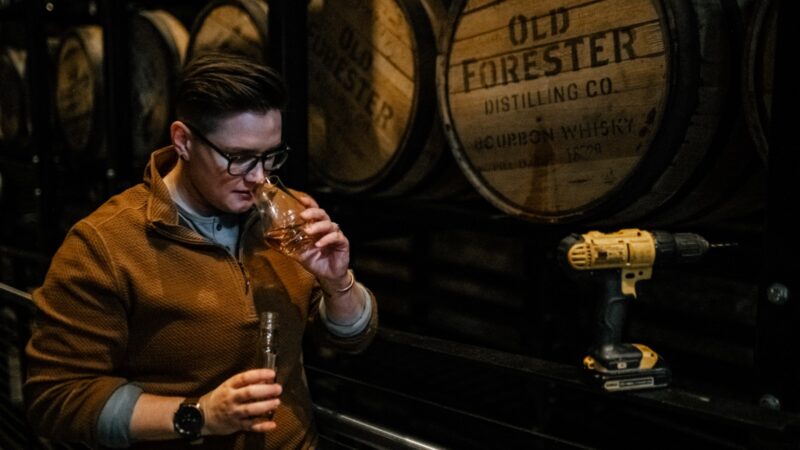
Melissa Rift, Old Forester Master Taster, will be in town for events and a bottle signing. Photo courtesy
Old Forester’s master taster Melissa Rift will make her first visit to Charlotte next week, meeting both bar industry and non-industry bourbon lovers while here. The Louisville native will share her knowledge of both Old Forester and bourbon history, with several public events, including a ticketed dinner at Dean’s Steakhouse on Sunday evening, featuring a five-course meal and whiskey tasting led by Rift. On Monday, Oct. 16, Rift will be at the Cotswold ABC Store for a bottle signing.
Ahead of her trip, we spoke to Rift about the difference in how chefs select barrels, how vintage bourbons or “dusties” taste different, and how the distillery is responding to the rapidly shifting demand for aged bourbon. This interview has been edited for clarity and brevity.
Unpretentious Palate: Charlotte has a booming craft beer scene. If somebody is into beer but not yet a huge whiskey drinker and wants to be, how would you compare various expressions to a style of beer?
Melissa Rift: I love this question. I’m a big craft beer drinker myself. Beginners, I would always say start with our Old Forester 86. It’s our core expression of Old Forester, it should be the most available, it should be behind every bar that you go to, and it’s 86 proof — a really accessible proof for people who are just getting into it, especially if you’re not a big distilled spirits drinker. In the grand scheme of Old Forester products, I’d say that’s like a Hefeweizen. It’s going to be nice and light and balanced. It’s going to have really good complexity of flavor, but accessible for people that aren’t looking for something really bold or really spicy or really out there.
I also love our Signature 100 proof, which is our other core expression. The 86 proof has a lot of that citrus on the front, a little bit of clove spice on the back. The 100 proof has a lot of vanilla and caramels and richer fruits. It’s great for mixing cocktails at home. It’s really nice if you want a bit of bolder flavor. If I had to choose a beer for that one, I’d say it’s more like an Amber Bock style that has roastiness, nuttiness, maltiness. That’s my favorite style of beer. Those are both going to be super available, and also those are going to be really affordable options.
Our craft series, the Whiskey Row Series, is a great portfolio for people to get into. It’s got a lot of momentum around the country right now because people are really into craft whiskey. So we’ve got four expressions with that one, all named after different benchmark years in our company’s history. For those who like storytelling to accompany their imbibement, that’s a great series because you can get into why we’ve named them after those years, and also the flavor profiles behind them. The whole series is great, but I’ll call out the 1910. It’s a fan favorite. It’s our double barrel expression. It’s tied to a story about in 1910, there was a fire in our historic Whiskey Row building, and Old Forester kind of by accident created the first double barrel expression of bourbon. Today, we fully mature whiskey, we process it, proof it to 100 proof, and then we dump it into a secondary new charred oak barrel and we finish it for an extra year. It takes on a lot of dark, rich dessert flavors. To me, that would be like a brown ale or a stout — something that has that darkness, that richness, really confectionary forward. And it’s just delightful. I most often recommend people drink it neat. It’s 93 proof, so not going to be like totally out of the realm for beginners, but it is going to have those really nice barrel notes.
UP: We also have a smattering of single barrel Old Forester here, both the 90 proof and the barrel strength. When you’re drinking those single barrel products, what are you looking for? What is the signature Old Forester taste?
MR: We have a lot of continuity of flavors throughout our history. We’ve been using the same mash bill and propagating the same proprietary yeast strain for years and years and years. It’s cool because you can taste old, dusty Old Forester and find some continuity of flavor with what we’re putting out today. That through-line has always been pretty fruit-forward profile compared to the grand spectrum of bourbons on the market. A lot of people know us for a kind of banana-centric note that comes from our yeast, but it doesn’t just stop with the banana, and I wouldn’t even say that’s the most pronounced flavor. I would say a bouquet of fruits; lots of citrus is present in some of our lower proof options.
90 proof is traditionally what we put the single barrel out at. Now we offer 100 proof and cask strength. I don’t necessarily get so much of the citrus in the cask strength, but that 100 proof really comes through with candied citrus notes. We get a lot of red fruits, dark cherries, dried fruits, fig base. It runs the gamut of what fruit is presenting more in single expressions from single barrels, because obviously they’re going to be pretty variable. But that fruit presence is always there and something that really jumps out to me, and also sets us apart from the classic caramel, toffee, and sweet aromatics that we’re going to get just from being a bourbon-style whiskey in general.
The other thing is going to be our spice. There’s a nice balance. There are some bourbons that are all about spice, and that’s the most pronounced flavor you get. Ours is very balanced with the sweet aromatics and the fruitiness that you get. We get a lot of those baking spices because we do use 18 percent rye; clove, a little bit of anise, nutmeg, and allspice are all going to be present, but they’re going to be pretty balanced with those sweeter notes that we get from the fruit in the barrels.
In a single barrel, I want there to be either notes that are really pronounced that stand out aside from the the core profile. Maybe one has a really nice dark cherry note that is much more pronounced. Or, I’m looking for that classic profile, I like to say with the volume turned up. We obviously don’t want to put out a bunch of single barrels that are super hard to differentiate from our core, because then you might as well just be buying our core product. We always want there to be something unique, something that’s a little louder or a core profile elevated note.
UP: What is it like when you’re doing a tasting with a group of chefs or a group of mixologists, industry folks, compared to how an average person selects a barrel?
MR: I gained most of my career credentials working in single barrels. I worked exclusively in single barrel sales for about four years, so I got to see a huge variety of people coming through the door. What I find is that a lot of retailers will bring their customers because they want bourbon consumer palates to choose those barrels for them. I have a lot of conversations with those people about the difference between choosing what you would like to drink every day and what the retailer’s going to sell to a wider breadth of consumer. There are a lot of people that are like, ‘I love this because it’s weird and it’s off-profile and it’s spicy.’ But is the retailer going to sell the most of those? Or might they sell something a little more mainstream, a little more core portfolio? Some people really want off-profile, some people really want that crowd pleaser.
With chefs and bartenders, it’s a totally different conversation. Their palates can be a little bit more developed to flavors in general. Sometimes we get a lot of chefs and bartenders that aren’t super well-versed in drinking whiskey. Especially when we’re picking a cask strength barrel, it can be pretty strong for them right off the bat, so sometimes we talk about like what to look for and ways to taste and we might add a couple drops of water, proof it down, and get some more of those nuances. But the language they use for flavors, I find, is so much more in depth. Bourbon consumers, they’re going to stick to your bourbon terminology, right? But when we have chefs and we have bartenders, I’m always really interested in the notes that they pull because they’re also on the regular tasting amaros and gins and wine. They have totally different language than other people come in with. I feel like I walk away learning more from those sessions than I do from others.
UP: How does the process of deciding which barrels become single barrels work? Do you taste something and say, “This should be released as the 90 proof offering now,” or, “This has unique flavors and it needs to be a single barrel”?
MR: It’s a collaborative process with our research and development team. Research and development is really the core team that is monitoring our inventory and maturation; they really have a finger on the pulse of what we have aging, what’s currently of age, what’s being held for higher aged projects.
I’ve only been in the role ten months, so I’m still very much learning the ropes. I have to remind people that just as bourbon is a very slow aging process, integrating into a role like master taster is also that. It will take me a couple of years to get integrated into how we put these barrels into the system, but it’s very much collaborative. It’s looking for barrels that are exceptional. Our batch products, we can use different flavors and different profiles to batch together to create continuity of flavor. Single barrels, we either want something that’s really unique in profile or like I said, something that’s our core flavor with the volume turned up, something more pronounced about it. We’ll have lots of barrels that get sampled just for quality control in general while they’re aging. When they come of age, which for us is between four and five years, there will be barrels identified based on our projections of how many barrels are going to be available for selection.
UP: Right now, bourbon is in such an interesting place with the demand is so high, especially with these single barrel offerings. Obviously, it takes a while until a barrel can be released as single barrel or barrel proof. How are you managing that trajectory of demand?
MR: It is a bit of a dance and a push and pull, because back in the early 2000s when bourbon was very under-invested, people were producing much less because that cost-to-benefit analysis is that we don’t want to overproduce and then not be able to sell this stuff. It’s a money pit for paying taxes. Now we’ve seen the industry pendulum swing in such a different direction. The last five years, we’ve seen premium products, higher-age products, have this push and pull of availability because we haven’t had enough time to produce and mature everything that’s being demanded.
There’s been a huge investment the last few years in laying down way, way, way more barrels to make sure in the next four or five years we have enough to meet that demand. That’s definitely something Brown-Forman has been investing in. We just are in the process of completing a huge expansion at the Brown-Forman distillery, where the majority of Old Forester is produced, so that we can really make sure, based on our forecasts and what we think people are going to want in the next four to five years, we’re producing enough today. But it’s a tricky thing to ask companies to do, because there is a certain amount of risk involved in laying down so much liquid. You have to trust that your consumers and your retailers are still going to be there for you in five years. In bourbon, we don’t foresee that going away anytime soon.
UP: North Carolina is a controlled state, so everything’s retail price in the ABC stores — when you can get it. But if you go down to South Carolina, just across the border there is more availability but everything is sold at much higher prices. I feel like there’s a really interesting conversation about who can afford that quality bourbon and what the value of it should be, especially considering it was such a blue collar spirit to begin with. How can you price something to make sure it stays that way, while also ensuring all of the profit isn’t going to whoever is selling it in stores or on the secondary market? Do you see any trends or changes in how people have access to those products?
MR: That’s a good question, and I don’t really participate in pricing discussions. But I will say that the secondary market has definitely posed a challenge to the industry. I think partially because bourbon, like you said, it’s kind of been blue collar. It’s been pretty widely available because it wasn’t super popular for a long time. People talk about things that go on the secondary market now that used to sit on the shelf. Birthday Bourbon launched in 2002 and it wasn’t allocated. It sat on the shelf. If you wanted to pick it up, you could. And that was a beautiful world for bourbon, except for the fact that we weren’t selling what we wanted to. So now people look back on that and they’re like, ‘Oh, what a great time for bourbon.’
We love to see the enthusiasm, but the secondary market has created this culture of scarcity that I don’t think a lot of brands probably would have chosen for themselves. Especially at Old Forester, we want that to be available to people that want to drink it but are enthusiasts of the brand. I don’t necessarily know what that means for kind of our pricing structure, but I do know that the way we’ve tried to mitigate it is by trying to make it as fair as possible. Our Birthday Bourbon this year for the second year going was a sweepstakes. Instead of lining up in front of the distillery for people who were able to be in Louisville the day of the release, we made it more available to people around the country who could enter that sweepstakes and get access to it. There will still be people that throw that stuff on the secondary market and make it really, really tough to get, and cost prohibitive. But our mission is what we can put out in our pricing structure. We want to make that as available to people as possible. It is again a push and pull, and it’s tough. We’re always trying to come up with ways to get stuff in the hands of people who are going to enjoy the products and who are really enthusiastic about the brand. But policing the secondary market is not something we’re able to do.
UP: I don’t know how anybody could possibly react to all the changes that happened so quickly in the bourbon market.
MR: I sound like such a curmudgeon, but with the internet, it’s like the secondary market is two steps ahead of us at all times, because we’re kind of bound by the three-tier system. We have a lot of legal steps that we have to follow when we’re coming up with our protocols. The secondary market doesn’t have all of that, and so they evolve much faster than we do, so we’re always trying to find ways to get our product in the hands of people who really, truly are going to enjoy it.
UP: In North Carolina, allocated bourbons are tough for restaurants and bars to get, but you can sell vintage spirits. What are some of the things that stick out to you when you’re sipping vintage spirits versus a recently released bottle?
MR: I’ve had some really great stuff from like the ’60s and ’70s from Old Forester. People always talk about bourbon made in that era having a funk to it. And I think that definitely true for the few that I’ve had from that era from us. Most of them are a bit lower proof. Today, our 115 proof, which is our Prohibition-style in the Whiskey Row Series, is one of our most popular expressions. Nobody in the ’60s and ’70s was putting out 115 proof, or not very many at least; a lot of them are 86 to 100. Because they have that proofing down to them, you get more breadth of flavors. I get a lot more of the banana notes from the dusties. In our current expressions, I think we have a lot more barrel influence. That banana note’s very pronounced and that fruitiness is very pronounced, but also a little bit of that funk, a little bit of that kind of like dusty, nutty, kind of interesting notes you don’t typically get from today’s.
I think that comes down to just different agricultural practices, like the grains were being produced differently. Equipment didn’t have the same cleaning standards as it does today, across the entire industry, so I think in fermentation you got some like really different cultures developing and that definitely comes through in those expressions.
The stuff I’ve had from the ’90s when bourbon was kind of on decline, were really light in flavor compared to what we usually get from Old Forester today— not a whole lot of that spice-forward profile. Still really delicious, lots of fruit depth to it, but really light, bright fruits and floral. It’s really interesting. There’s lots of continuity, especially with the fruitiness that we get from the old ones to the new, but definitely some funk from those really old ones.
UP: It sounds like in the ’90s, distilleries were trying to adjust to a different palate and make bourbon appealing to different styles of drinkers. Do you think we’ve gotten past that? Is bourbon now what bourbon is meant to be?
MR: I think the ’90s, they were definitely trying to appease clear spirits drinkers and blended whiskey drinkers. We were also importing a lot to Japan and internationally, because the U.S. market just wasn’t giving the industry what it needed, and international whiskey drinkers typically are looking for something a little bit lighter.
And I think that, yes, we’ve definitely shifted to trying to appeal to bourbon drinkers and enthusiasts. Bourbon consumers are really interested in bold notes. I’ve compared it to the rise of IPAs several years ago, where people got into hops and they went all into that bitterness and earthiness that you can get from hops. We’ve seen a lot of that in whiskey — cask strength whiskeys have gotten so popular because people want the bold flavors. They want to taste exactly what’s coming out of the barrel. You see that with more and more expressions coming out from different brands at cask strength or proofs that are more in the 110s versus your 80s and 90s proofs. We still have those available and you’ll mostly see core portfolios the 80 and 90 proof range because you do want to attract new consumers and you want people to be able to enjoy those expressions at those lower proofs, but I think that you see the market really leaning towards that palate of the bourbon drinker. It’s pretty cool.