


August 20, 2024
Mac Edgerton: farmer, painter, community-builder
Continuing a family legacy that’s over 260 years old
by Ebony L. Morman

If you frequent the Cotswold or Camp North End farmers markets, then you’ve probably seen Mac Edgerton operating Edgerton Farm’s tents. He’s a farmer at heart and a people’s person who likes to chat. But Edgerton also has a knack for creativity, so sometimes there’s more than meat cuts at his booth.
When inspired, Edgerton uses acrylic paints to create artwork, usually of trout streams where he fishes, things on the farm, or mountain scenes from places he’s visited. Occasionally, he sells them at the markets. And when he’s not painting, he’s curating detailed wood carvings of duck decoys (typically used to attract real ducks) that are not used for duck hunting but to be displayed in his home.
Edgerton’s creative pursuits are a way for him to pass the time during the off-season or in the evenings after a day’s work on the farm. He has to stay busy, he says. And he likes using his hands no matter what he’s doing, which is good because he inherited a farm.
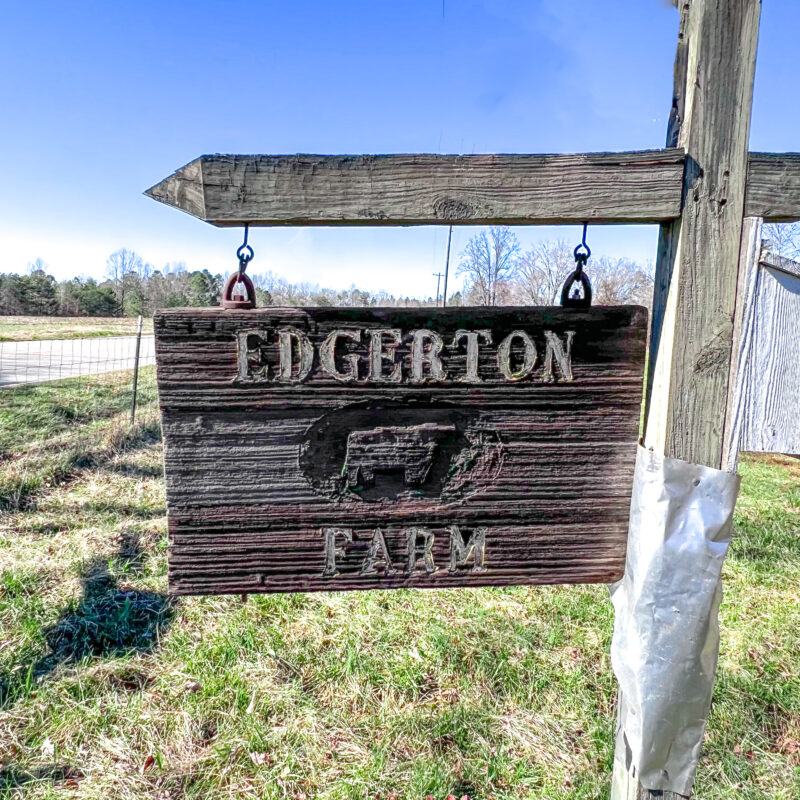
The land where Edgerton operates Edgerton Farm has been in his family since 1760. For nine generations, Edgerton’s family has farmed on the land in Rutherfordton, North Carolina, producing either cotton, tobacco, vegetables, meat (beef and pork cuts), or corn at one time or another during its long history.

Today, Edgerton’s operation houses 100 grass-fed beef cattle and 40 hogs. Along with meat cuts from the cattle and the hogs, which are sold weekly at local farmers markets, the farm wholesales field corn—starchy kernels used for animal feed.
His family’s rich history is the reason why he’s able to sustain the farm. Edgerton remembers the days when he witnessed his father performing regular farm duties, such as managing the crops, harvesting, and operating farming equipment.
In the 1950s and ’60s, his dad ran the farm on a smaller scale than Edgerton does today, producing cotton, tobacco, and vegetables. When his father was in charge, Edgerton would join him as they traveled to a farmers market in Asheville to sell produce.
“Back then, everybody farmed,” he says. “Everybody had a garden, a few cows, and a hog or two. It was subsistence farming. You farmed to make a living, produced your own food and you had a little bit of money left over to buy [other things].”
Subsistence farming—raising livestock and growing crops for the farming household—was familiar to Edgerton, so at the age of 17 and while still in high school, he started a small farming operation of his own using family resources. He started with renting 10 acres of his family’s land. Now, he’s grown the business to operate on 350 acres, 250 of which is his family’s farmland. The remaining 100 acres are rented and is mostly grass and hay land that Edgerton mows and bails hay off of for livestock.
From those early days of watching his father, Edgerton learned that the business must continue to evolve to ensure longevity. Consistent reinvention is a priority because Edgerton wants to ensure the business is financially secure. That’s why he’s proud that they’ve carved out a niche with field corn, he says. It provides an additional stream of revenue, independent of revenue generated at the markets through selling meat cuts.
In 2009, Edgerton started placing hardened field corn into green mesh bags and selling it at a retail price to deer hunters and people who want to attract deer to their plots. He also accepts wholesale orders for the corn. Since it’s full of carbohydrates and protein, corn is a major ingredient in the animal feed that Edgerton’s hogs eat.
The idea to use field corn to generate additional revenue was timely because, nearly 15 years ago, Edgerton Farm was a thriving vegetable farm. Seasonal produce is what farmergoers found at their booth for more than a decade, Edgerton says. But, they had to pivot.
“I couldn’t hire anybody to help me,” he says. “So we suspended [vegetable] operations. Plus, it was hard picking things like tomatoes all day because it wears you out. We sort of always had hogs, so we gradually migrated that way to where we are today.”
Throughout the years, Edgerton has learned many lessons in farming, such as the importance of controlling cost, producing the best commodity possible while ensuring quality, and keeping your customers happy.
For him, cultivating a sense of community with those customers is just as important as running the farm. It’s one of the reasons he enjoys operating the farm’s booth at local farmers markets, Camp North End on Thursdays and Cotswold on Saturdays.
“I want to be friends with everybody,” Edgerton says. “I treat people how I want to be treated. After I retired from the United States Department of Agriculture, where I met with clients every day, I needed contact with people that I didn’t have here at home. So I enjoy meeting the people on Thursday evenings and Saturday mornings.”