

Hidden gem in Charlotte’s Oakhurst neighborhood where the menu is as creative as the food
Hidden gem in Charlotte’s Oakhurst neighborhood where the menu is as creative as the food


New restaurants are opening at a faster rate than we’ve ever seen in Charlotte, causing a labor shortage that’s driving costs up and margins down. What will it take to keep kitchens staffed and doors open?
by Kristen Wile
Each month, even each week, the city celebrates new restaurant openings. Diners trade tips about where they’ve been, reveling in the culinary growth Charlotte has seen over the past few years. Instagram lights up with filtered photos of shiny new dining rooms, full of young professionals reserving tables to be the first to spend money at a hot new spot. According to economists, we’re in one of the longest periods of economic growth in American history. Unemployment is at a four-decade low, and the economy is flush with money. But with each of these big, shiny openings, an industry already spread too thin stretches just a little more.
COMPETITION FOR COOKS
Uptown restaurant Stoke, in Marriott City Center, provides employees with benefits and paid time off, something few restaurants are able to give. Yet when The Kimpton hotel opened up nearby, Stoke executive chef Chris Coleman lost a big chunk of his kitchen’s employees.
“We lost a sous chef, several lead line cooks, and a couple of really good line cooks to them,” he says. “In all, we lost about five people.”
Then Hello, Sailor, opened and a few more of Coleman’s cooks moved on. The competition for good workers has become so intense that cooks can move from restaurant to restaurant, slowly gaining a higher hourly wage. As a result, kitchens across the city are struggling to keep full staffs.
To economists, an unemployment rate of 4 percent is considered full employment.
“Broadly speaking, when you get under 4 percent, that’s when you see a lot of competition for workers,” explains Chuck McShane, VP of Business Analytics and Data for the Charlotte Chamber of Commerce.
In Charlotte, the unemployment rate for chefs and head cooks is 2.2 percent. For first line supervisors, that number is 3 percent, and both numbers are well below full employment. The small number of chefs available and looking for work shifts the power from the employers over to job seekers.
The result is not necessarily a bad thing, at least for employees. Kitchen staffers have long been underpaid and overworked, and the environments they work in can be toxic. The desperate need to retain staff is causing restaurant owners and chefs to change how they manage their kitchens and create an environment where people want to work.
“Fifteen years ago, there were 10 people in line ready to take their spot, so you could fire people on the spot,” says David Quintana, executive chef at Dot Dot Dot and Foxcroft Wine Co. “You could call them out, you could do whatever you want.”
Now, there’s nobody waiting in line, so restaurateurs have to try new things to maintain loyal staff. Toby Franklin, COO of Ford Fry Restaurant Group, explains the group has a developmental program for talented employees in both the kitchen and the front-of-house. The group opened Superica in SouthEnd earlier this year, and despite spending a month recruiting still wasn’t fully staffed by its grand opening. Finding good workers is tough, so when the company gets someone on the payroll, it tries to keep the new employee there by providing continuing education.
“We built an entire sort of university system so that we could literally say to someone, ‘Don’t go to culinary school. Come work for us and you will learn everything you need to know about how to be an executive chef from people who are doing it every day,’ ” Franklin says.
Smaller restaurants, however, don’t have this ability; many can’t even afford to offer paid time off. The result is constant job openings in the back of the house, from dishwashers to executive chefs. You also see many restaurateurs promoting chefs who aren’t ready for an executive chef position because they already are there and know the kitchen. Other times, it’s because a seasoned executive chef requires a bigger salary, and restaurant profits are getting smaller and smaller.
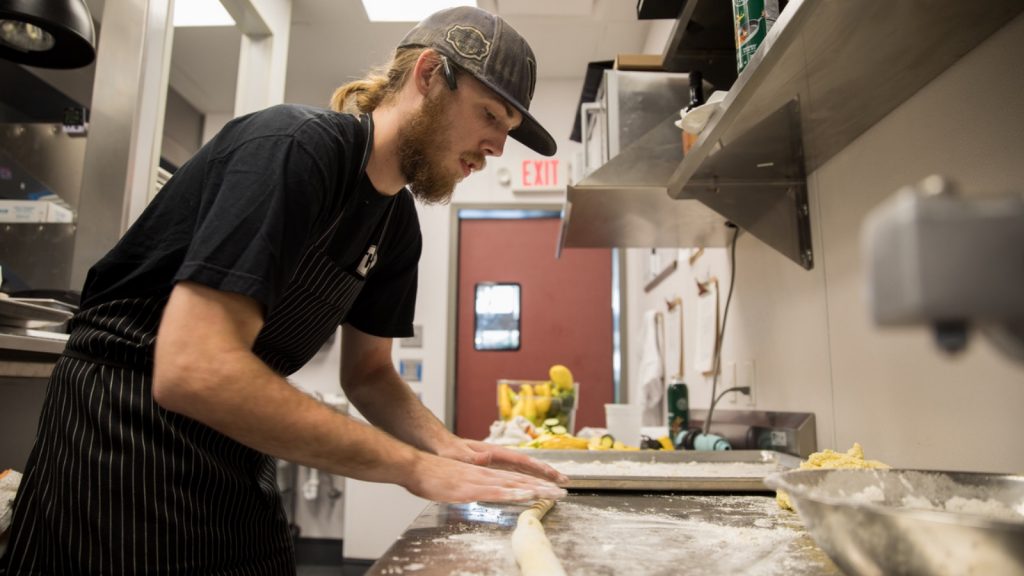
Chef Alex Verica in the kitchen of The Stanley in Elizabeth. Photo by Peter Taylor.
SHRINKING MARGINS
“Restaurants from a global landscape perspective, because of the oversupply, even in this economy have been experiencing very soft year-over-year sales,” Franklin says. “As an industry, we’re above it by a smidgen one month, then below it by a smidgen the next month. It’s definitely very competitive out there.”
Perhaps because of the strong economy, private equity is pouring into restaurants. Though never traditionally seen as a strong investment, Frankllin says, there’s a “cool factor” surrounding restaurants right now that we haven’t seen in the past. In addition to wages continuing to steeply rise, there are also now more options than ever for diners.
“Restaurant profit margins have always been slim, historically slim, but they at least in Charlotte seem to be getting slimmer and slimmer each year,” Coleman says. “In addition to the rising — which I personally think is a good thing — wages and the cost of food going up, we also have skyrocketing rents in Charlotte.”
Other than food costs, many of these increases are intangible to the diner. At Ford Fry restaurants, the hourly rate of a lead line cook has jumped 20 to 25 percent. A year ago, Franklin says, they maxed out at $16 an hour. Now, he’ll pay $20 an hour to keep a good talent. According to the Charlotte Chamber’s data, the average wage for an executive chef is $55,100; cooks are earning an average of $24,400. Some of these costs have to get passed on to the consumer for restaurants to survive, but customers aren’t always willing to pay enough to keep sustainable margins. There’s still a profit to be made in restaurants; the economy being flush with cash creates an experience economy, and dining out is part of that. With so much competition, however, it takes much more effort to get that profit.
“It’s not just dinner, it’s an experience — and people are willing and motivated to spend money for a great experience,” Franklin says. “And as long as restaurants strive not just to serve dinner but to provide a great experience, I think there’s always a place for us.”
Consistently providing good service, however, becomes more and more difficult when you can’t keep a kitchen fully staffed with good cooks.
THE QUALITY OF COOKS
According to the Chamber’s data, there are more food service and hotel jobs than banking jobs in Charlotte. Food service jobs are growing faster than the overall jobs in the region by a full percentage point. As the city draws in more high-paid workers, the city will become more and more attractive for investors to open restaurants.
One of the problems with that, Coleman explains, is that when chefs come to town to take advantage of the booming market, they’re coming alone.
“We have chefs coming in making Charlotte their home now and opening up awesome restaurants, but it’s just chefs,” he says. “The support staff isn’t coming with them.”
The city took another hit when the Art Institute announced it would close, cutting off one of the city’s biggest suppliers of trained cooks. The number of culinary graduates who will make it in a high-level kitchen was already a small percentage.
“Even with culinary school, you might find in a classroom of 20, you might have about two that really truly understand,” Quintana says. It’s a grueling job. Some never make it more than a few weeks in these kitchens. Many who can make it eventually get burnt out and exhausted, leaving the industry for easier jobs that pay the same, where they can have a better work/life balance and more reasonable stress levels. Even as chefs get burnt out of the industry and move into different careers, the number of open jobs in the city will continue to grow, with the Chamber projecting 730 job openings for head chef positions and 8,947 openings for restaurant cooks by 2023. That’s an additional 86 executive chefs around town, and 1,041 added positions for over the next five years.
This will continue, Franklin and McShane both suggest, until the market changes, and many economists believe there will be a downturn in 2019 or 2020, according to McShane.
“It’s all going to be dependent on having that discretionary income,” McShane says. “Once you see that income dry up, if you do, closure of restaurants will probably follow.”
LOOKING FORWARD
The intense competition for dollars has already produced a number of restaurant closings recently: Babalu Tacos & Tequila on East Boulevard, Luca’s in Elizabeth, Blue and Cantina 1511 in Uptown, The Rogue in Dilworth. And while it’s painful to see a restaurant shut its doors, closures aren’t a bad thing for the overall health of the restaurant economy.
“I think honestly we need less restaurants,” Coleman says. “I hate to say that, but we probably need the bubble to burst a little bit or we’re going to see our quality of food go down. Because we’re just not going to have the labor pool, the time, the effort, everything it takes that is Bon Appetit-worthy and featured at the Beard House and stuff. It’s just going to go away.”
Charlotte has been diligently working to build its reputation as a culinary city, but in order to lift that reputation, its restaurants need a staff capable of doing that heavy lifting, and chefs who are focusing on food and service instead of constantly scrambling to hire new cooks or fill in on the line. Without time to focus on the bigger picture, chefs are stuck in the grind of nightly service, and the restaurant suffers. Diners who notice will take their money elsewhere.
The key to guaranteed survival, it seems, is nearly unattainable in this restaurant economy: perfection as employers, chefs, and servers.
“You can’t be ordinary in this climate,” Franklin says. “You just have to be extraordinary on every front.”
















I look forward to more in this series. As a farmer, we haven’t raised prices in 10 years. This is becoming a huge problem for us.