

August 2, 2023
How much do we value vegetables?
A James Beard finalist’s vegetarian menu brought creativity — and financial difficulty
by Kristen Wile
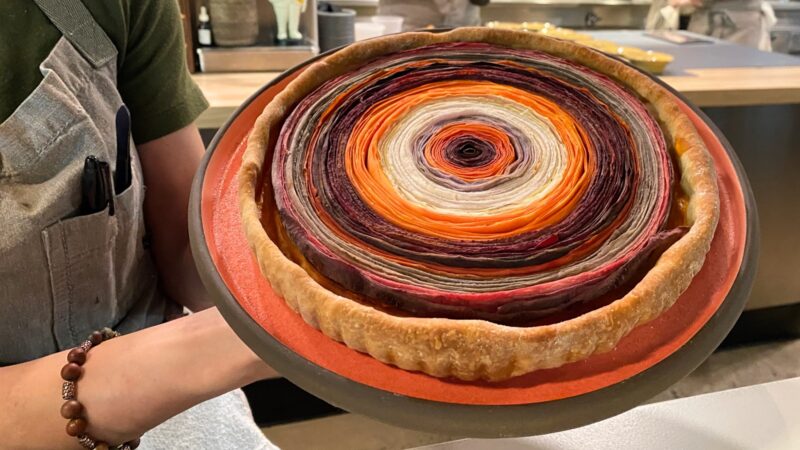
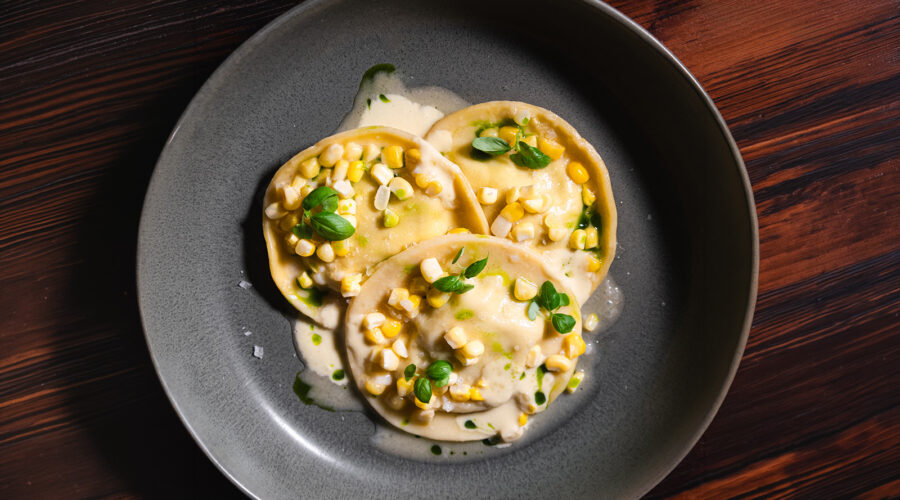
A root vegetable tart by pastry chef Faith Morley is one of the standout dishes on Counter-’s here and now menu. Kristen Wile/UP
When the team behind tasting menu restaurant Counter- planned a menu called Here & Now, the chefs looked forward to highlighting the seasonality of North Carolina’s bounty. They created a vegetarian menu using ingredients solely from the Carolinas, including olive oil pressed in South Carolina and salt from the Outer Banks. Because of the menu’s seasonality, dishes have changed throughout the course of the menu’s weeks-long run. The chefs were prepared for that.
What they didn’t foresee was the diner response to a menu without any meat.
According to Counter- chef/owner Sam Hart, reservations for the restaurant are significantly down from last summer, even following Hart’s recognition as a finalist Best Chef: Southeast in this year’s James Beard Awards. On a normal week, the restaurant generally sees about 130 guests per week. The Here & Now menu averages closer to 65 — a mere half of what other menus, even those in the summer, have brought in. While this could be seen as just a summer slowdown, there’s another issue that indicates the issue is diners’ perspectives on the menu: the cancellation rate is 20 percent, with nearly all of the cancellations coming from diners who do so because they realize it’s a vegetarian experience. Sales have been so slow, for the financial health of the restaurant, they are ending the menu’s run early.
“It was originally going to run through the end of August, but because of the sales, we had to end it August 7,” Hart says. “Honestly, if we didn’t do that, Counter- would have had to close up. That’s how big of a financial impact it was. We weren’t even selling the amount of our labor costs.”
Counter-’s tasting menus cost $175 for 10 courses and $235 for the 14-course experience. According to Hart, those who canceled their reservations felt as though they weren’t getting their money’s worth without meat on the menu. Due to the costs of sourcing even the basics locally, this menu ended up actually having some of the highest food costs of any of the menus. Charlotteans, it seems, don’t value vegetables in the same way they value meat — even when coming out of the kitchen of one of the most talked-about restaurants in the city. This menu has also brought out some of the best dishes we’ve eaten at Counter-, thanks to the creativity needed to pull this menu off. While guests who have eaten the vegetarian menu have shared overwhelmingly positive feedback, getting guests to come in despite a lack of meat on the menu has been a difficulty Counter- has struggled to overcome.
“It’s just the way that we’re programmed, especially Americans,” Hart says. “Whenever you go to a restaurant, when you read the entrées, it’s always the protein first and then everything else. And when people say what they’re thinking about eating that night, they’re like, ‘Oh, I want to go get a steak or I want to go get blah, blah, blah.’ They’re not thinking to themselves, ‘Oh, I really want to go out and get some good vegetables tonight.’”
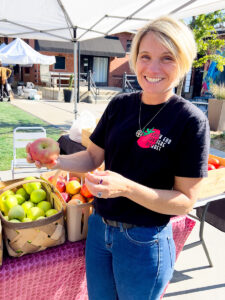
Samantha DeRosa, market director of Farmers Market Management Services. TM Petaccia/UP
Samantha DeRosa, market director of Farmers Market Management Services, agrees that Americans have come to value meat as the core part of diets, in part due to government policy.
“The [USDA] food pyramid always started with meat, and schools emphasize that,” DeRosa says. “We always learn that in school. We always talk about it in school lunches and stuff. There was always meat with fruit and vegetables or whatever. So I think it’s just something that is in every single part of our culture.”
At the markets FMMS manages — in Cotswold, University City, Camp North End, and South End — DeRosa says the vendors selling meat bring in some of the highest sales. While raising and processing meat is more expensive than growing vegetables in many ways, DeRosa believes that vegetables at the market are underpriced given how much work farmers put into producing those products, as well as the quantity they must sell in order to make a reasonable living. The prices of the produce, however, have to remain low in order to get customers to buy the product.
“Industrial agriculture decreases the cost to the consumer, and so it’s hard for them to see the benefit [of buying from local farmers] because the cost difference is such a big deal,” she says. “But then you also have the cost on the environment, economic development, and all of those other things that are my soapbox.”
Highlighting some of those costs are what Hart hopes he’s done through the Here & Now menu.
“One huge thing that we talk about during this menu is one of the biggest problems that we have in America: the destruction of our soil,” Hart says. “And I don’t think people, especially in the Midwest, will even recognize that or make massive changes until, you know, the thousands of acres of land that Monsanto has created a massive dust bowl in the middle of the country.”
Hart says given the financial struggle the menu brought, Counter- will not serve any more strictly vegetarian menus, though they will continue to focus on messages of sustainability. Both DeRosa and Hart agree that chefs play a large part in the education that needs to happen to shift American dining to become more sustainable, in collaboration with media, government, and educators.
Counter-’s Here & Now menu runs through this week, with reservations available on Tock.
Disclosure: Counter-’s current Here & Now menu features 10 Charlotteans making a difference in the city today, including myself for being one of the first diners at Counter- and the work we do at Unpretentious Palate.