
Hidden gem in Charlotte’s Oakhurst neighborhood where the menu is as creative as the food
Hidden gem in Charlotte’s Oakhurst neighborhood where the menu is as creative as the food


Peppers for Fire Belly Farm hot sauces are grown just outside Plaza Midwood
by TM Petaccia
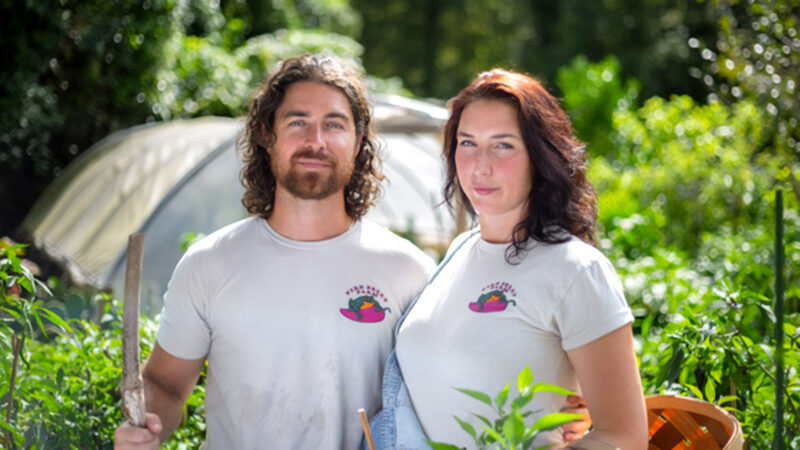
On a quarter-acre of land, somewhere in the buffer between Plaza Midwood and Plaza-Shamrock, Ace and Diane Henderson grow hot peppers. A lot of hot peppers. Currently, they are cultivating more than 30 varieties of the capsaicin-laden fruits, which provide the base for Fire Belly Farm’s line of hot sauces.
“We’ve always really enjoyed growing things, just enough to feed us, friends, and family,” Diane Henderson says. “One year, Ace, who has always loved spicy food, says, ‘I started 100 seedlings,’ and I said, ‘Of what?’ and he said, ‘Of peppers.’ We didn’t think too much of it. We ended up with 500 pounds of hot peppers that summer. So then it became, ‘What are we going to do with all these now?'”
And Fire Belly Farm hot sauces was born, but not without a few false starts. First, they tried making a hot sauce themselves. “It was terrible,” Diane says. Fortunately, she had a connection. A bartender by trade, she reached out to then co-worker Zack Renner, formerly of Noble Food & Pursuits, which includes Rooster’s, Noble Smoke, and Bossy Beulah’s, and introduced him to her husband.
“I’ve been making hot sauces ever since I was at Rooster’s,” Renner says. “I also made sauces with Noble Smoke and Bossy’s. Ace began telling me about the peppers he was growing, and I said ‘Sure, I’ll whip up something for you.'”
He came back to the couple with two sauces. They liked what they tasted, bought some bottles from Amazon to package it, and started giving the sauces to friends and family. When the recipients returned and asked for more, the Hendersons knew they had something. “I guess we better design a logo,” Diane recalls saying.
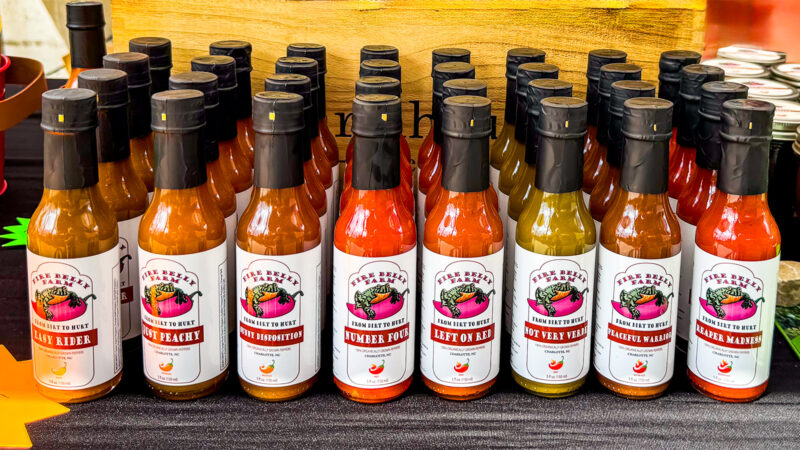
Using the tagline “From Dirt to Hurt,” Fire Belly Farm has expanded to a line of eight hot sauces (two are seasonal trials), each featuring various blends of the farm’s peppers, ranging from very mild to blazing hot. Several include the notorious locally developed Carolina Reaper, which was, until recently, the hottest consumable pepper in the world. It now ranks second behind Pepper X, also developed locally.
“Each pepper packs its own personality; its own color, size, flavor, and heat,” Ace Henderson says. “It’s an experience that demands your attention. We aim to have a flavorful sauce for everyone and everything, hot and not.”
Using a small-batch approach, the trio can quickly adjust to market tastes. “That’s the fun part,” Diane says. “Once we run out of a particular sauce, we might not bring it back. It just depends on the demand for it. Doing small batches keeps people craving it.”
As for the early success, Renner points back to the source.
“I feel like the reason why the sauces are so good is because of the flavors from the peppers,” he says. Ace puts a lot of care into growing them. There’s definitely a difference. We’re always talking about plants and gardening. What we have is something special, and it goes beyond professionalism, and it’s something we’re looking to potentially grow and maybe expand.”
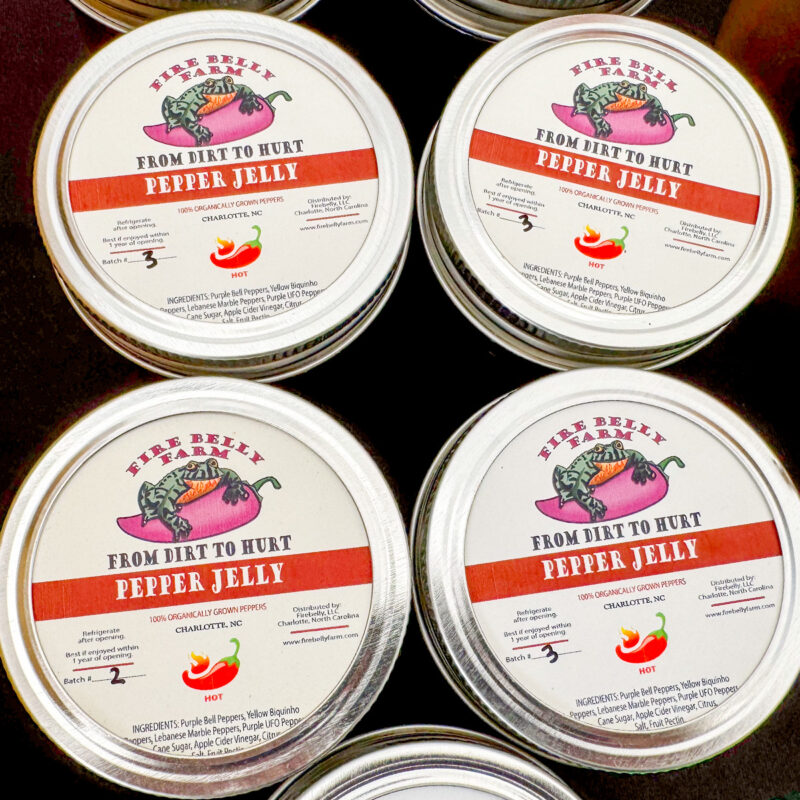
Recently, Fire Belly Farm expanded its product line to include mild and hot pepper jellies, plus a dried spice rub made from the pulp leftover from making the sauces, but that might not be the end of it. “I can see more kinds of rubs,” Renner says, and maybe some condiments, like a spicy aioli.”
In addition to the more traditional uses for hot sauce, such as eggs, spicy mayonnaise, wings, tacos, and making your own Bloody Mary mix, Renner also suggests some more unique combinations. “Try a dash on vanilla (or peach) ice cream,” he says. Also, a small dash (into the batter) when you are making a chocolate cake or cheesecake.”
At the farm, the Hendersons are full participants in natural, sustainable farming, only using seeds approved by the Organic Materials Review Institute (OMRI), an international nonprofit organization that determines which nurturing/growing products are allowed for organic production and processing.
“We have an amazing diversity of wildlife thriving on our farm thanks to organic and sustainable farming,” Ace says. The farm now produces more than 1,000 pounds of peppers annually.
Before processing, peppers are washed with a natural cleansing formula consisting of extracted botanical oils. The sauces themselves contain no artificial coloring, flavoring, or preservatives.
You can find Fire Belly Farm at several area farmer markets (follow its Instagram feed for exact markets and dates); pop-up events like Front Porch Sunday and Matthews Main Line; plus several independent retailers such as The Common Market, Rhino Deli, Copain, and Laurel Market. Products can also be ordered from the Fire Belly website.
Mass retail, however, is not a goal. “We’re not trying to get every grocery store or anything like that,” Diane says. “We’re loving being able to connect with the community. We love being a local commodity.”





We found them at the Old Meck Christmas Market. Not just hot, but full of flavor. Really great!