Hidden gem in Charlotte’s Oakhurst neighborhood where the menu is as creative as the food
Hidden gem in Charlotte’s Oakhurst neighborhood where the menu is as creative as the food


Kimmy Bazan speaks out about her time at Monarch Market
by Samantha Husted
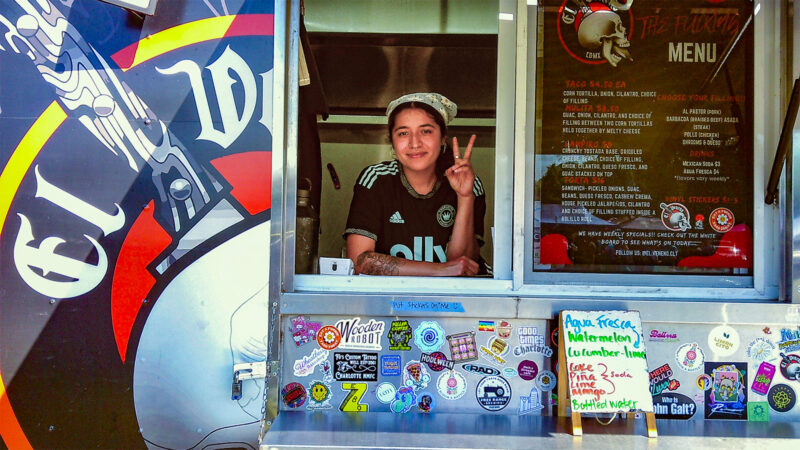
25-year-old chef Kimmy Bazan is filled with vigor — or venom.
Bazan is the owner of the popular Mexican street food truck El Veneno, which translates to “the venom” or “the poison.” In the two years since the food truck’s inception, El Veneno has earned recognition on Charlotte’s culinary scene, serving Mexican street food made precisely how Bazan sees fit: authentically and unapologetically.
“ [El Veneno] is a little bit of an odd name,” Bazan admits. “To me, it encompasses that we’re not trying to stick to what people typically view as traditional Mexican.”
The name is an embodiment of Bazan’s passion. She serves the Mexican street food she grew up eating, despite what the average American palate may be accustomed to.
Mexico is a melting pot, filled with diverse flavors and ideas — many of which Bazan wants to share with Charlotte.
“The idea of Mexican food has been warped because we’re in America….From the beginning I was like, ‘We’re gonna do things the way that they’re supposed to be done,’” Bazan says.
While El Veneno has undoubtedly made an impression on Charlotte foodies and industry pros alike, the food truck recently hit a bump in the road.
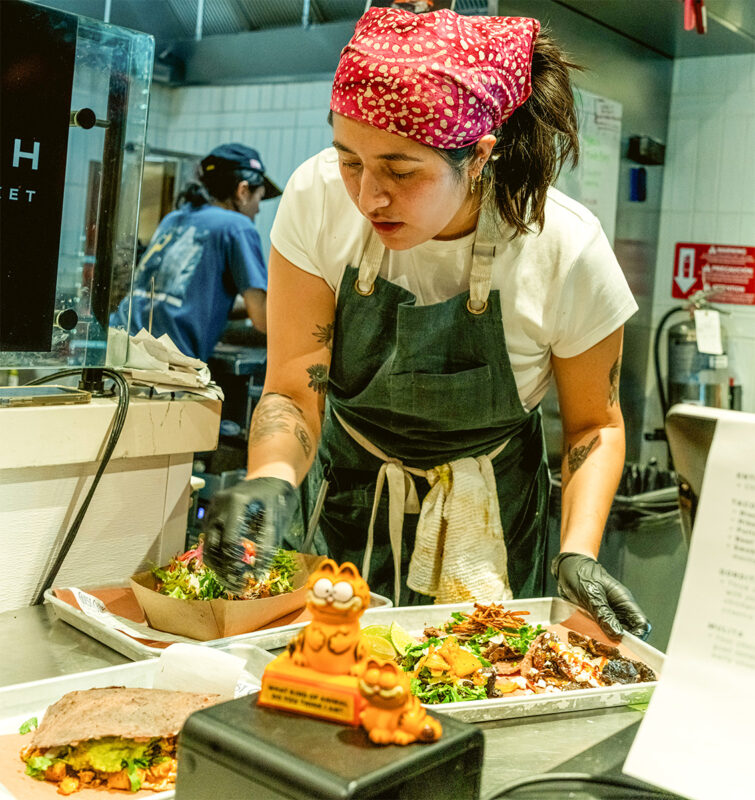
After a short residency in Monarch Market, a food hall in Uptown — El Veneno’s first ever stint as a brick and mortar — Bazan announced in an Instagram post that El Veneno would be leaving its stall and returning to its roots: a black and orange truck embossed with flames. The truck, which also dons a skull with a chef’s knife piercing it, is hard to miss — the food is even harder to forget.
For Bazan, El Veneno’s time at Monarch Market — a step that should have been seen as upward momentum — marked a period of intense struggle.
“ I think as soon as we got in there, we quickly realized, that this isn’t what we thought it was going to be,” Bazan says.
Faced with the pressure to conform to Monarch Market standards, Bazan felt that the food hall dampened El Veneno’s core mission: serving the Mexican food she loves so dearly.
“ We weren’t hitting the sales that we anticipated and that they also made it seem like we were going to get,” Bazan says. “It was disappointing on that end, but it was mostly disappointing because I feel like we had to dilute who we were to be able to fit in there.”
Instead of some of the traditional Mexican street food the truck was best known for, Bazan found herself making burritos and loaded french fries.
“Anything we do, we always try to do it to the best of our ability,” Bazan says. “Even the bowls, or the burritos, or the loaded fries — things that I hated doing — they were still good. We’re going to make everything to the best of our ability, but we didn’t want to make it. We were just doing it because we had to.”
Bazan’s passion for El Veneno is palpable. In a post to El Veneno’s Instagram she candidly shared her disappointment with the experience and also grappled with her own sense of failure. The post currently has more than 1,400 likes.
In a candid admission of the struggles of small business, Bazan wrote:
“Opening a storefront uptown was supposed to be something I felt proud of. But right off the rip I regretted it and wished I could turn back. I never once felt welcomed there. It’s a horrible feeling when you sacrificed everything you’ve had to build something from the ground up and see people disrespect it. Having the uptown location made me hate every aspect of something that I used to feel very proud of.”
On the truck, Bazan — with the help of her siblings Dante and Yexi and her good friend Josefina — cooks with conviction. She doesn’t care if you don’t like it — though she’s pretty sure you will once you give it a try. Her take it or leave it attitude is part of what makes El Veneno so successful. Her fire is like the flames on the truck.
“On the food truck we were always like, ‘We’re going to do this, we don’t care if you like it or not, this is how it’s supposed to be,’ and we’re gonna stick to how it’s supposed to be,” Bazan says. “Kind of breaking that barrier of the idea that people had in their heads of what Mexican food was. At Monarch, we kind of fell back into everything that we were trying to go against when we first opened the truck.”
While El Veneno’s time at the food stall seemed to dim Bazan’s light, it didn’t kill her spirit.
“ I always tell everybody that cooking is a sacrifice, but it’s also a way to show love,” she says.
El Veneno has always been Bazan’s way of sharing her culture, her upbringing, and her passion with Charlotte.
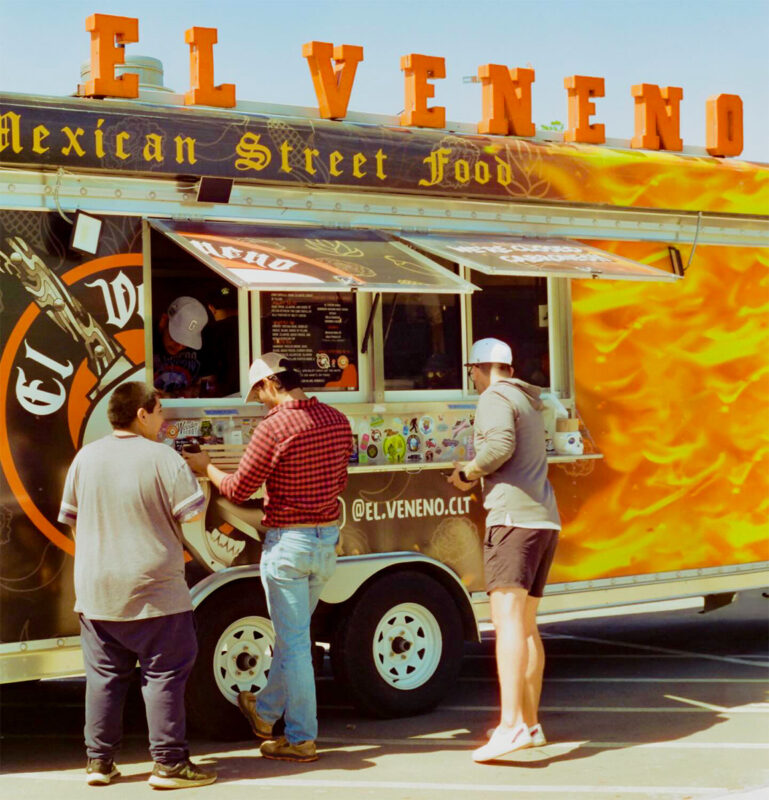
After a month away, Bazan is back on the truck again doing what she does best, cooking El Veneno favorites like the black al pastor, made using a traditional marinade sourced from Mérida, Yucatán in Mexico.
While the truck has a set menu, on any given night you might be in for a surprise special. Bazan says the El Veneno crew has served a variety of traditional dishes including six different types of moles, cochinitas, tetelas, huaraches, pozole and cemitas.
“The specials don’t really have a rhyme or reason,” Bazan says. “It’s just whatever I feel like doing. I try to not repeat specials though. But some of them have been so good that we bring them back a couple times per year.”
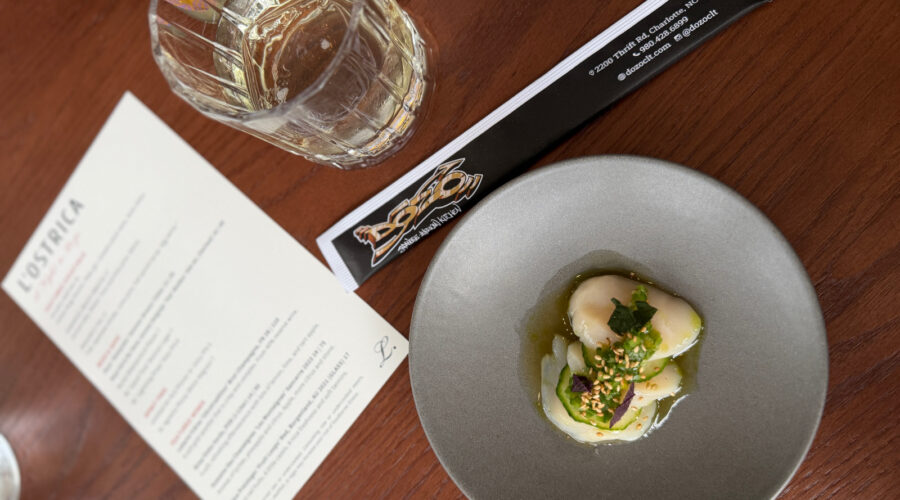
Aside from traditional cuisine, Bazan sometimes comes up with dishes that are inspired from the food she grew up eating — but with a twist. El Veneno has served al pastor bahn mi, Mexican-inspired barbecue, pastas and even an octopus carpaccio.
“There’s so much more to Mexican food than what people are used to seeing,” Bazan says. “Especially being from Mexico City, it’s such a melting pot of cultures and ideas. That really inspires me when eating and coming up with new things.”
Could a stand alone El Veneno exist in the future? Bazan says yes. But it’s not a decision she takes lightly.
“ If anything, the experience at Monarch showed me that I should wait and not rush myself into a decision like that,” Bazan says.