Hidden gem in Charlotte’s Oakhurst neighborhood where the menu is as creative as the food
Hidden gem in Charlotte’s Oakhurst neighborhood where the menu is as creative as the food


The Bulb is expanding to bring more produce to more people

The Bulb’s mobile market brings quality produce to Charlotteans in food deserts. Shannon Blair/UP
Ebonee Bailey, executive director at The Bulb, recalls opening a Freshlist package and finding an abundance of vibrant, freshly harvested beets. While she regularly places orders with Freshlist to supplement The Bulb’s own harvests, she had not placed this one. She then noticed the restaurant Leah & Louise on the recipient label. “I called Freshlist and said, ‘This isn’t for us, Aaron. It’s for Leah & Louise.’ And she said, ‘No, they ordered too much. We’re donating it.’ That’s when it all kind of clicked.” Bailey considers this her lightbulb-Bulb moment: those served by The Bulb are receiving the same quality, locally-grown goods as the best restaurants in town. As they should. Affordable access to nutritious, delicious fruits and vegetables should not be a privilege.
Unfortunately, though, it is for many Charlotteans who reside in neighborhoods known as food deserts, areas where obtaining good-for-you food is hindered by a variety of factors, such as market proximity, product availability, affordability, and transportation needs. UNC Charlotte Urban Institute reported in 2020 that almost 15% of Mecklenburg county residents were living in such food deserts, exceeding both national and state levels; furthermore, the Bulb’s internal 2018 data revealed that more than half of Mecklenburg County residents had unreliable transportation to reach healthy markets with plentiful produce within budget.
“Everyone deserves fresh, local produce. And there is no shortage on it,” Bailey says. “There is just a shortage on distribution and getting it to people who need it.”
The Bulb, like other hunger-fighting nonprofits, addresses food insecurity — but in a uniquely barrier-free way; customers do not need referrals for the groceries. Instead, they are encouraged to simply show up to The Bulb’s pop-up markets, take what they need, and give what they can. “When I first started with The Bulb and working the markets, I noticed that there were a lot of times where if someone had only two dollars, all in quarters, and they’d gotten three bags of food from us, they still wanted to pay for it, as much as they could, with anything they had,” Bailey says. “I’ve seen ten dollars in pennies. We accept any form of donations, and we have suggested pricing that aligns with EBT.” The Bulb staff removes obstacles to provide the city’s most under-resourced neighbors access to what is essentially an equitable CSA. “Fresh food for all” is The Bulb motto.
It is also the principle upon which founder Alisha Street built The Bulb from its inception. As a social worker, she soon discovered underlying hurdles for clients receiving hunger relief agency referrals; some did not meet all eligibility requirements and were denied food. Some did qualify but received only shelf-stable items less than ideal for their health needs. “Alisha definitely saw a hole and got creative on how to fill it,” Bailey says. “She started working with different farmers from farmers’ markets on Saturdays. Any excess produce they had, she began to bring directly to the food insecure neighborhoods of the residents she was working with. She served right out of her trunk.”
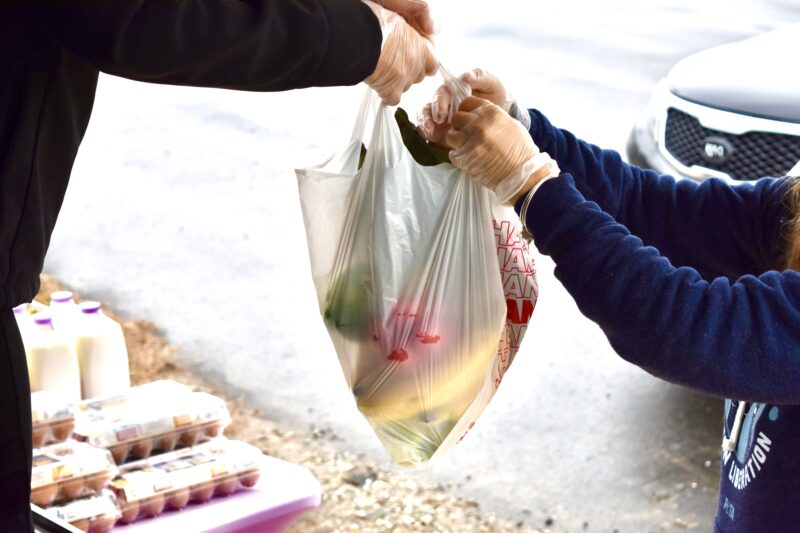
The Bulb’s pop-up markets work on a pay-what-you-can system. Photo courtesy
Street made The Bulb official in 2016. She and a lean staff of two others operated out of Catawba Brewing’s barrel room to share cooler space for two weekly markets’ perishable goods. Since then, the organization has grown significantly in scale. Now a staff of 10 is able to offer the public twelve weekly market sites, and the nonprofit has moved into the Innovation Barn to house its operations. “We’ve been able to grow from sharing our space with the brewery to having our own right next door in two years,” Bailey says. “It’s crazy.” The staff, partners, and volunteers are having crazy impact, too. Here is what they’ve been able to achieve in just the first half of 2022:
As The Bulb widens its reach, the mission remains a local one: local food sourcing and meeting local needs where they are. Each March and September, the staff surveys customers to see what kinds of produce they would like to see grown and to better understand cultural preferences. The Bulb’s farm mentors Eddie Watt and Andrew Acosta then work at responding to those requests with what they grow and teach others to grow themselves. “For instance, we’ve figured out that there are two markets of ours that love okra, so we bring the most okra to those markets,” Bailey says. “Collards also do really well.”
Along with providing fruits and vegetables, the staff works to spot other gaps they can fill at markets. For instance, literacy insecurity often coincides with food insecurity, so they now bring along children’s books from Promising Pages to some markets where that need exists. Sometimes, they even set out starter plants and seed packets for clients to “cultivate a knowledge of growing your own food,” Bailey says.
All ages are welcome at all markets, but Archwell Health recently helped The Bulb launch two additional weekly markets, senior-focused ones, on Graham Street and Beatties Ford Road. Other pivotal partners in bringing produce to the people have been Johnson & Wales University and Wooden Robot Brewery. For the past three years, a culinary nutrition professor and her students have been providing The Bulb with recipes and instructional videos to help customers maximize the produce options and reduce waste. The Wooden Robot sponsors The Charlotte Transportation Center Market each week to ensure it is fully stocked for those needing access; they are continuing sponsorship for 2023. Restaurants like Sanctuary Bistro, Flour Shop, and Haberdish have been dedicated to fundraising and advocating for The Bulb.
The farm stands are filled in part by The Bulb’s own farming efforts on two plots of land at the Lomax Teaching Farm in Concord and a section of land owned by Charlotte Mecklenburg Schools at Garinger High School. The remainder comes through collaboration with small farms in the Carolinas, Freshlist, Trader Joe’s, 100 Gardens, and community and church gardens to procure fresh produce for the neighborhoods they visit each week.
There are plenty of ways for foodies, families, and hospitality professionals to support The Bulb. Children and parents can do hands-on farm work; older children are even able to help sort food and facilitate market days. Individuals and organizations can shop The Bulb’s Amazon wish list, donate produce, and sponsor or co-sponsor markets; two are still in need of sponsorships (Garinger High School and Tuckaseegee Elementary markets). One of the most important ways to help right now is by becoming a board member. “We are in this post-pandemic world and in a huge transitional restructuring phase,” Bailey says. “We are looking for board members who are passionate about food, passionate about social justice. The requirements are super light, but we need people on the team who can help get us to that next place.”
The next fundraising event for The Bulb is Paella for Produce on Saturday, September 3 from 12 to 4 p.m. at High Branch Brewery (at Gibson Mill in Concord). Chef Craig of Live Fire Feasts is preparing a 60-inch vegan-friendly paella featuring The Bulb’s own locally-grown vegetables. Street Fare Farm is providing all the fixings for an accompanying salad bar, and drinks are available from High Branch Brewery. Several local farms will have fresh flower bouquets available for sale, too. Tickets are $50, available here, with all proceeds going to Garinger and Tuckaseegee markets that collectively serve more than two hundred people weekly.