



February 5, 2021
Chef Oscar Johnson on code-switching and acceptance
In honor of Black History Month, we’re listening to Black industry professionals
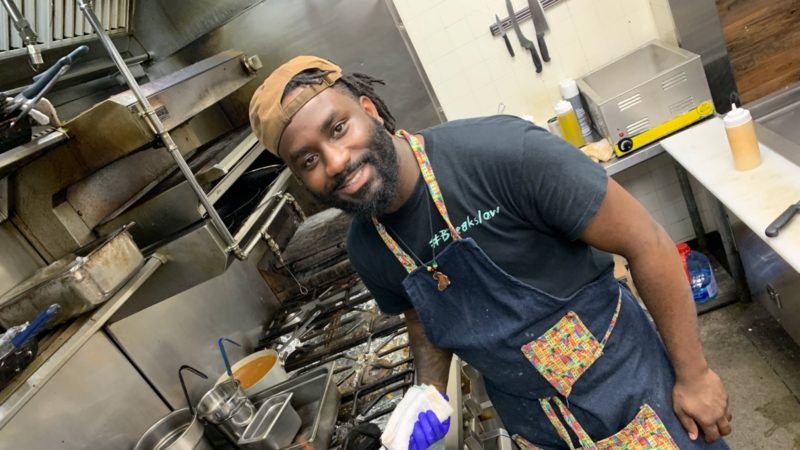
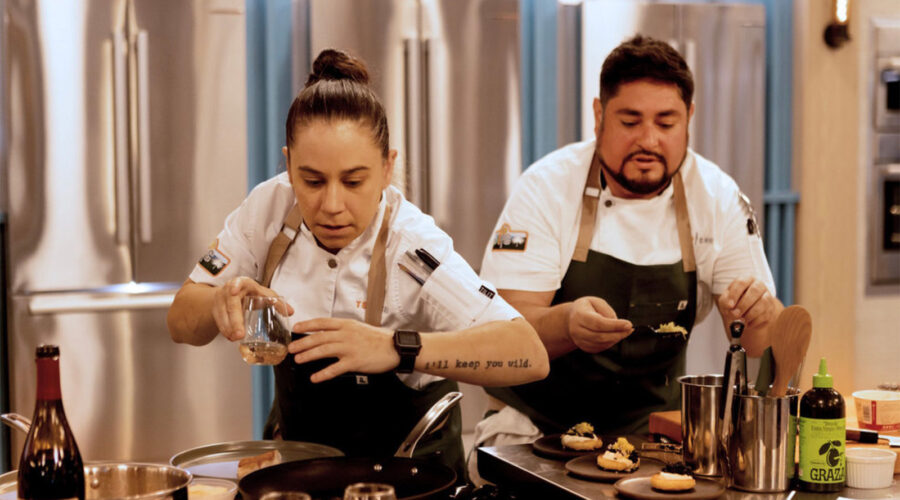
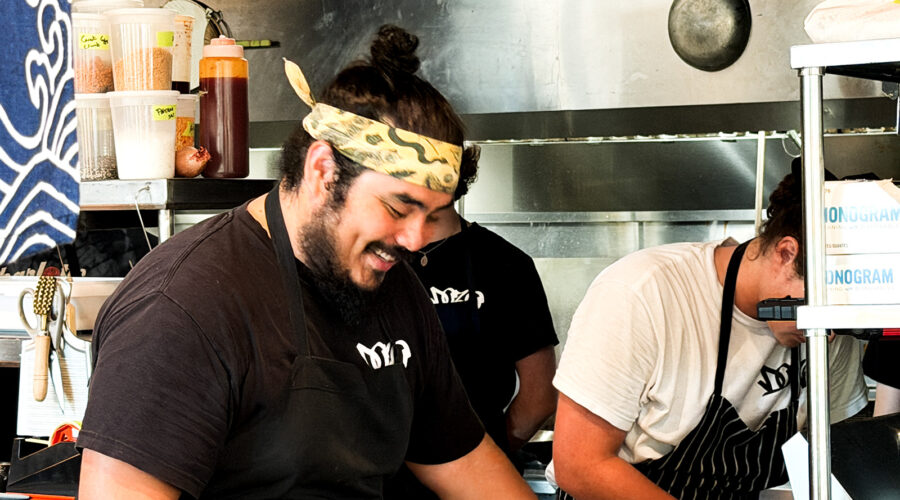
Chef Oscar Johnson, who works for Greg and Subrina Collier at Uptown Yolk and co-owns a concept called Jimmy Pearls. Photo by Jonathan Cooper
In honor of Black History Month, we’ll be interviewing a Black voice in Charlotte’s food and beverage industry each week in February. Today, we’re speaking with Jimmy Pearls co-owner and chef Oscar Johnson about how diversity makes a restaurant better and why it’s important to celebrate employees for who they are.
Unpretentious Palate: When did you realize that there weren’t many fine dining chefs that looked like you?
Chef Oscar Johnson: When I was working at a country club — I think it’s been about five years now. I give a lot of credit to that place because that’s where I established my skill set. That’s where I really started to come into my own as a chef. That being said, during my journey there, it was just dominated by white chefs that were certified sous chefs, master chefs, all of the major distinctions. And there wasn’t a lot of brothers and sisters that look like myself. There was one Black chef at the time, but he was labeled a “demi-chef,” basically a potential suitor for sous chef in the future. Fine dining restaurants are mostly run by white male chefs. I left the country club and did my own thing in the private sector and I started digging on Instagram and following people. Going to those different spaces, you hear names. And then I came across Greg Collier and Michael Bowling and how they were doing Soul Food Sessions dinners. At that point, it was just a buzz — it wasn’t any disrespect towards them or anything, but it was just so new to me that I was just like, “OK, well, I’ll see about it when I come around to it.” Working under two master chefs, having that training and experience, seemed like enough for me to be successful going forward. I didn’t really know that there was a whole other realm of culinary excellence with people who look like me. So fast forward to now, you see that situation has changed a lot.
UP: What is one way that you think the restaurant industry can encourage diversity and change going forward?
OJ: I just think that they need to give us opportunities. People need to do away with the stereotypes that are out there about Black people, particularly those who are in the food service industry. ALL people have bad attitudes, arrive to work late, et cetera. Also, genuinely get to know who we are as people, acknowledge the great work ethic and practical skills quite a few of us have. From there, allow these Black and Brown cooks the same opportunity to be elevated in your establishment, just as the white cooks are. Accept us for who we are, with our personality, our talk, our hair — all that.
I have a pretty electric, high-octane energy level. And I talk how I talk. I’m from Hampton, Virginia. However, I still know how to be a professional and speak clearly to people without using a totally different voice in order to sound like the part of “chef.” I have been in spaces where I’ve switched to my “white voice” or whatever for years, and that was the sound that I thought was professional and that was what I thought was going to gain me access to the next level. But we have a lot of brilliant minds out here and personalities, and if you give us those opportunities, we can exceed whatever expectations you might have. Getting rid of the notion that Black folks are going to come in and we’re going to cause trouble or, if there’s conflict on the job, I can’t talk to him because he’s going to give me all this, that, and the third. You just need to give us opportunities. Allow us to use what we have and if there are areas that need improvement but you see the work ethic, trust that we can learn what we need to learn and we can be molded into the chefs and professionals that we need to be.
UP: Can you define code-switching for someone who may not be familiar?
OJ: Code-switching is pretty much walking into a space and totally changing up who you are to better fit your environment. I use a country club, for example, because I was one of the only Black cooks there. I could be shoulder-to-shoulder with some of the other chefs and if they’re talking about whatever it could be, any type of conversation, if something is not funny to you, you just laugh and go along, engaging in certain conversation. You’re doing all this stuff to fit in and you know that that’s not who you are — talking a certain way so that your environment accepts you. But you’re not being your authentic self.
UP: Why does diversity matter? How does diversity benefit a kitchen?
OJ: Diversity matters because it creates a sense of inclusion and community that is needed in a place. This helps the kitchen evolve, become more innovative in every aspect, and illuminates a positive culture. With a diverse kitchen, you will also see more efficiency, worker engagement, and better problem-solving methods. Allowing diversity to take over also creates a greater sense of trust all across the board with other team members of the restaurant. Whenever there is true “equal opportunity” and a young Black cook can sense that, they will shine and end up being one of your best people.
UP: How does your Black heritage show through when you’re cooking?
OJ: The Hampton Roads area, where I’m from, has West African influence, dating back to when the first enslaved Africans arrived at Point Comfort (Fort Monroe) in 1619. Recently, I have reconnected to my family roots tied to Virginia. I have embraced how I grew up eating, our family history, and possess the desire to discover more as I trace my lineage back to Africa. I like to cook hearty dishes that remind people of what their mother or grandmother might have made; if anyone has had my cooking, they will say that my food is also spice heavy. All of this inspiration comes from my own curiosity of how my ancestors might have prepared a dish way back in the day. I use Ethiopian spices and cooking methods from time to time, as I tie that in with what I do with the Jimmy Pearls menu. I have brothers and sisters from Ghana that also provide guidance whenever I’m looking to pull from that particular place of influence. Day by day, I feel like I’m getting closer to that discovery of my lineage as I read more cookbooks, and connect with other Black chefs who are doing their work centered around the African diaspora.
UP: How are you trying to make things better for future generations of chefs?
OJ: I know what it felt like when I was able to look up and I had brothers and sisters that were killing it, at the top of their game. It didn’t matter if they were doing fine dining or they had a food truck — just the fact that they were the best of the best at what they were doing. It’s a family affair. It does not feel like a competition, because you can easily get discouraged looking on social media at someone else’s progress and using that to compare where you are. The mentorship that I have received and how strong I’ve gotten not just as a chef, but as a person, as a businessman, it’s just been tremendous, it’s been such a blessing. Imagine how someone else younger than me would feel. I’m actually mentoring someone right now and it genuinely feels great. I have a different level of patience than I’ve ever had. I’ve got my mentee, I’m telling him hit me up whenever you need anything. As far as talking about entrepreneurship, I have had men and women who have just taken their time with me and given me all the game, not keeping anything. It’s not about getting into a space and trying to do the same thing as someone else, you need to get some structure and figure out how to navigate and make it yours. It’s a blessing to be a blessing, and it has to continue to happen in order for us to continue to grow as young professionals. And so I’m going to continue doing it. We’ve got trailblazers who have kicked down doors and broken down barriers. And so it’s only right that you sow into the next generation. It’s the only right thing to do.
UP: Who is one Black chef in Charlotte people should know about?
OJ: My man Brandon Staton. I’m picking him because he is one of my younger brothers and he is so intelligent. I learn from him. Just because you’re older than someone, it doesn’t necessarily mean that you can’t learn. He’s so brilliant. I enjoy working with him at The Yolk. He is a very respectful young man and he’s got creativity out of this world. The knowledge that he has about baking and Asian cuisine, he’s just so well rounded. You look at the younger generation in the workforce right now, people just want to get on quick, make a lot of money. They want to make a certain amount an hour, and if they don’t they’re going to keep hopping around restaurant to restaurant and they give you a really terrible work ethic. But Brandon is going to battle with me. And I just think that his skill set is just amazing. I went to school for four years, took what I learned and graduated. However, all people who went to college had a different learning experience and I look at Brandon like, “Damn bro, what did I miss?” Sometimes that cooking terminology sneaks up on you while you’re working and you forget what processes are technically called. Brandon is there to help me out and correct my “incorrects.”
Brandon’s a super underrated chef. Once he gets his footing and figures out what he wants to do with everything that he’s capable of doing — he’s done a bao bun pop-up, Bao Down, a few times, and the dude puts out phenomenal food. So he has a great situation on his hands where he’s just working and constantly building up his skill set, his repertoire, getting in the network. He really just needs to find out what he wants to do with it. And I think that whatever he decides to do is going to be great.
UP: How can diners encourage change?
OJ: Diners can encourage change by being respectful and being aware of where they are, and taking the time to seriously get to know who the chefs are of some of these places instead of falling in love with pictures.
Food does look good. People eat with their eyes and we get all that. But I think diners just need to understand more of what some of these concepts are and who the people are and what the goal is, what they’re trying to get accomplished, before you go to a place.
You have two ends of the spectrum. There’s fine dining, and then casual places. Even with fine dining, the verbiage on the menu could say fish and grits. Diners need to understand that with chefs and owners, there are different methods of cooking and creativity and culture to where you can’t sit there and just go in blind and say, OK, I asked for fish and grits, what is this? The grit is a grit cake or it’s grit croquettes or grit fritters — it’s just displayed different. And then you go and you leave a horrible review because it wasn’t what you expected, but you also didn’t read and you didn’t get to know the place. You didn’t ask the questions. You didn’t educate yourself. I think taking that time, it just means everything, because we have a lot of great chefs who are doing great food.