Hidden gem in Charlotte’s Oakhurst neighborhood where the menu is as creative as the food
Hidden gem in Charlotte’s Oakhurst neighborhood where the menu is as creative as the food


The Slide introduces young students to careers in the culinary arts
by Ebony L. Morman
Game changers. That’s how Exposure Project, an organization that empowers under-resourced youth through real-life career experiences, refers to the middle and high school students who take part in their programming. For five years, the non-profit’s founder Leanna Calvin has offered character development sessions, career shadowing opportunities, group-led service projects, and exposure field trips to youth in Charlotte with the hope of helping them rise above their present and past challenges.
Now, The Slide — the organization’s new food truck initiative — will be another aspect that actively empowers teens, introducing culinary arts as a career path.
The idea for a food truck business stemmed from a light-bulb moment Calvin had two years ago. Concerned about fundraising, she considered different revenue sources that could lead to long-term financial sustainability for the organization, she says. She wanted that revenue stream to also help the kids learn new skill sets.
“The food truck will allow them to be immersed in not only one industry, which would be culinary, but it encompasses other industries, like photography, graphic design, and marketing,” Calvin says. “We wanted to build something that covered various industries, so that people are able to see that this is truly impactful.”
While Calvin began working toward The Slide two years ago, the teens didn’t get hands-on experience until this past summer. Calvin revealed the food truck initiative to students enrolled in the program, and let them know that they would have to interview to see which team would be the best fit among photography, graphic design, and marketing. Then, they were given two weeks to reflect on what running a food truck entails and the various business skills necessary to do so successfully. In the midst of that, they prepared for a culminating activity for the summer program: a taste-testing event intended to gather feedback from guests on potential menu items.
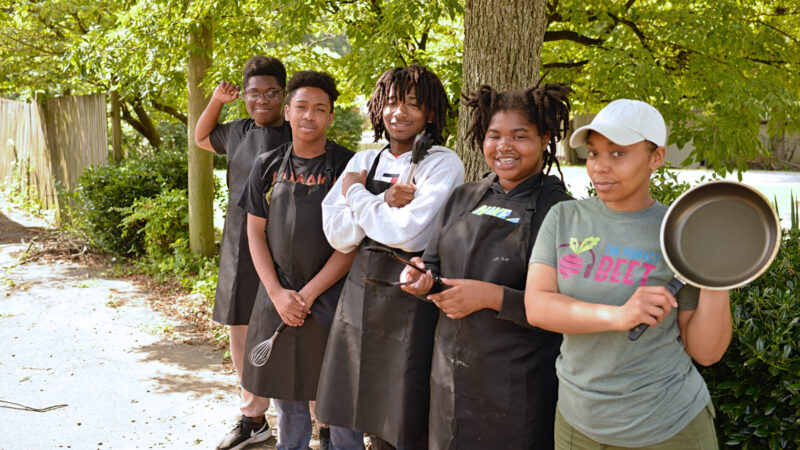
The teens considered the type of food they wanted to serve, brand messaging, menus, and logos, Calvin says. Industry experts, including chef Mylan “Lonnie” Miguel of The Perfect Beet, volunteered their time to teach the teens about food photography, design, and menu pricing.
“They were fully immersed in all things food truck and design,” she says. “It ended with them being able to successfully pull off an event where their parents and community members were able to come and see that it’s an actual, real thing that they were able to do.”
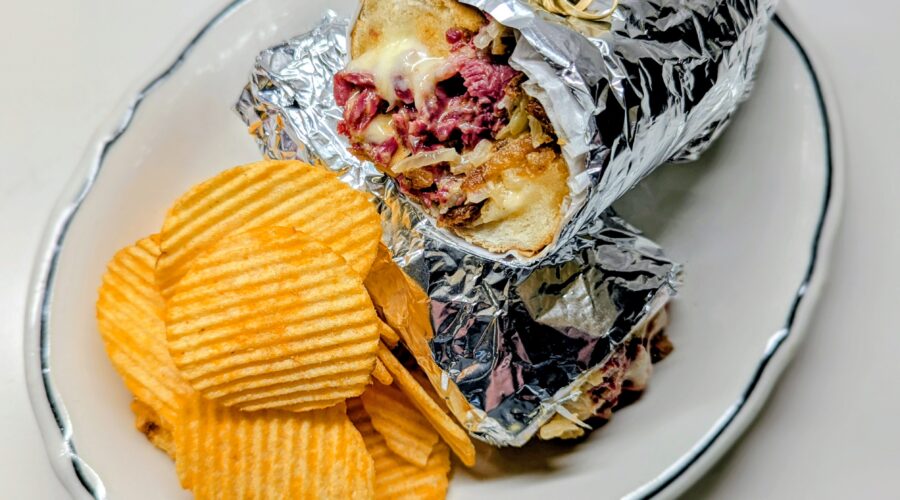
For high school junior Makayla Brown, introducing a new brand was thrilling — and she’s proud that it’s youth-led, she says. As the marketing team lead, Brown spends most of her time promoting The Slide and other Exposure Project activities. In preparation for the tasting event, she led her team as they generated ideas for branding and decor, and she interviewed participating teens. During the tasting, she engaged with guests, gauging their interest and gathering feedback on the menu, which included a Philly cheesesteak slider, a chicken and waffle slider, and a side of shoestring fries. The Philly cheesesteak was a crowd favorite.
“It was really fun to introduce it to potential customers and gather feedback because people obviously had different opinions on the two sliders that we had,” Brown says. “I felt like it was crucial for us to be able to fine-tune everything, so that it can become something way bigger.”
The organization has successfully raised $145,000 toward their $175,000 goal, which includes the food truck purchase, equipment, culinary classes for students, the fee for a creative marketing company to help develop their concept, and the cost of hiring a food truck coordinator.
Once the food truck launches, the program will encompass two sessions: during the school year (nine months) and over the summer (two weeks). During the school year, there’ll be a project-based curriculum that immerses participants in entrepreneurship, culinary arts, business operations, and food truck management. The summer experience will be condensed and geared towards new participants. As food truck program slots become available, the organization will select new participants annually. Participants have to complete another program with the organization for eligibility.
Currently, the 16 teens, who meet once per week, are focused on logistics. Brown and her team are specifically working on pricing equipment, products, and supplies. The teens are considering creative alternatives for a food truck, such as the possibility, and the cost, of gutting a small school bus and renovating it.
Though this is just the start, Brown’s dream for the food truck is vivid. She wants to show teens that going viral isn’t the only option, she says. Having a regular job like working on a food truck is smart.
“I want it to be the biggest food truck in Charlotte,” Brown says. “And for us to be able to expand this food truck to even a restaurant or multiple food trucks in different states that other youth-led organizations could have the opportunity to run.”
Calvin shares a similar sentiment.
“I would love for it to grow beyond a food truck and become an actual restaurant business,” she says. “It would be a similar format to Community Matters Cafe where teens learn workforce development while running a food truck and a restaurant business.”
In May, teens will lead a second tasting event, working with the audience to finalize food truck recipes, which will be primarily composed of different sliders. Weeks later, the plan is for teens to launch The Slide for the first time.
Calvin’s work with Exposure Project was inspired by her experience in the social work and mental health fields, a space she’s been in for 13 years. When she interacted with teens while working in New York, she found that most of them envisioned themselves in entertainment or sports-related careers. Knowing there are plenty of other viable options, Calvin wanted to create a space for teens to be exposed to various careers through her connections to different industry experts.
Before starting the organization, Calvin contacted 30 middle schools to see what programs existed for her target age group, she says. She learned there was a gap that needed to be filled for middle school students.
“They’re in this developmental stage where they’re really trying to figure out who they are and oftentimes they’re overlooked from even the career standpoint,” she says. “They’re asked what they want to be, but they’re not really given hands-on experience until they’re older.”
Some high school students still don’t know what they want to be or what they want to do yet, she says. Letting them try out a career is vital.
“These are the ages that you really need to hone in on, or just be thinking about, what careers you want to go into,” Calvin says. “What better way to do that than through hands-on experiences?”
Future plans include serving food at local events, community gatherings, festivals, and partnering with other organizations to expand reach, Calvin says. A food truck coordinator will oversee the work of program participants. Those in the program who are of age will be the primary workforce.
“This hands-on involvement allows students to apply the skills they learn in real-time, from food preparation to customer interaction and cash handling,” Calvin says.