




November 8, 2023
At Laughing Owl Farm, health starts with healthy land
Jenifer and Dean Mullis run a five-acre, sustainable farm
By Ebony L. Morman
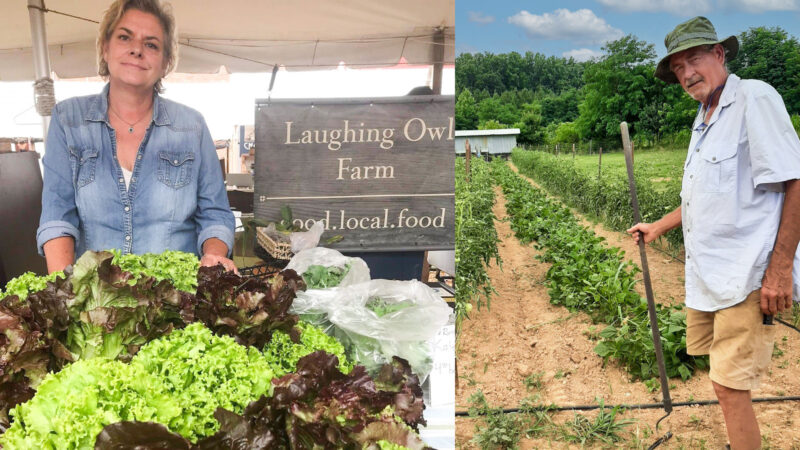
Jenifer and Dean Mullis, owners of Laughing Owl Farm. Photos courtesy
When Jenifer and Dean Mullis opened Laughing Owl Farm for business in 1989, they did so with one notion in mind: unconventional farming. It’s an approach that asks the landowners to collaborate with nature through the use of alternative growing methods, implementing sustainable systems, and shying away from using chemical fertilizers and herbicides, which are often used in conventional agriculture. For more than 30 years, the Mullis’ — who were among the local farmers who were recently celebrated at the Founders Feast — have provided organic vegetables and eggs to the Charlotte area community that reveals the land’s local history.
While the idea to grow organically came from a mutual friend, Dean Mullis’ agriculture background was instrumental in starting Laughing Owl Farm. He grew up on his father’s farm and helped out after graduating from Western Carolina University. Then, two years prior to getting married, Dean and Jenifer started Laughing Owl Farm in Stanly County and sold produce at Charlotte farmers markets, beginning with the Charlotte Regional Farmers Market.
Since the start, the five-acre farm has been home to sustainable and regenerative agricultural practices, such as hand cultivation, manual weed control, and more. For Jenifer Mullis, it’s the only way to go because they believe food is nutrition and health.
“We try to grow the very cleanest, best food we can,” she says. “It’s good for our bodies and it’s good for the soil. Over the years, with cover cropping and only using organic practices, we’re really trying to build up the soil to make it more sustainable and long lasting. We feel like that’s what everybody needs for their bodies, as well as they need clean, fresh food.”
Currently, locals can find Mullis at the Matthews Farmers Market year-round. Mullis enjoys that it’s a grower-only market because of the opportunity to build relationships with customers, she says. Visitors get to know them, taste their produce, and talk to them about what they’re growing and how they’re growing it. Through this, customers learn to appreciate and understand the value of the farm’s offerings.
“They know when they come there, they’re getting it right from the source,” she says. “They can ask questions and everything is super fresh and homegrown.”
In the decades she’s spent in the industry, Mullis learned that success is connected to standards. “We have all kinds of stuff that we could sell that doesn’t look great but we try to keep a premium product on the table so customers are happy all the time,” she says.
“It’s about integrity and honesty. You just can’t fool people if your stuff isn’t good.”
Mullis also believes people are starting to realize they’ve got to take control of their own health and farmers are realizing they have to take control of their own land to make it be good for them and good for everybody, she says.
Having a what’s-good-for-everyone mindset has is key for Mullis. Even though farming is highly unpredictable because the environment and climate are different each year, winters are the same. It’s when Mullis spends time completing maintenance, reflecting, and planning. It’s a time for deciding on next year’s crops, different approaches, improvements in practices, and what’s ultimately good for the community and farm.
Despite obstacles, they’ve experienced longevity throughout decades because they’re always looking for different approaches and methods to farming. Most recently, they’ve explored other kinds of fertilization methods, such as biochar.
“You bake and cook wood, then make charcoal to an extent,” Mullis says. “Then, you inoculate it with microorganisms and it becomes a permanent fertilizer that you can put in your soil that builds mycorrhizae and all kinds of living organisms to permanently help fertilize and improve your soil. We’re looking into that small scale.”
While Mullis doesn’t see herself as a legacy kind of person, she does hope that Laughing Owl Farm will be remembered for doing the right things on the land, she says. “We want people to see the importance of supporting local businesses and small-scale, local farmers,” Mullis says. “People lost that for the sake of convenience, efficiency, price, and everything else. It made people lose their connection to the land — and there’s just nothing more important.”
Over the years, Mullis has witnessed several changes in farming and is most excited about more people realizing that sustainability and regenerative practices are vital. “People are starting to realize the satisfaction of growing your own food and that it’s very important to take care of the land because we’ve been just abusing it for years as it comes out in our commercial needs,” she says.
In the battle against industrialization, Mullis has realized that this type of physical labor is hard on the body. It’s also an aspect she’s come to appreciate, however.
“Whether we make a lot of money or not, it’s just very satisfying,” she says. “And it’s very purposeful. If nothing else, we’re not spoiling the land and we’re trying to make people healthier, including ourselves.”











Jenifer and Dean are amazing leaders and friends. Their food is amazing and their kindness and love are even more so. We adore them.