

March 19, 2021
Aria’s Briana Cohen on women in wineries and kitchens
“You have to work really deliberately,” she says
In honor of Women’s History Month, we’ll be interviewing a female voice in Charlotte’s food and beverage industry each week in March. Today, we’re speaking with Briana Cohen, who got her first chef job working for celebrity chef Eric Ripert. She has also spent time working in wineries in Italy. Today, she is the beverage director and director of operations at Aria and Cicchetti. A 30-year veteran of the industry, Cohen shared insights into life as a female working in both the wine world and restaurant kitchens.
Unpretentious Palate: When did you realize that there were few females in leadership roles in the restaurant industry?
Briana Cohen: Since the very beginning. I actually started as a chef in Miami, that was my introduction into the hospitality business. My first kitchen job was actually for Eric Ripert at Brasserie Le Coze in Miami. And you’re talking a very male dominated field from the get-go. My introduction to the business started with being one of the only women he’d ever hired in a kitchen, and it stayed that way. Honestly, most of my career that has been the case.
It’s been a challenge most of my career to prove myself and to be taken seriously. It’s always been a challenge and — like every other field, unfortunately — you have to work really deliberately and really very hard and be very strong to find your way to any type of leadership role in this business. It can be very frustrating. Everybody in the business, I think, is aware of the sexual harassment and working conditions that many women have endured throughout years and years in this business. And that’s steadily changed over the years. That absolutely improved.
It’s just one of those things that you put your head down and you keep working. A lot of us did that for a really long time.
UP: You’ve also spent time working in all aspects of the wine business. Are things any different in wine?
BC: Unfortunately, I don’t think it’s progressed as quickly as the kitchen, if you can believe it, or in restaurants. I’ve been to Italy multiple times over the last 10 years and just speaking to women in Italy that are daughters and granddaughters, they may be making the wine, but they’re still not recognized as the winemaker. It’s really fascinating because so much of the rest of the business world is moving forward and it is taking a lot of strides. But I feel like it’s a bit slower still in the wine business, at least in Europe.
For whatever the reason there’s such a family structure in Europe that it’s almost not thought of, it’s such a family operation that it just doesn’t quite shine as strongly as it does in the U.S., where you notice somebody not moving up. We focus, I think, on it here more than they do in Europe and really bring a bit more of attention to it. But it’s changing.
When I started buying wine in Charlotte, it was a challenge to be taken seriously. It was a challenge because people didn’t expect me to have knowledge. When the person trying to sell you wine doesn’t expect you to know what you’re talking about, it’s an interesting dynamic. People assumed I was combative or that I had an attitude, all sorts of things, simply because I had an expectation that if you’re going to come talk to me about wine and want to sell me wine, you’re going to be vested in the wine as well, you’re going to have something to share and not just expect that I’m just going to buy something from you because you walked in.
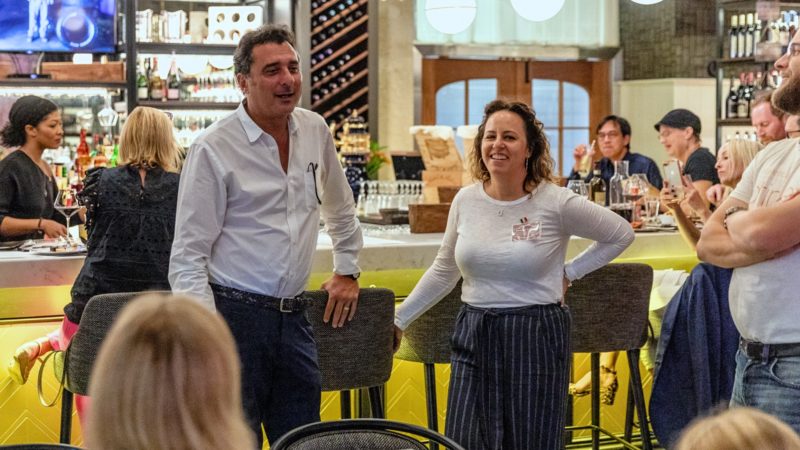
Briana Cohen with Cicchetti and Aria owner Pierre Bader at un Unpretentious Palate event. Photo by Peter Taylor
UP: Why does having women in leadership roles matter, and how does it benefit the restaurant industry as a whole?
BC: Oh, it just makes it so much better, honestly. It’s a whole other perspective coming into the business and it’s a whole other level of enthusiasm and passion. It’s really exciting to see. I love it.
When you’re in the industry, in my case for 30 years, and you’ve been doing it on your own with no one else to communicate with, you view things one way. Over the last 10 years, there’s been a lot of younger women in Charlotte taking on the business, wanting to be sommeliers, wanting to be buyers, and their excitement and their passion for really the same things I have passion for: bringing new wines to the market, teaching their teams about new varietals and negotiant wines and cool things you wouldn’t normally see in Charlotte. But now Charlotte is suddenly embracing it.
I truly believe it’s because there’s so many of them, really passionate and excited. And I think it’s really helping the market.
UP: What does the responsibility of being a female leader in the restaurant industry mean to you?
BC: It means a lot. It’s one of those things I reflect on, believe it or not, a lot, especially as I get older. I think of all the mistakes that I made or how I may have handled things differently if I were the age I am now, with some of the knowledge I have now.
I definitely made a lot of mistakes, but I feel responsible to own those mistakes and to share them because it can be a tough road to navigate by yourself. If you have somebody to look towards as a role model or someone who did it before you, it’s absolutely worth reaching out and sharing those experiences and trying to educate as much as you can about how not to do something as much as how to do something. I think the mistakes I made — and there were a tremendous amount of them — helped me get to where I am today. Because I stuck with it, I stuck through it. I didn’t give up because somebody told me that I couldn’t do it, or somebody told me I couldn’t do it because I was a woman, or nobody will respect you because you’re a woman leader, or worrying if you are in an ownership role, are you going to have a male chef that’s going to work for you? Do you only have to hire women?
There’s so much more to learn when you’re a woman leader. I find myself adjusting more and making more changes on my end to what I do and how I do it than others make to accommodate me. That’s one of the biggest lessons I’ve learned — I’m never afraid to make a change. I’m never afraid to make a mistake. It’s what I do with that information that is the biggest driver for me and how I move forward.
UP: How are you working to make things better for future generations of women professionals and leaders ?
BC: I think continuing to hold myself to a standard of continuing to grow and continuing to change and continuing to learn. I think being stagnant and being complacent is the biggest mistake any of us can make. And we can never take for granted how we got where we are and how hard it was to get here. I absolutely believe you have to continue to work at growing — never going backwards, never letting the wheels turn back.
As many hours as I may work in the restaurant, I still try to stay connected to people that I’m not working with that are also in the business. I love to go out and see what other people are doing. I love to read wine lists, as crazy as it is, but I really do. Information is power; that never changes no matter the field that you’re in, so I think that that’s tremendously important.
UP: What is one way that diners or people who are going out to buy a bottle of wine impact change in the industry?
BC: Right now, Trevor Wood, who is my GM for Cicchetti, he and I are tasting a lot because we’re bringing in new wines and we both get really excited when some random, small varietals — a domestic gamay or a tiny, cool little red wine from the Loire — you put it on the list and suddenly everybody’s buying it and you think, ‘Oh, my gosh.’ People want to learn. People want to try. People want to grow. And it’s so neat to see the change in the Charlotte palate from when I first started buying wine and it was completely chardonnay and cabernet. Eventually, a little shiraz made a hit for a while. But now there are no limits. People really want to try stuff.
What’s really interesting is millennials in particular, they amaze me. They are so wide open to any new wine — new varietals, new regions of the world, wines from Romania, from India. It’s so exciting and it’s really inspiring.
UP: Who is one female in the Charlotte restaurant industry that you think everyone should know about?
BC: Natalie Stewart [wine director at Fin & Fino] for me. She is not afraid.
She is not afraid to try new things, new wines. She loves to learn. She is very vested in traveling to learn and educating herself. Her passion really does spread to people. She really works hard to build excitement, which is really hard in the restaurant business, finding a way to do something other than a wine dinner to sell wine and educate people online and make it fun. It sounds like it should be so easy, but it is really a challenge, and I think she does it successfully.
She continues to reach out to people, to educate herself, to broaden her knowledge, and to become better in her field, and she does that with such enthusiasm and very little frustration. She just keeps going. And that’s what I love about her.