


February 9, 2021
A traditional Jewish eatery is coming to Charlotte
“A physical space gives us more of an opportunity to tell our story.”
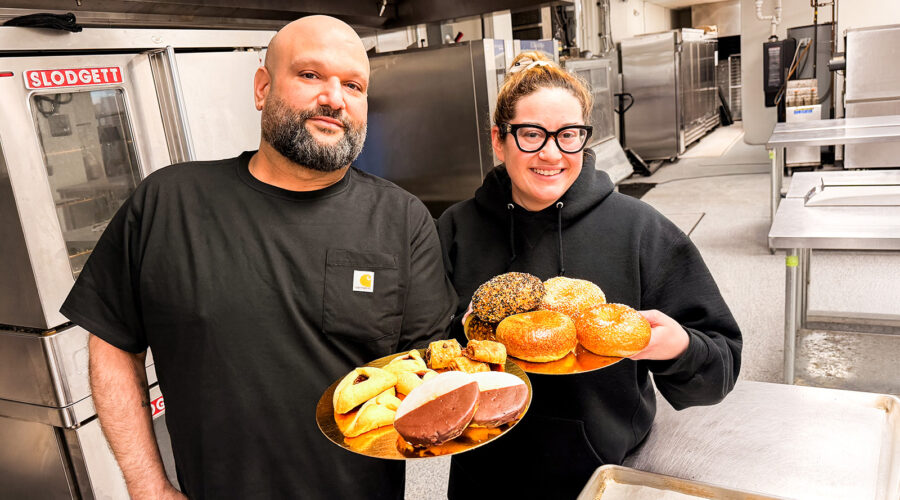
Rob Clement, owner of the Jewish deli pop-up Meshugganah, has partnered with Moonbox Bakery owner Hannah Woociker to open a brick and mortar. The two pop-up owners collaborated earlier this year when Clement invited Woociker to bring Jewish pastries to the Meshugganah menu. With the success of their collaboration, the two began talking more about their personal experiences with Jewish cuisine and what they see missing in Charlotte: access to and availability of Jewish food and ingredients. The conversation identified common goals within their respected pop-ups and an official partnership made sense, joining forces to make their projects permanent under one name with a physical space in Charlotte.
“We want a brick and mortar because it’s easier to be visible,” Clement says. “We could make more money with a pop-up, but having a physical space gives us more of an opportunity to tell our story, which to us is more important.”
Jewish delis are hard to find in Charlotte. With only a handful to pick from, some are authentic, while others are a hybrid of Jewish-American cuisine. Besides a few delicatessens, there is a lack of Jewish markets or corner stores commonly found in other cities like New York. Historically, Jewish delis and markets have been family-owned businesses, preserving family recipes and traditions of Jewish cuisine. In the early ‘30s New York City had an estimated 2,000 delis, according to David Sax’s 2009 book Save the Deli: In Search of Perfect Pastrami, Crusty Rye and the Heart of Jewish Delicatessen. Now, only a couple dozen remain in operation due to decreasing profitability because of rising rent, cost of ingredients, and changes in customer taste and expectations.
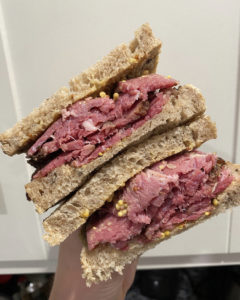
Meshugganah’s pastrami sandwich is traditionally made from locally sourced ingredients. Photo courtesy
What is happening in New York City is happening across the country. Authentic Jewish delis are declining while hybrid restaurants with Jewish offerings are increasing. These hybrids are changing what customers expect from Jewish food, and changing what family-owned delis have been doing for decades. With hybrid restaurants offering extravagant mile-high pastrami sandwiches with inexpensive, outsourced ingredients and owners chasing trends, Jewish delis and markets cannot compete.
“This cuisine was so close to not existing because of the Holocaust,” Clement says. “One of the few things people brought with them when they got ripped from their houses were recipes. To me, that is crazy. We want to put that into the conversation in food, because it’s a missed opportunity if not.”
Clement and Woociker want to help stop the decline of Jewish food. What worked for family-owned Jewish delis in the 1930s does not work anymore, and rather than feel the pressure of modern-day eating and consumers, Clements and Woociker want their concept to adjust the operations of a traditional deli but maintain the integrity and preservation of what made Jewish delis and markets popular in the first place. That includes access to Jewish food and ingredients for holidays, special occasions, and everyday life around the corner from your home.
Meshugganah will embrace the mom-and-pop corner store feel, a one-stop-shop for Jewish cuisine. There will not be a dining room, rather patio seating for guests to enjoy sandwiches, pastries, and housemade sodas. The space will be parts bakery, deli, market, and catering. The food will be locally sourced and authentically made, profiling Jewish cuisine of both traditional and Southern influence.
“Preservation of food in the South is so relatable to Judaism and our cuisine,” Woociker says.
Meshugganah, open only during the day, will operate with the mindset of quality over quantity — once an item is sold out, it’s sold out for the day. Besides offering over-the-counter items, Meshugganah will also put an emphasis on take-and-bake meals and catering options.
“On holidays like Passover, you can buy an entire package from us for Seder,” Clement says. “We want to go beyond just the food. If there’s a funeral and you know someone who is sitting shiva, you can call and have a bakery platter sent to them. We want to give more opportunities for people to buy more things in one place they normally can’t get in Charlotte.”
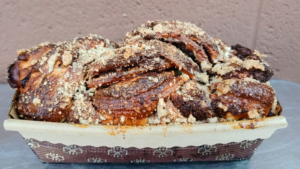
Hannah Woociker’s popular babka will be a regular option in the bakery case. Photo courtesy
The bakery portion of Meshugganah will include both the popular and hard-to-find Jewish pastries.
“Holidays in Judaism are so big and big with pastries,” Woociker says. “ Hamantaschen is hard to find and get in Charlotte, for us to provide and offer that to the Jewish community and everyone is exciting.”
Clement and Woociker are aiming for a late summer opening and are currently looking at spaces. In the meantime, the partners, who prefer not to call themselves chefs, will continue pop-ups leading up to their opening. Woociker will set aside Moonbox Bakery operations, possibly holding a pop-up or two if the opportunity is right, but her full attention is now on Meshugganah.
Meshugganah’s next pop-up is Thursday, Feb. 11 at 6 p.m. at Stable Hand offering a Mardi Gras-inspired menu with sandwiches like Ma’s tuna melt, Manischewitz braised beef, and a bakery box including black and white cookies, brown butter citrus bar, and a King Cake babka ring.