Hidden gem in Charlotte’s Oakhurst neighborhood where the menu is as creative as the food
Hidden gem in Charlotte’s Oakhurst neighborhood where the menu is as creative as the food


Here’s how to select the right variety and placement on your cheese plates
by Anita Skogland
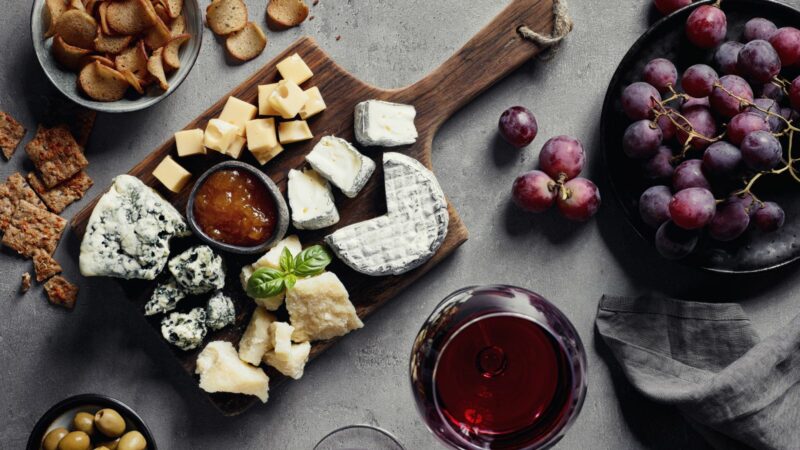
Grapes and olives make for great cheese accompaniments. Photo by Canva
There are so many versions of “boards” these days, from butter boards to icing boards, and everything in between. Cheese boards are not charcuterie boards. According to Mirriam-Webster, charcuterie is typically associated with sliced, cured meats and originated in France. Over time, a cheese was added to charcuterie platters. This article is not about charcuterie, it is focusing on cheeses and accompaniments to enhance the cheese experience. Here’s how to built better boards at home.
When building a cheese spread, think about achieving these things: a variety of textures and colors, salt, sweet, refreshing, crunch, and size. For 8 to 10 people, I use a wooden board that is 14” by 23”. You do not need a wooden board; you can use a sturdy, flat platter that won’t scratch from cutting cheese on it. Five cheeses at about a half pound each will be adequate.
Start by considering your cheeses. A creamy cheese like Fromage d’Affinois, which is very soft and spreadable, can be placed on one corner of the board. Then add a small round or a slice of brie or Camembert on another corner. You can top this with a bit of honey, or blueberry jam – the creamy and the sweet make for a lovely mouth feel. Another soft cheese to consider is a goat cheese log. Vermont Creamery has a variety of goat cheeses, including a log that is coated in herbs. This would make a nice color contrast, and the herbs enhance the light goat cheese funk. The log can go on corner three.
Next, add one or two medium-firm cheeses such as gouda, manchego (sheep milk), Comté, Lamb Chopper by Cypress Grove, Morbier (which has a light center line of ash), or Gruyère. Most of these harder cheeses should be pre-sliced so your guests are not struggling to cut them and making a mess of your beautiful arrangement. These and the next cheese can take center stage on the board as they are already sliced.
Finally, add a well aged cheddar, such as Prairie Breeze from Iowa, Red Rock from Wisconsin, or Montgomery from England. This cheese should be pre-cut; some of these cheddars crumble as they are cut, which is fine as you can just put the crumbles in a creative pile next to a small pile of toasted walnuts or smoked almonds.
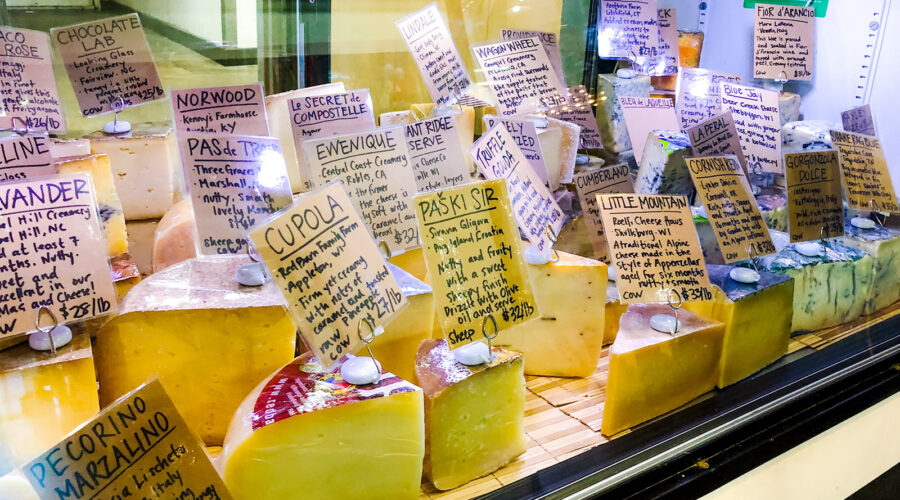
One more consideration is a blue cheese — I like to add a Gorgonzola Dolce as it is sweet, creamy, and the blue veins are not sharp and biting like they are in a Roquefort or other hard blue cheese. This soft cheese should be placed close to the edge of your presentation, on corner four, so it is easily accessible for guests to slice into.
Now, what else should you provide? Pitted olives – black, green or red – placed in a small bowl on the board. Cornichons should also be served in a small bowl. Salted nuts and dried fruit (figs, apricots, cranberries) can be scattered to fill open spaces. Green or red seedless grapes offer a palate-cleansing opportunity. Tart apple slices tossed in lemon juice to keep them from browning are another refreshing addition. Lastly, some thinly sliced carrots or radishes bring a pop of color and a crunchy bite.
I often see crackers tucked into the cheeses here and there on the boards – I recommend that you put your crackers in a basket or bowl next to the cheese board. Crackers on the board will get soggy and anyone with a gluten allergy will get cross contamination. You can also thinly slice and toast baguettes to use as crackers. Consider adding gluten-free crackers in a side bowl for those who have allergies. You can also add a couple of tiny jars of raspberry jam or honey with a spreader. These are popular with the hard cheeses.
There are many different types of small tongs you can place on top of your board so people can pick up items without using their fingers. Another option is to place appetizer-sized forks around the board. The nuts would benefit from appetizer spoons to pick them up. Toothpicks are another option for precut cheeses.
We are fortunate in Charlotte to have a few very good cheese shops with knowledgeable employees who are very helpful when planning your presentation. Orrman’s Cheese Shop is at the Market at Seventh Street, and customers receive free parking for 90 minutes. The Loyalist Market in downtown Matthews has a well curated selection and well trained staff. Mere’s Curated Gourmet is on Park Road near The Toastery. The Culture Shop, near The Plaza in Plaza Midwood, is one of the city’s newer additions. All these shops carry a variety of crackers, wines, spreaders, honey, jam, nuts, and other items for service. Whole Foods is another resource for a variety of quality cheeses.
Now, what beverages to serve? Sparkling wine enhances cheese flavors — consider a sparkling wine from Loire or Burgundy, a Prosecco from Italy, or a Cava from Spain. You will find that many of the above mentioned cheeses are better with white wine, with the exception of the very hard cheeses like aged cheddar. Grapes that work well with cheeses are pinot blanc from Alsace, Italy, or Oregon; chenin blanc from Loire, California, or South Africa; and albariño from Spain or vino verde from Portugal. When selecting red wines, the medium body, medium tannin wines such as Rioja, merlot, pinot noir, Chianti, Rosso di Montalcino, Nero d’Avola, or Côtes du Rhone will compliment and not overpower the cheese flavors. Good quality apple cider is an option, as well as saison, stout or Belgian ale if you prefer beer.
Cheese prices are not trivial. Most of the cheeses I review are between $20 and $38 per pound. Cheese is very filling, so if your guests each try one piece of each of the five or six6 cheeses, as well as nuts and other board enhancements, their hunger should be satisfied. I sometimes add a mixed fruit platter or pimento cheese with sliced raw vegetables on a side platter for a low cost filler.
Be creative and enjoy your dive into the vast world of cheese milks, textures, and styles. There are cheeses made from camel and yak milks, but they are not currently available in Charlotte. Perhaps one day they will be!