

June 5, 2024
These businesses started during Covid. How are they doing now?
The pandemic may have eased up, but the challenges haven’t
By Allison Braden
Doug Rose never imagined himself as a professional baker. He and his wife, Kaitlin, owned a leather goods company, but the pandemic crushed luggage sales, and they had to find a way to support their family of six. Doug and Kaitlin, with help from their four children, launched Team Rose Bread from an old carport at their home in south Charlotte. Four years later, they’re still churning out loaf after loaf of sourdough.
Team Rose Bread, along with Beyond Amazing Donuts and Patrick’s Gourmet, launched in 2020, an unusual time with unusual challenges. Since then,they’ve all had to adapt to maintain their success as the world has returned to normal and presented more traditional challenges. For example, inflation has driven up rent, labor, and food costs. Unpretentious Palate checked in with their owners to see how they’ve weathered the journey from that turbulent time four years ago to something like stability.
Beyond Amazing Donuts
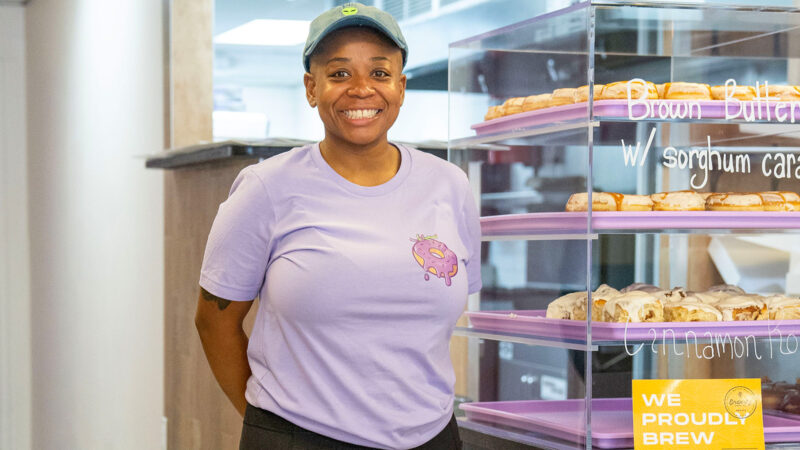
Unlike Doug Rose, Jasmine Macon always knew where she’d end up. When she interviewed with Chef Greg Collier for the pastry chef job at Leah & Louise, she recalls, “one of the first things I said was, ‘If I get this job, I will work for you, but understand I’m working toward a donut shop.’” He seemed to admire her determination; she got the job. The restaurant’s grand opening was scheduled for the March day when Charlotte shut down.
Leah & Louise, like everyone else, pivoted. They offered to-go meals, and Macon crafted pastry boxes, which became a hit. She always included donuts. Her friends and customers batted around the idea of a donut pop-up, but Covid restrictions kept the idea on the back burner. Then Keia Mastrianni of Milk Glass Pie invited her to sell donuts as part of a fundraiser, and its success convinced her to make the pop-ups a regular thing. She continued hosting pop-ups, built a following, and in fall 2023, she opened a brick-and-mortar shop in Montford.
Jasmine held many of her pop-ups at Camp North End, but her new location is across town, not far from Myers Park. She’s noticed that some of her regular customers from north Charlotte have only stopped in once or twice, if at all. “And we gained a new following that had no idea who we were.” Ideally, she’d like to see both groups in the shop, but its location farther from Uptown has changed her clientele.
She’s also had to adapt to a much higher overhead. “It’s a little bittersweet when people come in and they’re like, ‘Oh my God, these donuts are expensive,’” she says. “And I’m like, ‘But they’re not though.’” She wants people to understand that she may make just 20 cents on a donut that costs $3. Restaurants are famous for their at times impossibly thin margins. In December 2022, more than half of independent restaurant operators weren’t able to make rent. Macon charges between $3 and $3.50 for her donuts, which include flavors like black garlic everything and brown butter with sorghum caramel. They’re prices she believes will be able to sustain the business long-term.
Macon cites the challenge of “getting people to understand that, yes, I had to raise my prices a little bit. I have rent. I have an electricity bill, a water bill. I have all these other items to consider, versus being in the commissary space and doing all the labor myself.”
When Macon interviewed with chef Collier, she was eager to benefit from his guidance. There weren’t many Black restaurateurs in Charlotte, and there still aren’t. Now, though, there’s one more. Jasmine has a team of six, and when she’s not tinkering with flavors in the kitchen, she’s mentoring her staff.
Despite the stressors, Beyond Amazing Donuts is the culmination of a longtime dream, and Macon’s strived to make it a community hub, both in the kitchen and out. On Saturdays, she watches the families who come in. One little girl visits every week and does a special donut dance. “I love,” Macon says, “having regulars.”
Patrick’s Gourmet
In March 2020, Patrick Garrivier says, “everybody in the world probably got laid off.” He was one of them. He’d been service director at Upstream for just eight months. After about five months of unemployment, he was sick of it. “I was getting bored,” he says, “and I had to do something.” So, in August 2020, he founded Patrick’s Gourmet.
After decades in restaurants, the chef developed a delivery meal service and capitalized on an exploding market. It’s no surprise that in the first months of the pandemic, meal delivery services skyrocketed. The food delivery industry in the U.S. grew 85 percent between January 2018 and February 2020. But as the pandemic waned, so did demand. “If I were to live just on deliveries,” he says, “I would have to close.”
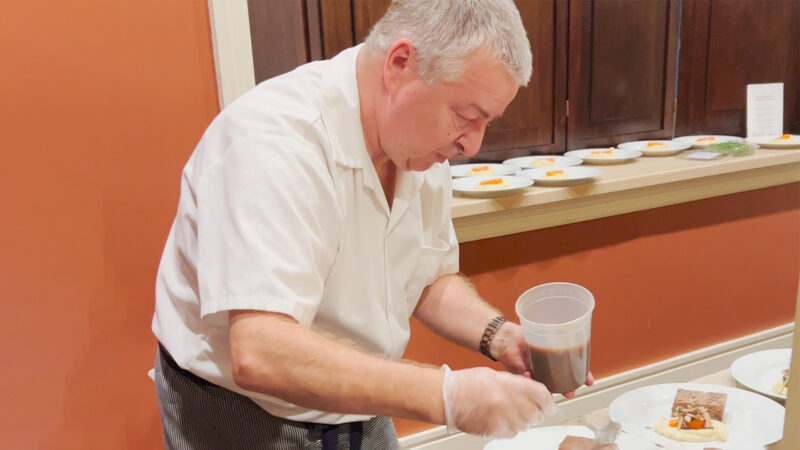
Garrivier still has some regulars, like elderly customers who prefer not to cook, but he’s made up for the loss with private chef work and catering small gatherings, which he says have picked up since the pandemic. He speculates that the hosts of small gatherings, between 20 and 30 people, prefer the casual ambiance of home and want to avoid the fees to book a space. It’s a more relaxing environment for him, too. In restaurants, he says, diners are often complaining, but “when you’re in somebody’s home, you always feel welcome.”
When he’s not cooking in a private home, he prepares meals in a commissary kitchen, Halal Mobile Kitchen on Sharon Amity Road. He pays a monthly bill, but he doesn’t have to worry about electricity, gas, payroll, and other typical restaurant costs. It’s also afforded him more time with his family.
“I spent 35 to 40 years in the restaurant business,” he says. “I never had Christmas Eve, New Year’s Eve, Mother’s Day with my family, so this is the first time I’ve started to have all these holidays with them.”
Covid forced us all to rethink how we live and work, what we wanted from our communities, and even who we were. Patrick’s Gourmet, like Team Rose Bread and Beyond Amazing Donuts, are products of those reflections. As some, like Jasmine, achieved their goal of opening a restaurant, others, like Patrick, left restaurants behind for good.
“When the pandemic happened,” Patrick says, “I was like, whoa, this is something different, and at least I can make a good living at it — and be free to do what I want, when I want.”
Team Rose Bread
“Our business,” Doug Rose says, “was definitely a product of every component of the pandemic.” They turned to baking because their previous business — selling luggage — had suddenly become untenable. They developed a cottage bakery, where they baked at home and customers picked up their products in their cars, in response to Covid restrictions. In some ways, those restrictions haven’t changed for the Roses; they still have to abide by cottage bakery regulations, which limit how many cars can pick up orders at a time and restrict where the family does business and what they can make.
“The biggest pain point for us is, our carport that we converted into a bakery is 200 square feet,” Doug says. “We’ve pushed ourselves to the limit in terms of what we could create in our space.” Without being able to expand at home, the Roses instead focus on how to become more efficient and better utilize their limited space. Unlike Macon, the Roses have no rent and low labor costs since Doug and Kaitlin do most of the work, even as they serve about 750 customers every week.

The result is that their business has grown organically, largely through word of mouth. This year, sales are up by more than 25% from 2023, which, Doug says, “seems impossible.” It’s pushed the Roses to look at permanent spaces, but he says they’ve approached the process with caution, partly because this hasn’t been a long-held dream. They haven’t fantasized about the decor or the menu for years; they’re just beginning to imagine the possibilities. Could they offer pizza? Bagels and homemade cream cheese?
“We are constantly talking with each other about like, OK, what’s the location we want to be in? How much space do we need? Do we want to lease the building? Do we want to buy the building? Are we just gonna keep doing what we’re doing but on a much bigger scale? Or are there other things that we can’t do right now that really excite us?”
Just as Rose tells me he’s going to look at a permanent space they’re excited about the next day, he excuses himself. It turns out that one of his delivery drivers has gotten into a car accident. Later, he calls back and explains that the driver was fine, but he had to let customers know about canceled deliveries. Some of the bread was a loss. It illustrates the unpredictable nature of running a business, no matter what format the business takes.
Still, he has no regrets, and he hasn’t returned to the luggage business. Team Rose Bread demands intensive time and attention, but it’s also brought the family closer together. “By far, the most transformative part about this business has been the impact it’s had on our family life,” he says. “Our kids, their love for food, their understanding of food, and their involvement in it.”
He considers the unexpected turn in his life a gift. Plus, he says, “We’re too deep in it at this point to look back.”