Hidden gem in Charlotte’s Oakhurst neighborhood where the menu is as creative as the food
Hidden gem in Charlotte’s Oakhurst neighborhood where the menu is as creative as the food


Charlotte chef finds new paths after a series of setbacks
by TM Petaccia
His restaurant closed. His food truck crashed. His wrist broke. The second act didn’t work. And then an unimaginable tragedy. Chef Jamie Barnes had every reason to throw in the towel. Instead, he shifted from plating fries to shaping futures, from building a brand to building community, and from loss to light.
For the creator of What the Fries and one of the founders of the original Soul Food Sessions, the last few years for Barnes were anything but sunny. Still, he found a way to achieve new growth.
Barnes and business partner Greg Williams launched the brick-and-mortar version of What the Fries in South Charlotte in 2021, building on the momentum of their successful food truck business. A few years later, they chose to close the restaurant to refocus on truck operations, but that pivot marked the beginning of a difficult stretch.
“We informed our staff that we were shutting down the restaurant,” Barnes says. “We were operating with some of the staff as a food truck only, but then we got into a wreck with the truck and that’s when I broke my wrist. We were just down for a while after that.”
Still believing in What the Fries, he decided to gear it up again, this time as a ghost kitchen takeout business working out of City Kitch in West Charlotte, but that only lasted a few months. “It just wasn’t what we thought it would be,” he says. “It just wasn’t making sense money-wise. After that, we were just trying to figure out what’s next for us. For me, it was doing caterings and other events, but I needed to find something more stable than that.”
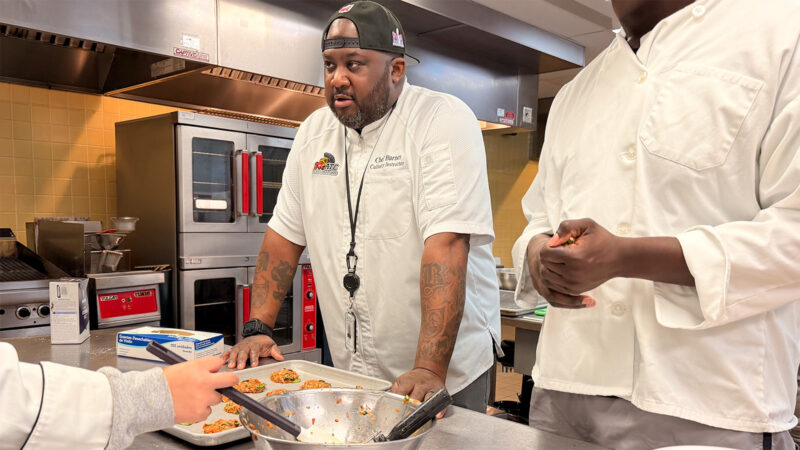
Turns out, the answer lay not so much in the kitchen, but in the classroom. More accurately, a classroom-kitchen. In March 2025, Barnes stepped into a culinary instructor role at the Applied Technology Center high school in Rock Hill. What began as a trial period quickly became something more.
“I finished up the school year and felt I wanted to stick with it,” Barnes says. “I felt it was cool that I could be one of the people who had firsthand entry of getting these kids ready for the real world. Working in restaurants, having to hire people, sometimes they come very lacking of skills. So it’s cool I give them some of the right tools. Of course, every kid in the class doesn’t want to be a chef, but sharing some of my knowledge, they can get some life skills as they go on to go to college and live on their own.”
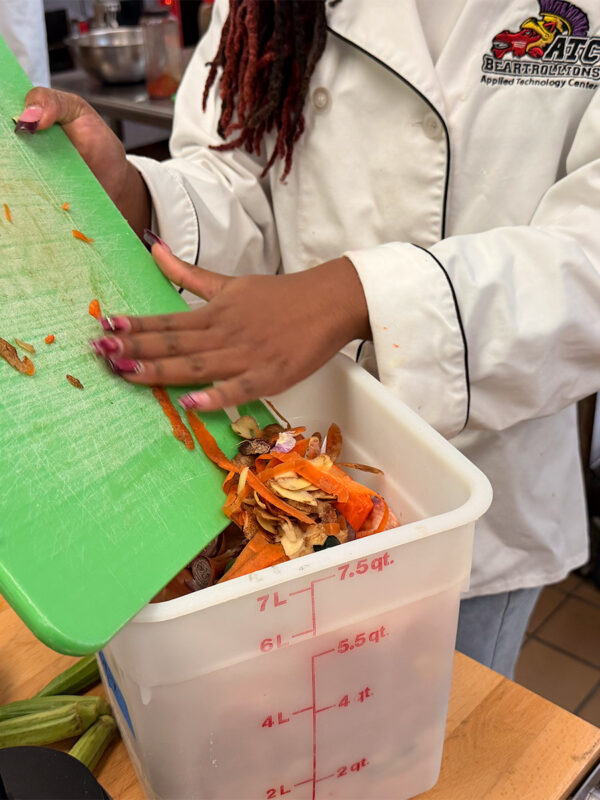
Barnes teaches under South Carolina’s ProStart curriculum, covering knife skills, food safety, costing, and kitchen fundamentals. But the experienced restaurateur brings something different the school’s table: industry reality — from burn scars to balance sheets. He veers beyond the textbook, pushing students into modern restaurant thinking. During his recent Vegetable Week, instead of simply sautéing green beans, students might make vegetable pancakes. Leftover potatoes might become brownies. Scraps are stored frozen for stocks or go into a dehydrator and re-emerge as house-made seasonings. Zero waste isn’t just classroom theory here. It’s real-world practice.
“They start policing each other,” he laughs. “They see somebody throw something away, and they’re like, ‘No, no, you’re not supposed to do that.’ They’re all on board now.”
The passion Barnes has always exhibited at his restaurant, food truck, popups, and collabs appears to have spread to his students. “I’ll be cooking for an afterschool event, and I’ll ask the kids if they have a little time, could some come help cook after school, and they all show up,” he says.
Another real-world aspect of the Barnes’ curriculum is the “mock lunch service.” Teachers come in have a total of fifteen minutes to eat. “They’re getting that real feel of a restaurant,” Barnes says. “The kitchen gets loud, and sometimes the kids get flustered, but it’s a good experience for them. It shows them a different side of the culinary world than they may have been exposed to; that it’s not all Instagram and celebrity chefs.
“That’s been the most rewarding part of it for me.”
Building on the foundation of the original Soul Food Sessions — a collaborative dinner series celebrating Black chefs and foodways founded in 2016 by Barnes, Greg Williams, Greg Collier, Jamie Turner and Michael Bowling — Barnes has recently partnered with event organizer Shelton Starks to launch Serving the Culture, a more immersive experience that blends food and music.
“We’d be in chats together talking about music, having debates, going back and forth,” Barnes says, “and we finally said ‘could we kind of piggyback off what we used to do with Soul Food Sessions?'”
Previous events have paired elevated cuisine with the music of artists such as Wu-Tang Clan, Bad Boy, Death Row, Missy Elliott, and Mary J. Blige. They recently were invited to do an event in Austin, Texas. “It was a lot of learning about what the different markets entail for us,” Barnes says. The next event, set for March 22 at Lenny Boy Brewing, will spotlight New Jack Swing, a music subgenre fusion of hip hop, R&B vocals, and high-energy dance music.
“For the most part, we’ve been able to stick to our guns and make things happen how we want to,” he says. “If something doesn’t feel right, we’ve been able to pivot with it, but each day we learn more and we just try to make it better the next time.”
The most profound chapter of Barnes’ bounceback story is far more personal.
He and his wife Alicia were very open about their daughter, Lane Marcelina’s battle with cerebral palsy, posting her progress on social media. Just when it looked like things were looking up, she suddently passed away in 2024, just before her second birthday.
“A lot of people helped us out when we lost our daughter,” Barnes says. “We wanted to find a way to say ‘thank you’ to everybody.” The result is Lane’s Light, a nonprofit created to honor and preserve Lane’s memory. The organization supports families with babies in NICUs at hospitals across North and South Carolina; the same units where Lane spent the first four months of her life.
“We do things like help with paperwork and understanding the process,” Barnes says. “Most of all, I come in with food because families are there all day and this is one way we can help so they don’t have to worry about that.”
Barnes plans to work with other chefs to arrange meals directly as well as offer restaurant meal cards and other essential care assistance. The Barneses are in the process of setting up donation channels. Updates will be posted on their website.
If resilience and tenacity are measured not by avoiding hardship but by what you build in its wake, Barnes has developed a winning recipe. The kitchens and service areas may look different now: a classroom line, a collaborative pop-up, a NICU waiting room, but the mission remains the same: feed people, lift people, and keep moving forward.