

September 20, 2019
How restaurateurs decide when to expand
Between staffing, funding, and spaces, here’s what three owners say drive their decisions
Can you make a living off one restaurant? And if so, how do you do it? With margins shrinking in the restaurant industry and many restaurateurs expanding from one restaurant to multiple, we wanted to ask the people who have successfully scaled their restaurant operations how they did it. Here’s what they had to say about when to grow and how. —Kristen Wile
Katy and Joe Kindred
Kindred Restaurant and Hello, Sailor
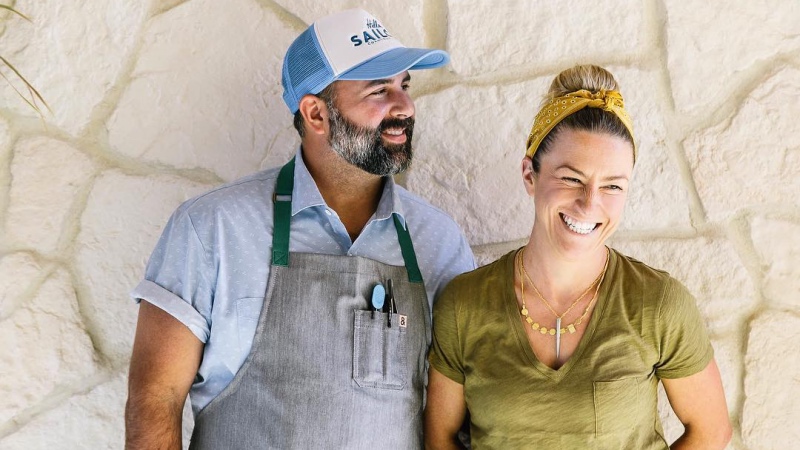
Joe and Katy Kindred are the owners of Hello, Sailor and Kindred. Photo courtesy.
On when they decided to add a second restaurant: “We were always sort of waiting to see the right opportunity, if it came — it would just present itself, and if we had the bandwidth to handle it we would.” Katy says. “But knowing that, after we got Kindred stable, which I would say took the better part of six months to get semi-stable and then a year to get to the point where we were ready to look at other ideas, knowing that it would be over a year before you actually opened something else because of how long that kind of stuff takes. We were kind of growth-minded out of the gate, so we could set ourselves up. Because I think you have to set yourself up from a staffing perspective and also just a cultural perspective, if you build a restaurant around you being there all the time then it makes growth very difficult.”
On the difficulty of going from one to two restaurants: “When you open your first restaurant, you make a lot of mistakes as far as design or functionality or things that you didn’t think of,” Joe says. “Every time you do a new project, you get to improve upon the first go-around. One of our business mentors, Jon Dressler, always tells us that going from one to two restaurants is the hardest thing, but going from two to three and then going beyond is a much easier transition. What’s funny is that it was the same way with kids. When we went from one to two it was very hard, when we went from two to three, your new you was used to that situation. It creates opportunity for your team, and we definitely want to be able to create opportunities for people because honestly, we’re in the people business now. We get to be creative for a brief moment in time, but after that we’re in the people business, you know?”
On being able to support your family with one restaurant: “There is something to say about being a first-time restaurateur,” Katy says. “It’s going to be a lot more difficult to get a really solid deal for you because a) restaurants are incredibly high risk for investors and so they are going to want a really good deal if they’re going to invest in a first-time restaurateur. They want a good deal investing in a third, fourth, fifth time restaurateur let alone a first-timer. So I could see why it would be difficult to make a solid living, but it’s certainly possible. We also live within our means pretty solidly. We have this little tiny house and whatever, but yeah, you can make a decent living as a restaurateur. The other thing is like people will buy the real estate. That’s a smart move, because then you’re your own landlord. There’s just so many different ways to do it, but in the most sort of common sense what most people do way of opening their first restaurant, it is difficult to raise three kids and live a comfortable life. You can live a good simple life, but it just depends what your lifestyle is. If you want to send your kids to private school and all that kind of stuff, that would be a little bit of a challenge on one restaurant income.
On whether the size of the restaurant matters: “Somebody gave us advice before we opened Kindred … and I’m pretty confident that he’s right, is that if you want to make money, you have to have at least 100 seats,” Katy says. “There are exceptions to that. If you do a style of service that’s counter service or quick service or fast casual, that doesn’t really apply. But if you’re doing something like Kindred, fine dining where you have hour and a half, two hour, two and a half hour turn time, and expensive ingredients, and high labor too, to do that kind of food and have that kind of labor with that amount of seats — if somebody else can do it, they need to give us the formula and tell us, because I can’t figure the math out on that. Kindred, our margin is way lower than Sailor, because Sailor is a) way bigger and there’s a tipping point. There’s a certain amount of staff that can do 100 seats, and if you add another 50 you can probably do it with the same amount of people, they just have to crush it a little harder. So there’s a tipping point where you can handle more without adding more resources to it. … In the winter time, we have a team of however many, let’s call it seven people. In the summer we add that whole patio which is like 60 more seats. We need to hire one more person to handle that. So we’ve nearly doubled our capacity and we only need to add one more body to make it happen. You can see volume matters, volume is everything.”
On what advice you’d give to someone expanding for the first time: “Focus on your mental health and your psychical health, because with that your creative health will be fine.” Joe says. “The second that that gets out of balance, you’re screwed.”
Bruce Moffett
Barrington’s, Good Food on Montford, Stagioni, N.C. Red, Bao + Broth

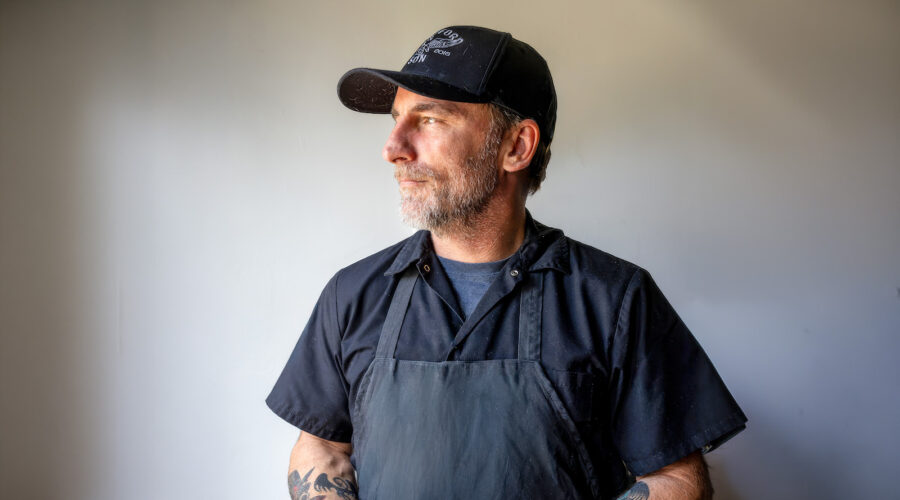
Bruce Moffett, chef and owner of N.C. Red, Barrington’s, Good Food on Montford, and Stagioni, at N.C. Red. Photo by Peter Taylor/Peter Taylor Photography
On when he decided to open a second restaurant: “After I’d worked with Kerry, my brother, for 8 years, it started to feel like the kitchen was getting a little small. I felt like he didn’t necessarily want to leave Charlotte, but I felt like he wanted a little more responsibility, so I started to look around a little bit. With restaurants, it’s kind of like, I have these moments where it’s like, well, what if one restaurant gets hit? What do I do? If I just have Barrington’s and Good Food, what if Good Food slows down? What if Good Food and Barrington’s slow down? Sometimes that insecurity drives me to look into other ventures.”
On whether he could make a living on one restaurant: “I could make a six-figure income if I just worked at Barrington’s, five days a week, 1 to 10 or 11 p.m. But we just don’t have a lot of people working here, which is why it works. If I had to pay 700,000 or 800,000 to get this place open, then it would be hard to ever get that back. I basically gave Fran 30,000 down, she sold it to me for 100,000, I gave her 30,000 down and I paid her as I went along. I did it and I did it quickly, but I’d be nervous about taking out a big bank loan. I think the other thing with this is it’s just me. I think if I had three partners and two partners that weren’t working here, I bet it might have been a bit of a nightmare.”
On what advice he’d give to someone expanding for the first time: “When you have systems and you have people you trust working for you and you’re comfortable then I think that’s a good time to start, but I just think after you’ve been open for a year, you haven’t been through all of the cycles that Charlotte’s going to give you, as far as the ups and downs of owning a restaurant. You can feel literally on top of the world and your restaurant’s invincible and then two months later, you’re trying to figure out what happened. We’re going through that at N.C. Red right now. It was like, we’ve been so busy for 5 months we could barely look up and now all of a sudden, hopefully it’s school starting, but we’re doing a third of the business. Just stay the course. I don’t think you understand what your business is capable of for at least three years and whether or not it has longevity.”
On stepping out of the kitchen as the restaurant group grows: “I had basically the same job description for 15 years, and I started to see it was taking a toll on me physically. I have hernia issues — I’ve had four hernias, and the last one was pretty extensive. Some mesh issues, then I had a blocked intestine so I just wound up stuck in a hospital for the better part of a week and lost 20 pounds. I felt like getting into and out of the reach-ins, my knees hurt. Then I had some vascular issues, so I had to have surgery on my legs several times, and I’ve had some hearing loss. I enjoy it when I do it now, but when you do it five days a week, it just beats you up.
I have a lot more flexibility. That’s one of the things I’ve been messing around with is changing my job description. I work here a little bit when we were short staffed, but I have the flexibility now which is nice. I don’t have to cook at all anymore. I’ve got it situated so I don’t have to do that. What I started looking at was like, is my skill set best used for a position I can pay someone $13-$15 an hour? Am I only worth $13 to $15 an hour? Because if I’m on the line, I’m filling a $13-$15 an hour position.”
On whether he’ll expand more: “I think I’ve had it on this one. I mean, never say never. I think it would be really intriguing to open an N.C. Red in Newport, Rhode Island, but that’s about it as far as it goes. I have to see if it’s going to work here first.”
Frank Scibelli
Mama Ricotta’s, Paco’s Tacos, Midwood Smokehouse, Yafo Kitchen, Little Mama’s (coming soon)
Frank Scibelli, owner of several popular restaurants around town. Photo courtesy of The Littlefield Co.
On expanding to a second restaurant: “My second restaurant failed, it was Si Italian Restaurant. The chef was an Italian chef that was on Park Road, essentially where Ilios Noches is now. They came in and they said they were doing 1.2, 1.3 million, which at the time was a good number. We did six something the first year. They cooked their books — it was a losing experience for me. Then we converted it to Mama’s for a minute, and literally we got a dumb luck, someone came to buy the restaurant and made me whole. We ended up focusing on catering — that was like ’94.
It taught me how to run my business. I used to go from like where I’d spend one to two months solely in that store and I would fix it, and then I would come back and what I’d left had been a mess. So I was chasing my tail all the time. I learned how to develop my team.”
On what it means to experience a failed restaurant: “I think ultimately it was the best thing that ever happened to me, but I really learned from it. It really taught me how to run my business. Around that time we had a Greek chef who worked for us and he was great. He said, all old Greek guys say it’s a penny business. And I say it since then. It is a penny business. You have to watch your margins.”
On how much growth is too much: ” I think there’s a breaking point, the question is where the breaking point is. Even something as simple as Chipotle was sort of a magic brand to a thousand units, and there was still a huge buzz and they did a great job, and then they just sort of lost their mojo, in my opinion. There’s people like Houston’s, I don’t know how many stores they have, but Houston’s does a great job. They have different concepts … They’re really good operators. Pappasito’s is a really good operator nationally. So I mean, they still have their mojo. You grow to a certain size but part of that is where they are.
I have no interest to grow to 1,000 stores or 500 stores. I don’t even know that I’m interested in 100 stores at this point. It’s just, intellectually what interests me. I like creating concepts, and it’s the whole thing — making it work financially, making it work from a popularity standpoint. I’m very proud, of the top 20 Trip Advisors, we’re five of the restaurants. And Bad Daddy’s, which I started. I like that they’re good restaurants and successful from a profit standpoint.”
On how much the costs of opening a restaurant have changed since he’s been in the business: “I think when I moved here in 2002, [Mama’s] had been a restaurant before, and we had some equipment we brought over, but I think I spent $105,000. And I was always cheap, I was always cheap about the buildout. Even when we were doing Bad Daddy’s, I think it was around $500,000 or $600,000 a restaurant. Now you’re close to a million. Someone else was like, ‘We’re doing it for $300,000.’ I was like, ‘You’re going to be missing a lot of stuff.’ Construction costs have gone up and labor costs have gone up, rent’s gone up because Charlotte’s gotten to be a hotter market. Fuels gone up, so prices of everything’s more expensive.”