



July 12, 2022
A Day in the Life: New Town Farms’ Sammy Koenigsberg
Meet a pioneer in Charlotte’s local food scene
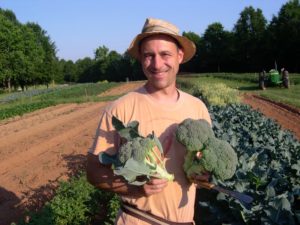
New Town Farms owner Sammy Koenigsberg. Photo courtesy of Noey Koenigsberg
In the 1970s, Sammy Koenigsberg’s dad purchased 5 acres of land in Waxhaw, about 20 minutes from downtown Matthews and 45 minutes from Charlotte. Back then, the land — where Koenigsberg came out to ride horses and motorcycles — seemed farther from the city. Today, housing subdivisions border the fields and pastures. Koenigsberg’s dad built a house on the property in the 1980s, and Koenigsberg lived there for his junior and senior year of high school.
In 1990, Koenigsberg and his wife, Melinda, began growing vegetables there and selling them wholesale to local health food stores. At the time, Koenigsberg’s passion for local sustainable agriculture was radical. Soon after he started farming, he co-founded the Matthews Community Farmers Market, the first farmers market in the region that featured exclusively local producers. Koenigsberg describes sitting there with five or so other vendors, waiting for a customer to come down the steps. This year, on the last Saturday in June, more than 1,000 customers showed up in the first hour the market was open.
Even as he’s watched local food and regenerative agriculture enter the mainstream, Koenigsberg hasn’t stopped educating and advocating for the next generation of small-scale farmers. He’s also planning and building for the next phase of his family’s groundbreaking farm. When I reach him in early July, he’s on his tractor in the rain, a chorus of birds in the background.
Here’s what a day in his life looks like.
5 a.m. Koenigsberg is in the habit of waking up early. “It depends on what happened the night before,” he says. “With eight kids and all that — we grew up raising them and now we’re partying with them.” (Three of his kids still live at home.) The early hours are a contemplative time, “kind of a prayer time.” He retreats to a kid’s former bedroom, furnished with just a couple of chairs, a rug and lamp, and stacks and stacks of books. “I’ll stay in that chair as long as I can,” he says. “I’m a slow reader and the stack is high.” He also writes. “I’ve been writing for years,” he says. “Probably just for my own way to think, more than anything.”
Some mornings, he exercises instead, either a run or “CrossFit-ish stuff.” Farming is intensely physical, and he wants to continue for a while longer yet. His daughter Noey and her husband, Matt Hoang, former executive chef at Indaco, help him run the farm. “They’re not ready for me to hit the beach,” Koenigsberg says.
7 a.m. “The sun comes in and tells me it’s time to go out to work,” he says, “and I just get out and get to it.” It’s early summer, and he’s transitioning the fields for fall planting. One high tunnel is full of tomatoes — “getting ready to have the tomato avalanche” — and another brims with trellis cucumbers. The tunnels, Koenigsberg says, “are almost as useful in the summer as they are in winter. You just roll the sides up and have a little rain-free microclimate, so a lot of the funguses are much reduced inside.”
Matt and Noey have taken over most of the harvesting. “I just don’t enjoy that much anymore, but I do enjoy the planting and planning and tractor work,” he says. “Whatever rises to the top of the heap, I go after it, because you never really get caught up.” Matt has also taken over much of the care for the livestock, including pastured hens and free-range hogs. “He really loves animals,” Koenigsberg says. “I bought him a big Berkshire boar for his birthday.”
11 a.m. Koenigsberg doesn’t eat breakfast, so he takes an early lunch, which is usually a grab-and-go affair: “a handful of this or a handful of that.” Then he’s back outside. This year, he’s scaled back production to grow the farm’s hospitality business, a dream he and Noey have shared since before she went to college a decade ago. Beginning around 2006, the farm has hosted a couple of events per year, typically fundraisers or events that showcase and educate about sustainable farming practices. The family is working to expand those capabilities, inspired by European-style agritourism. Their vision isn’t a restaurant or a wedding venue, but will incorporate elements of both and serve as a unique reflection and extension of their farm.
Building and planning tasks are now part of the heap of farm work. Koenigsberg may spend afternoons meeting with contractors or supervising construction. The day before I spoke to him, they trenched “a couple thousand feet” of gas line for a new stove: “So I was on the Bobcat for hours, closing up the ditch.”
2 p.m. During heat waves, Koenigsberg may take a break to avoid the hottest part of the day. His work also includes meetings and interviews to promote not only his work on the farm but the mission he’s maintained since he and Melinda started New Town Farms 32 years ago. For example, he recently appeared on Jamie Lynch’s podcast, Eating Habits. He reflected on the fact that the reasons that motivated him to start farming — that “we as a culture in our time are so far removed from agriculture” — were not well known. But over the past 20 years, “the curtain that stands between us and our food — I think that’s how Michael Pollan put it — has parted.” People (and restaurants) have engaged with those issues and changed their habits. The Matthews market, he says, “seems to be record-breaking every week.” It’s a shift he couldn’t have imagined when he started. ”I went from being an architect to being a farmer, and in the culture at the end of the ’80s, that was a big demotion,” he says. “My mom couldn’t talk about me at cocktail parties.”
Over the years, he’s mentored interns, volunteers (including me), and other folks who are interested in starting their own farms, like Jamie Lynch himself. Koenigsberg has been a relentless advocate for the kind of agriculture he believes in and the people who want to do it. One of the biggest hurdles is farm ownership. Lots of young farmers can’t afford land. The morning of our conversation, Koenigberg met with an Atlanta-based group working to solve that problem and connect farmers with farms.
As Koenigsberg did decades ago, “they see the importance and the crucial nature of decentralizing agriculture and getting a belt of farms around our cities to feed these cities, instead of building subdivision tract housing on the best farmland in the country. And that the best way to care for the land is to have more hands and more small parcels. The best way to care for diverse breeds and diverse seeds is not big ag — it’s many, many different farmers expressing their own unique art on different pieces of land. It’s difficult to have the kind of affection for a piece of land you really want to pour your life into unless you own it.”
6 p.m. After days of physical labor in the sun (or rain), Koenigsberg’s evenings are short. The family shares dinner, their biggest meal of the day. “That’s where we sit down and enjoy the bounty of the farm and one another,” he says. He may pick up his book again before bed, but he says he rarely makes it more than a paragraph in. He often falls asleep before 9 p.m. These days, it’s still light outside then. Koenigsberg says, “I’ve gotten where I’m OK with that.”






Nice.