



October 7, 2021
The beauty behind Enat Ethiopian’s makeover
See the before and after photos of the restaurant, which will expand soon to Optimist Hall
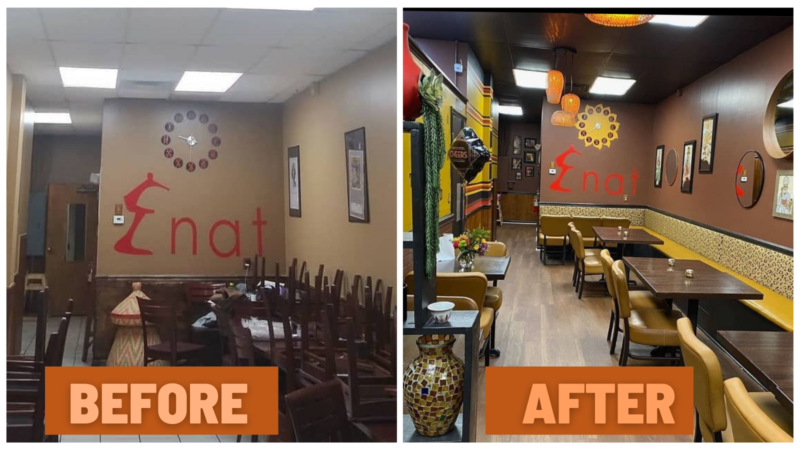
Enat before and after the dining room underwent a transformation with help from designer Scott Weaver. Photos courtesy
Tina Tedla, owner of Enat (pronounced eh-knot), was relaxing in Tattoo, the cocktail bar within Kiki Bistro, when she learned she was sitting next to its designer, Scott Weaver. She shared how much she appreciated the hints of glam and moodiness, bold all-over black paint, and special touches like a collection of classic cocktail books. Tedla explained to him how she had been wanting to elevate her own restaurant’s aesthetic, but Weaver sensed she was hesitant to commit. He wasn’t sure if he’d hear from her again about a redesign, but he did not forget about her.
“She left an impression on me,” Weaver says.
Now, Enat’s East Charlotte spot has a vibe worthy of its service and fare, thanks to Weaver’s vision. The Ethiopian restaurant will also open in a second location in Optimist Hall this winter.
Several months after their initial encounter, Weaver decided to give Tedla a call to check in on her; she was the last new person he met before COVID-19 struck, and he wondered how she was doing as a fellow small business owner. Mired in small business setbacks and lows himself, he also needed a way to creatively recharge. He felt offering his artistic services to her might provide that, and help Tedla achieve her goal of improving Enat’s look and feel for guests. Trying to keep the lights on herself and operating only as a takeout restaurant, Tedla didn’t feel she could yet afford to do so.
As long as she could procure the paint and decor accessories, Weaver told her, he’d do whatever he could to pull together the look. “I told Tina, ‘Really, what I want as payment is…You’re going to have to let me ask every uninformed question about your culture possible because I want to leave here more educated. And I would also like to get fed a lot of delicious Ethiopian food.’ She was like, ‘That’s totally cool!’ It definitely created a friendship.”
After pondering together what they could do with little funds to give Tedla the interior Weaver felt she deserved, Weaver calls his first design challenge “knocking the harshness out of the space.” The restaurant is situated in a lackluster shopping center; Tedla sought out a modest, affordable location to start Enat.
“Some people thought it was too small, but I thought, ‘If I fail, I’d rather fail small,'” she says.
Still, Weaver could see potential. “I wanted her to feel like it matched her food and that she could be proud of it,” he says of the space. “Atmosphere’s really important.”
He found the solution in a simple curtain. The curtain now hanging in Enat happened to be fabric from a dress worn by Tedla’s sister — the dress her sister wore as she immigrated to America. With its bright, traditional African colors of brown, red, and yellow, Weaver had found his focal point. Taking inspiration from there, he then showcased images from Ethiopian calendars in upcycled frames and displayed baskets mailed from relatives. Weaver’s usual approach to curating a look is to work solo, but he sought Tedla’s input on this particular endeavor. “I asked Tina what she wanted to display,” he says. “Enat’s her home away from home, so it had to have layers of her personality.”
Between November 2020 and January 2021, the two collaborated and saw others join the effort as well.
“There was more than one resource and more than one person involved,” Weaver says. “I headed up the project and had the idea, but a couple of my friends jumped in on a couple of days to help paint. A couple of her friends came and helped paint. I became friends with them. It was really fun to meet everybody. It became a team effort.”
Instead of dragging on in isolation, lockdown hours ticked away with laughter, eating and brainstorming where to go next with the design plan. There were drab ceiling tiles to liven up, and Tedla’s nieces even helped carefully paint around the Ethiopian alphabet decals so they could be left intact.
During the project, Weaver directed his own personal Instagram connections to follow and share his professional account’s progress. “I felt it was important to share as we went along because I wanted people to understand that small businesses should support other small businesses, and that you get what you give,” he says.
This coming together to support one another in the industry continues to breathe life back into establishments on life support. In March 2021, we reported on Katy Kindred’s design venture — and her pro bono projects. Weaver shares the perspective that more successful restaurants mean more success for the city. From his viewpoint, otherness should not deter us but rather attract us to new experiences, such as another culture’s cuisine or dining in a part of town we might not normally visit.
“Do something cool for somebody,” he says. “It’s just being neighborly, ultimately.”
Tedla agrees. In fact, that’s how Enat originated. When Tedla graduated college, she was surprised to see Charlotte still did not have the Ethiopian dining options other large cities do. Her family had been preparing Ethiopian food in Charlotte since 1996, with her mother frequently enlisted to cater and cook for fellow East African families. She started to think she could be the one to bring an Ethiopian restaurant to life.
Still, she was scared. Tedla worked in the hospitality industry in college but did not have a business background. She found the encouragement she needed in her mother. In appreciation for that support, Tedla named the restaurant Enat, which translates to “mother” in Ethiopian.
Now, Optimist Hall has come calling. “Here I am, four years later,” Tedla says. “I was shocked. I had thought about opening a second location but felt it was out of my reach right now. When they called, I couldn’t pass on the opportunity.”
She reserved the spot before telling anybody — even her mother. Then, she took her family there to hang out. “Mom said, ‘You know, we should bring Enat here.’ One of my siblings said, ‘No, it’ll be too much. She can’t handle it.’ Nobody knew I had already secured it.”
Tedla’s father was a risk taker, too. He fought for fair wages as a labor union representative in Ethiopia, ultimately bringing Tedla and her siblings to America to avoid governmental threats of arrest and possibly death. Perhaps that is part of what propels Tedla onward when she doubts herself. She shares her father’s daring spirit.
She took a gamble that Charlotte diners would give her food a try, and they have. Most of her customers are regulars now, and she’s been in business educating those new to Ethiopian dining since 2017. She decided to seize the moment during a shutdown to finally renovate, even though funds were tight. Not only did the redesign invigorate the space, it increased seating capacity and led customers away from saying “oh” when they entered to “wow.”
“Customers would tell me the website and food’s grandness did not match the interior,” Tedla says. “Now they do.”
Tedla will serve “The Passport Plate” and other customer favorites from Optimist Hall. Customers will also be able to reserve one of two tables for family-style dining over a mesob. Takeout will be an option as well. Tedla will become Optimist Hall’s 26th and final tenant to fill the venue.