Hidden gem in Charlotte’s Oakhurst neighborhood where the menu is as creative as the food
Hidden gem in Charlotte’s Oakhurst neighborhood where the menu is as creative as the food


The Italian charcuterie is popping up on menus around town
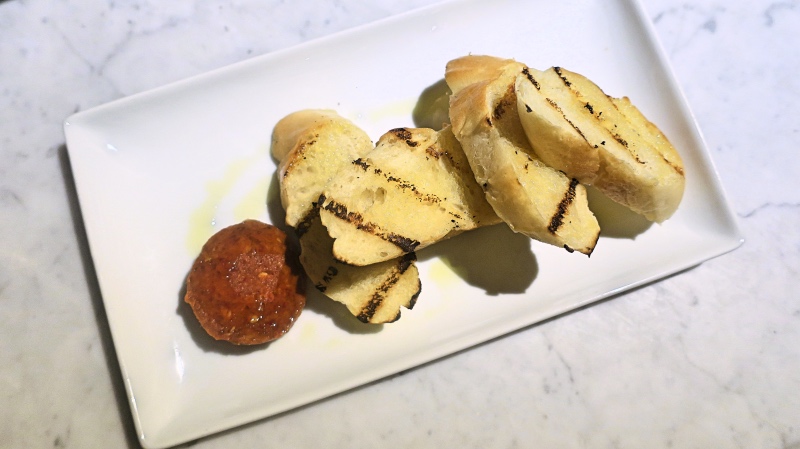
The nduja at Dot Dot Dot, a cocktail bar in Park Road Shopping Center, is made in-house. Kristen Wile/ Unpretentious Palate
It’s interesting to watch a single ingredient spread across a city’s menus. I noticed nduja gaining popularity early this year, though the Italian charcuterie has been popular elsewhere in the States elsewhere for a while now. To learn a bit more about it, I reached out to Dot Dot Dot and Foxcroft Wine Co. executive chef David Quintana, who has long been known as the charcuterie guy around town.
So, what exactly is nduja, also written as ‘nduja? It’s a spreadable salami that’s generally 80 percent fat, which makes it soft enough to spread. Pork is ground with a spice blend made out of Calabrian chiles, salt, and dextrose, then put into casing (traditionally, it’s hog end caps). The meat is cold smoked for about 20 hours, then ferments for 24 to 72 hours before aging.
As the meat ferments, Quintana explains, chefs must watch for the PH level to drop, killing any bacteria — and allowing you to eat the meat raw. After fermenting, the meat can be hung to age anywhere from two weeks to nearly a year.
“The end result is a spreadable salami that should have a nice peppery flavor up front; you should get the taste fairly quick,” Quintana says. “It’s its own flavor, because Calabrian peppers — and I’m not talking about Calabrian peppers in oil that we get that are harvested in America, we’re talking about imported Calabrian peppers — that’s where your flavor comes from.”
Quintana says he first fell in love with nduja while dining at the now-closed Cyprus in Charleston in the late 2000s, when chef Craig Deihl (now at Hello, Sailor in Cornelius) was making some in-house. The meal inspired him to learn more about making charcuterie. As the executive chef at Dot Dot Dot, Quintana has been slowly building a serious charcuterie program at the cocktail bar.
His nduja there is served with toasted baguette. The chiles lend a deep red color to the spread, as well as a strong heat that is mellowed by its fat content. The seeds are a hint that you’re eating nduja made the right way, as opposed to a soft salami that borrows the name.
“People are just calling spreadable things nduja and it’s not,” Quintana says. “It makes my blood boil.”
While Quintana is able to make his own nduja because his Dot Dot Dot is a private club, other restaurants serve it as well. Stagioni, for example, pairs nduja with its charred octopus; Angeline’s uses it in a mussel dish. At Mimosa Grill, nduja is a charcuterie option.
See it somewhere else? Let us know in the comments!